
 •
Rating:
•
Rating:
THE REVIEW
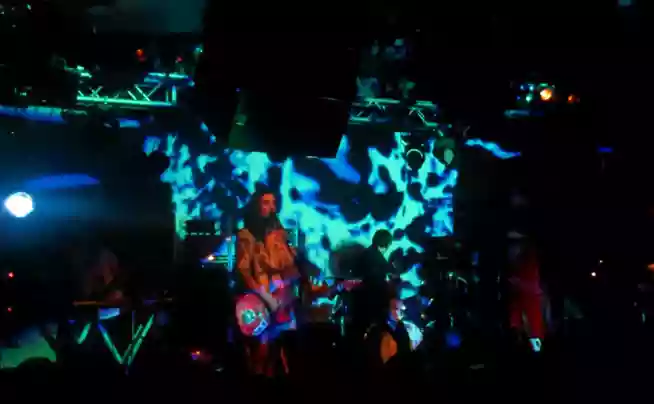
The avant-garde essence of a live noise performance reveals itself in a double negation. The gaze of the viewer is stripped of its usual role; the paying audience is not asked to witness the work that fades and of which, by the end of the evening, no trace will remain; their presence—and the band's looking elsewhere is an unequivocal sign from the start—is, for the execution, entirely contingent.
Denying the otherness of the audience, the band cannot but also deny itself at the same time: the guitars venture into the shadows on the outskirts of the stage, bass and drums are sucked into the maelstroms of visual effects (people, shouting "Voice!" in annoyance, manifest all their discomfort in confronting performers who have become deindividualized); at the same time, throughout the performance, there's a progressive destruction of the Text, in subtler ways compared to, for example, jazz improvisation: it's true, they follow a canonical setlist, but the execution no longer refers to the track as a separate existence, there is no appeal to its character of "repeatable materiality" originally inscribed in a CD, the attempt, instead, is to foreground sound as a pure hic et nunc event: the spectator, continually entering and exiting moments, violent, of "acoustic blow-up," is forced to lose, each time, the reference to the "track title" (just as, in mantras, a word repeated obsessively sheds its meaning to become a mere sound occurrence).
In the finale, the holocaust of feedback celebrates the success of such demolition: an audience that is no longer an audience, artists to whom what happens is no longer even ascribable, the score reduced to shreds, but, at the same time, the space of the representation has expanded, from the stage, to encompass the entire room, and someone covers their ears or, exhausted, retreats to the corners.
In vain: there is noise everywhere.
Loading comments slowly
Summary by Bot
This review explores My Bloody Valentine's live concert in Rome as an avant-garde sonic event where traditional audience roles dissolve. The band subverts the usual structure by eroding the identity of tracks and focusing on sound as a fleeting, immersive presence. The performance culminates in a chaotic feedback finale, symbolizing both destruction and expansion of the music space. Audience reaction ranges from frustration to retreat, emphasizing the challenging nature of the experience.
My Bloody Valentine
My Bloody Valentine are an Irish alternative rock band formed in Dublin in 1983, widely credited as pioneers of shoegaze. Led by Kevin Shields and featuring Bilinda Butcher, Colm Ó Cíosóig and Debbie Googe, they are best known for the 1991 album Loveless and for influential EPs and albums across the late 1980s and 2013's MBV.29 Reviews
Other reviews
By jeremy
If Van Gogh had been a rocker, he would have sounded like this.
Melodies that tickle the unconscious, unlocking distant memories and unspoken desires.
By R13557436
Listening to this album is undoubtedly the greatest sensory and metaphysical experience a person can have.
Loveless is proof of the existence of the divine, a unique work that even escapes itself.
By joe strummer
All of My Bloody Valentine’s music is a perpetual clash between noise and beauty, between animalistic violence and divine sensitivity.
"Isn’t Anything" carries all the seeds that will bear fruit in 1991, yet it maintains its distinctive profile.
By joe strummer
"Loveless stuns with an unheard power and immediacy. Here lies the entire essence of rock. Violence and purity. Hypnosis and spontaneity."
"This album is exactly that, a huge accumulation of distortions, combined with the typically English melodic urgency and an unprecedented electronic framework."
By theJOKE
If you think an album must be immediate, concise, and catchy... then don’t judge this rare unique jewel of the world.
MBV managed to imprint transposed and metaphysical images on a musical album.
