
 •
Rating:
•
Rating:
THE REVIEW
Some stories seem to gain meaning simply by being passed down: they flow as if following an Ariadne's thread placed there, amidst the miseries of uncertain beginnings and the climax of a scenic ending. Sometimes it happens that we need to take a step back, become aware of what we hear, and relocate everything in flesh, bones, blood. One must be aware that things can go differently, not following a predetermined fate, slipping away due to a missed glance or encounter. It could be said that History is made up of a chain of small events; never fully planned, always left at the mercy of random reasons (pages and pages Tolstoy wrote about this).
The story of Muddy Waters (born McKinley Morganfield) is certainly no exception. Far from being born under a lucky star, he lived up to the early 40s with the immense cotton fields before his eyes, gazing at the labor fields of the Mississippi on the horizon.
He was damn good with his guitar, admiring his idols Son House and Robert Johnson as gods on Earth. From them, he took the dirtiest, saddest, most boisterous, and brazen blues soul ever forged. He made it his own, carried it with him everywhere. He played at his own wedding, he couldn't betray who he was.
On a sultry summer day, in a distant 1941, someone knocked on his door; there in a remote corner of Stovall, Mississippi. The Library of Congress had commissioned someone named Alan Lomax to record some musicians who had grown up on plantations and made a name for themselves with the growing blues subculture.
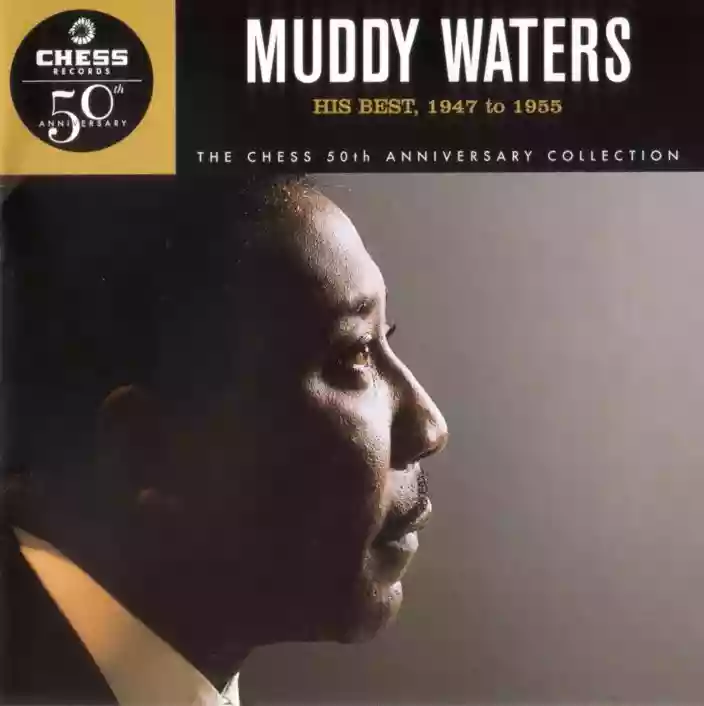
For Muddy Waters, that was the turning point: hearing his own music on record for the first time truly made him aware of his potential. A narcissist mirrored in the lake, falling in love with himself. So, within a couple of years, he decided to move to a big city. It just so happened that city was Chicago, where as a street musician he met Leonard Chess (the historic founder of the eponymous label). Muddy began his recordings with Chess in 1947, and it is from here that the story of this collection begins. Within a few years, he created around him the greatest blues band the world has ever known. To name a few: Little Walter on harmonica, Jimmy Rogers on guitar, Willie Dixon on double bass on some occasions. The collection presented here testifies to this golden age: from the beginnings in '47 to the explosive eruption of rock'n'roll.
To be honest, all tracks included in this collection should be mentioned. But it would still be difficult to analyze them: we're talking about true monuments that paved the way for both the popularization of blues in the international scene and "white" culture (in the sixties many bands will owe a debt to Muddy Waters) as well as the explosion of black music to come, in all its forms.
Perhaps there would be no talk of rock'n'roll were it not for the great success achieved by bluesmen thanks to Chess Records. A heart attack would take Leonard Chess away in October 1969 and would do the same with Muddy Waters in '83. Dying in his sleep, in the tranquility of his home, Muddy Waters took with him a guitaristic prowess that few will equal: his chromatisms, shouted with an almost fiery slide, are among the traits that most distinguished him.
He sang the blues like few others: steeped in sex, alcohol, betrayed wives, life on the verge of vagrancy, friends lost along the way. He carried the fathers' blues with him for a whole life, until he became its earthly incarnation.
Loading comments slowly
Summary by Bot
This review celebrates the transformative years of Muddy Waters between 1947 and 1955, highlighting his move from Mississippi to Chicago and his groundbreaking recordings with Chess Records. It praises the album as a definitive collection capturing the golden age of blues and the foundation of rock'n'roll, while emphasizing Waters' distinctive guitar style and lyrical themes rooted in hardship and authenticity.Tracklist Lyrics Videos
Muddy Waters
Muddy Waters (born McKinley Morganfield) was an American blues singer and guitarist widely credited as a key architect of electric Chicago blues. Born in Mississippi in April 1913, he was recorded early by Alan Lomax and later became a central Chess Records artist in Chicago, influencing generations of blues and rock musicians. He died in 1983.12 Reviews
