
 •
Rating:
•
Rating:
THE REVIEW
"My hero? Definitely Muddy Waters... I know his music well, it's sublime. I also know him personally, a true gentleman, quite the opposite of me...". Keith Richards describes him this way, one of the most important and fundamental artists of the last century, a man whose music influenced generations of future artists.
Just think about how many were influenced by his blues; Johnny Winter (who collaborated with him on some albums in the late '70s), Brian Jones (who named his band after one of Waters' songs "Rollin' Stone"), Alvin Lee, Eric Clapton, Mayall, Jimi Hendrix, Jimmy Page of Zeppelin, an endless list of artists who deeply loved his music.
Born in Jug's Corner, a small rural village in deep Mississippi, on April 4, 1913 (or '14 or '15, the actual year of birth is uncertain, partly because at that time, record-keeping was a bit all over the place) little McKinley Morganfield was nicknamed Muddy Waters by his grandmother for his habit of playing with other children along the swampy banks of the great American river. From a young age, he played anything he could get his hands on, and he learned the first rudimentary guitar lessons from his uncle, but his first job offer came as a singer in the local group Son Sims Four, with whom he performed at small parties in the evening, while during the day he worked as a laborer in the fields. To make some extra money, he made moonshine whiskey, and it was for this reason that in '41, when Alan Lomax went to find him to record his music, he ran away for a few days, thinking they had come to arrest him. Finally, Lomax managed to get him to record some songs, and Muddy grew aware of the possibility of earning with music and seized the opportunity. In '43, he left for Chicago, the mecca of blues, where he began performing at parties, fairs, and in small venues, working in a factory during the day. After a certain period, he managed to record his first records at the Chess Records studios of Polish-origin brothers Phil and Leonard Chess, who, after some hesitation, decided to sign him. During that time, he became passionate about the electric guitar, learning to use a thumb pick to amplify the sound, and performing with other great bluesmen like Memphis Slim and Tampa Red. His first hits were "Can't Be Satisfied" and "Feel Like Goin' Home," which gave him the initial notoriety among the African American population (whites were not yet lovers of blues, considered "negro music," while they preferred jazz and swing), songs that expressed the independence and loneliness of Southern immigrants. By the '50s, Muddy was already very famous, especially in the "Windy City," writing true blues masterpieces like "Rollin' Stone," "Hoochie Coochie Man," and "Train Fare Home," which brought him great fame.
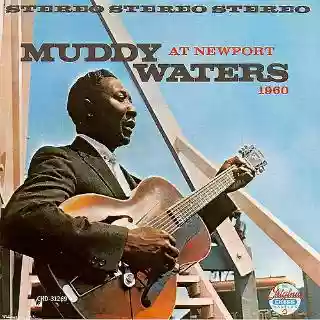
It's curious to think that, when they weren't busy recording or when a record of theirs did poorly, to recover their salary, many Chess bluesmen (including Waters) were engaged in chores and small jobs for the record company's headquarters, like painting or changing the wallpaper... incredible! (I'd really like to see the likes of Mengoni or Fabri Fibra earning their bread that way). The record that established him was undoubtedly "At Newport," a great live performance that highlighted all the musician's skill and character, accompanied by his band, which included great artists like Otis Spann on piano, James Cotton on harmonica, and Pate Hare on guitar, extraordinary musicians who enriched his music. The Newport Festival that year was partially ruined by a large group of young drunk and violent people who tried to forcefully enter to watch the Saturday night performance. The concert management decided to conclude the festival in the afternoon, and Muddy Waters' performance was the last allowed. The band performed exceptionally, the group chemistry was palpable, and the show was applauded by the entire audience present, captivated by the raw performances of pure blues of pieces like "I Got My Brand On You," "I Feel So Good," and the classics "Hoochie Coochie Man" and "Baby, Please Don't Go." The show flew by quickly, Waters gave his all with his slide, and Otis Spann enriched it all with his delicate and precise piano, alternating with Cotton's extraordinary harmonica, who emulated his idol Little Walter. The closure was entrusted to "Goodbye Newport Blues," sung by Spann, the logical conclusion to an afternoon of great music.
This live album was a great success, equal to or perhaps surpassing "Live at Regal" by the great BB King; an album that made many white kids fall in love with the genre and can be considered one of the most influential records for future generations of musicians..
Loading comments slowly
Summary by Bot
This review celebrates Muddy Waters’ iconic live album 'At Newport 1960.' It highlights his influential career, the talented band lineup, and the historic performance at the Newport Festival. The album is praised as a pivotal blues record that introduced many to the genre and inspired countless musicians. The atmosphere, musicianship, and cultural impact are thoroughly recognized.Tracklist Lyrics
01 Bonus Tracks (Studio Takes) (00:00)
03 Tell Me Baby (02:19)
04 Southbound Train (02:55)
05 When I Get To Thinking (03:09)
06 Just A Dream (On My Mind) (02:33)
07 Double Trouble (02:48)
08 I Feel So Good (02:57)
09 Baby, I Done Got Wise (03:00)
10 Mopper's Blues (02:56)
11 Lonesome Road Blues (03:04)
12 Hey, Hey (02:45)
13 (I'm Your) Hoochie Coochie Man (02:57)
14 I've Got My Mojo Working (02:52)
15 Meanest Woman (02:21)
19 Tiger In Your Tank (02:14)
20 Baby, Please Don't Go (03:04)
22 Tiger In Your Tank (04:36)
23 I Feel So Good (02:55)
24 I've Got My Mojo Working (Part 1) (04:28)
25 I've Got My Mojo Working (Part 2) (03:02)
26 Goodbye Newport Blues (04:53)
Muddy Waters
Muddy Waters (born McKinley Morganfield) was an American blues singer and guitarist widely credited as a key architect of electric Chicago blues. Born in Mississippi in April 1913, he was recorded early by Alan Lomax and later became a central Chess Records artist in Chicago, influencing generations of blues and rock musicians. He died in 1983.12 Reviews
