
 •
Rating:
•
Rating:
THE REVIEW
Often, the best work of a rock band, the jewel of the entire discography, is produced just before the decline, the breakup, or perhaps a futile reformation with some new elements. When the internal coexistence among different strong personalities, among those who want to do this and those who want to do that, is still in balance, albeit precarious, creativity often soars, stylistic variety and musical consistency rule, and internal struggles bring out the best in the belligerent roosters leading the coop.
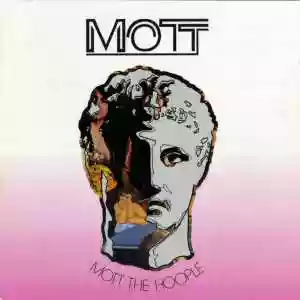
Such is the case with this "Mott," the sixth and penultimate album by Mott The Hoople dated 1973. Speaking of the two roosters of the group, the singer and pianist Ian Hunter is a strange rock animal with his own unique characteristics: he sings just like Bob Dylan (with much more breath and power, of course) but also has quite a pop/rock talent, which makes him write anthemic and irresistible choruses, perfectly suited for one of the popular genres at the time, that glam rock which sees Spider From Mars by David Bowie and T.Rex by Marc Bolan as the acclaimed leaders. The guitarist Mick Ralphs, on the other hand, is the typical British hard blues musician, devoted to a much drier and more geometric genre, with the great things combined in those years by Zeppelin, Free, Rolling Stones and company in mind, completely resistant to glitter, sequins, swagger, eyeliner around the eyes, and nursery rhyme choruses.
The trouble for him is that Mott The Hoople finally managed to break through the year before, thanks to a super glam anthem given to them by David Bowie, that "All The Young Dudes" so good that Bowie almost regretted it, soon taking it back and putting it in his concert setlist. Hunter, therefore, has a good game in this album, invaded by dazzling urban rock'n'roll, his acidic and melancholic lyrics, the scent of the filthy, ill-frequented alleys of old London. Ralphs can do nothing but leave after these recordings, soon and more than happily fulfilling his rock blues aspirations by forming the glorious Bad Company with his new partner Paul Rodgers.
As with all well-done works, there isn't a track to throw away in "Mott," and it's worth spending a few words on each of them. The debut "All The Way From Memphis" is electrifying: the piano stubbornly pounded on a single chord takes a while to modulate and be joined by the rhythm section, creating one of the longest, most suspended, and captivating intros of shimmering piano rock'n'roll, onto which Andy McKay's (Roxy Music) sax glistens, exchanging solos with Ralphs' proverbially essential and penetrating guitar. "Wizz Kid" seems to come out of "Ziggy Stardust," the guitar has the same sounds as Mick Ronson's (guitarist and arranger of the Spiders), backing vocals (aaah?) recorded altering tape speed dominate, all typical glam ingredients, but the lyrics go even further, containing phrases that greatly anticipate a certain future ("Her dad's a street punk", and we're in 1973!). "Hymn For The Dudes" is a whole different world, also because the music comes from the group's former keyboardist Verden Allen. In fact, it is an emphatic and lyrical piano ballad, with glam temporarily set aside. It rather approaches Bruce Springsteen atmospheres (at the time perfectly unknown, mind you), therefore practically an intense and noisy vision of Bob Dylan, brought into focus by Hunter's appreciably off-key but magnificently expressive voice. "Hanaloochie Boogie" shows as never before the subjugation of Ralphs' rock blues riffs, the author of the music, to the glam word made of hyper-compressed sounds and falsetto choruses, while singing of long hair, boots and other glittering trinkets. The subsequent "Violence" is unbridled and shameless glam, with lyrics as metropolitan as can be, worthy of the young Lou Reed. In "Drivin Sister," Ralphs is left free to develop his beloved themes without too much embellishment, resulting in a very direct hard rock, the kind he will have later the chance to perfect greatly in his subsequent and definitive band. "Ballad Of Mott" is, by contrast, a track musically entirely subservient to its verbose lyrics, in which Hunter paints a picture of what life on the road in the rock'n'roll circus is like, calling directly on himself and his fellow travelers. "I'm A Cadillac" is sung by Ralphs, his weak and ineffective voice sounds like a final consolation prize, before the musician's departure from the group, but the long instrumental coda ("El Camino Doloroso") is unheard of as one of the album's peaks! The great guitarist interlaces an acoustic guitar with continuous interventions with the electric one, played with a slide finger, showing the incredible class, taste, and restraint he is endowed with. One of those musicians appreciated especially for what he DOESN'T play, capable of increasing the strength and meaning of what he does play. The epilogue is entrusted to the hyper-Dylanesque "I Wish I Was Your Mother," with Ralphs on mandolin and a beautiful lyric by Hunter.
Those who adore "Ziggy Stardust And The Spiders From Mars" and don't know this album absolutely cannot miss the experience of listening to it. Personally, I consider them the two giants of glam rock, with a certain preference for ? "Mott," which says it all given the excellent quality of Bowie's well-known exploit.
Loading comments slowly
Summary by Bot
The review praises 'Mott,' the penultimate 1973 album by Mott The Hoople, as a peak in the band’s creative output. It highlights the tension and balance between Ian Hunter’s glam rock style and Mick Ralphs’ hard blues influences. Each track is noted for its quality and distinct character. The album is recommended especially to fans of glam rock classics like David Bowie’s 'Ziggy Stardust.'Tracklist Lyrics Videos
Mott the Hoople
Mott the Hoople are an English rock band formed in 1969. Fronted by Ian Hunter and featuring guitarist Mick Ralphs, they helped define early-70s glam rock. Their breakthrough came with the David Bowie–penned All the Young Dudes (1972), followed by acclaimed albums Mott (1973) and The Hoople (1974). Ralphs later left to form Bad Company.03 Reviews
