
 •
Rating:
•
Rating:
THE REVIEW
Here is what Mike Browning, former drummer of Morbid Angel and Nocturnus, says about this record he played on, in an interview:
"So, let's get one thing straight right away: "Abominations Of Desolation" was recorded in 1986 under contract with Goreque Records, and it was the first real contract for Morbid Angel, therefore the first actual full-length. It was never a demo until Trey Azagthoth decided to write on Morbid Angel's official site that it was a demo, which is a lie! Also, Sterling didn't play bass on "Abominations...," because the bass lines were played by John Ortega. Sterling replaced Ortega after the recordings of "Abominations...". So that's another incorrect fact among those posted on Morbid Angel's site by Trey. Trey is trying to change history to suit his needs, but he's just making himself look stupid in public if he thinks people believe these lies."
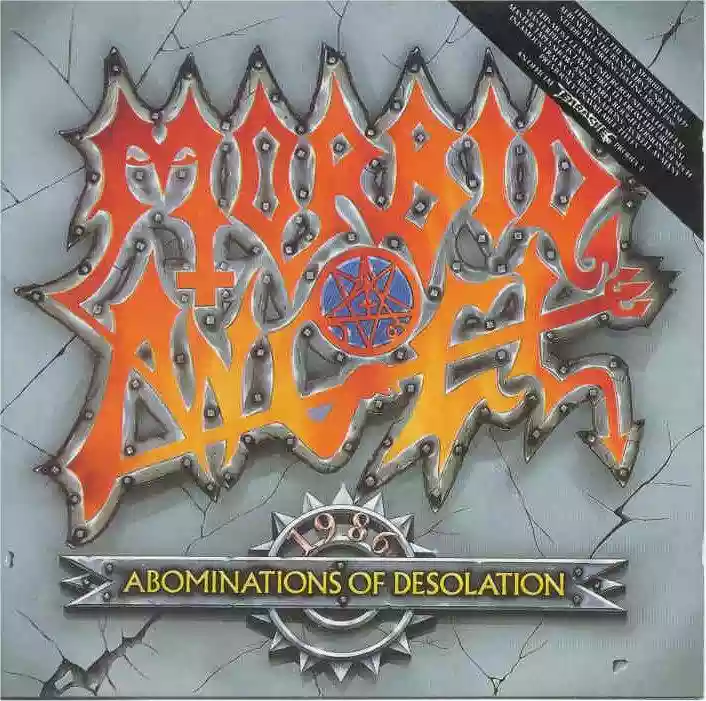
Morbid Angel started with this demo also known as "Scream For Blasphemies" from which some songs were already recorded on this album released in 1991 and recorded in 1986, a work that has always been the band's compositional reserve, the pantry where lacking inspiration goes to draw nourishment to complete the first two albums. In fact, all the songs on this platter, except for "Demon Seed", have been re-recorded by the band and catapulted onto subsequent albums, starting from the debut "Altars Of Madness" up to "Formulas Fatal To The Flesh". David Vincent was involved as a producer in this little project, who later became bassist and singer for Morbid Angel themselves, who will do a better job on "World Downfall" by Terrorizer, naturally supported by Scott Burns.
In "Abominations Of Desolation" the approximation of the sounds reigns supreme, with a cumbersome mix that completely obscures the bass, leaving the guitar to fill the ears, where the drums, still tied to the proto-death stylistics of the time, goes to complete a sound that recalls a weary thrash metal, a kind of slow-motion vision of Sepultura in "Morbid Visions", of Possessed in "Seven Churches", passing through Celtic Frost in "Morbid Tales" with little incisiveness in the fast parts. The blast beats that Sandoval would intelligently use in years to come are not present yet, nor is the piercing speed of thrash, but a drumming often similar to what Six Feet Under will adopt starting from "Maximum Violence", accompanied by Browning's voice, which is not a pure and hard growl but a sort of wheezing exhalation produced by a witch with bronchitis, indeed reminiscent of certain scenes from "House 4". The songs appear in better form on subsequent albums, except for the rhythmic "Angel Of Disease", always furrowed by Trey Azaghtoth's solos which lead to exhaustion. But this time we don't complain: the rhythm is swift and the singing very aggressive, strengthened by the good old cascading rolls amid a sound reminiscent of a frantic race in an ambulance.
Killer songs, still in an embryonic state, already capture attention like "Chapel of Ghouls" ("Ghouls attack the church/crush the holy priest...") which is always crude and effective, swift but not too much, with Browning and Azagthoth almost stealing each other's space, although it must be admitted that the album's limit, aside from the inadequate production, is the insistent use of solos that Trey throws in throughout the tracks, such as in "Demon Seed" or in the already classic "Lord Of All Fevers And Plague"("...ia iak sakkakh iak sakkakth/Ia shaxul/I call forth the god Pazuzu/I call forth the lord of plague"), where the troublesome demon Pazuzu, star in Friedkin's "The Exorcist", returns to the scene, set in a nice speed scenario and preceded by the opening of the infernal door. "Welcome To Hell" is also nice (which will become "Evil Spells" in "Altars Of Madness"), calm in rhythm, accelerating in the chorus with well-calibrated vocals that repeat "Welcome To Hell" and then off with solos. "Unholy Blasphemies" and "Abominations" are just tasty appetizers for the much heavier and well-played versions on "Blessed Are The Sick"
Today this record seems more like a curiosity than a valid episode of extreme heavy metal, however, this old sound has the merit of evoking, distant, distant civilizations from the clamor of modern life, castles in darkness, woods full of spirits, although it is not a sufficient reason to ignite the fuse of a full-bodied and articulated death metal. All this doom magma will instead be condensed in the instrumental episode "Doomsday Celebration", taken from "Blessed Are The Sick". "Abominations Of Desolation" is the first and only Morbid Angel vinyl I bought in 1991 without knowing there were other more deserving products nearby, and one of the few with a lot of dust on it.
Loading comments slowly
Summary by Bot
Abominations Of Desolation is Morbid Angel's first full-length recorded in 1986 but released in 1991, often mistaken as a demo. The album features embryonic versions of later classic songs with raw production and a thrash-influenced death metal sound. Mike Browning clarifies historical inaccuracies about lineup and status. Despite production flaws, the record holds historical value and showcases the band's early compositional seeds.Tracklist Lyrics
Morbid Angel
Morbid Angel is an American death metal band from Florida, widely regarded in the reviews as a pioneering and influential act in the genre, strongly associated with guitarist Trey Azagthoth and drummer Pete “Commando” Sandoval, with notable vocal eras led by David Vincent and later Steve Tucker.24 Reviews


