
 •
Rating:
•
Rating:
THE REVIEW
There is a journey that everyone takes during their youth. For each person it's different, but anyone who reaches twenty-five feeling alive goes through some path during their teenage years that leads them somewhere.
And often, they are accompanied by music. Modena City Ramblers are one of those bands that, in Italy from the '90s onwards, have shaped the most young people. And it's not random; Modena carried with them a precise imagery, of which they are perhaps among the pioneers. Them, CCCP, and off the top of my head, I can't think of many others. Careful—I'm not saying that no other band has contributed to what Italian culture has to offer today (also because we're obviously talking about only certain cultural strands), but I am saying that the Modena City Ramblers are among the foundations of this world. Everything revolving around collectives, indie scenes, those two slightly goofy folk groups touring the festivals—it wouldn't be the same. Maybe the indie artist playing little gigs would exist anyway, and maybe MCR never really even cared about them, but the world where they now move was also forged by Modena. Just as, without CCCP, like it or not, we wouldn't have all those more or less cultured "alternative" people talking about hardcore punk and bizarre black-and-white Russian stuff.
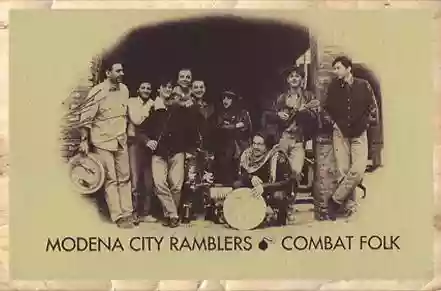
Then, well, there’s more: Modena City Ramblers are obviously not just the legacy they've left to those young people who, in the year domini 2026, take to the streets singing along to the version of “Bella Ciao” contained in RTAC. And to understand all this, what better way than to rediscover the first album—a demo—of this extraordinary band? It's frankly disorienting how the modern world, with its mix of colors and shadows, smoky social centers and occupied schools with graffiti, has as its soundtrack a band whose imagery was so different: a Guccini-style cover, tales of folklore, politics done simply and no-nonsense (how much I love the accusations against traitors in “Contessa”), in their own way, not grungy droning voices but strong, powerful ones, folk riffs that make you feel like you're jumping around like a demon in the woods, in an atmosphere that perhaps even bands like Cruachan would have envied at times.
“Quarant'anni” is one of my favorite Modena tracks: head-on against the politics of its time, with a punk approach and no nonsense. Borrowed from the legendary Pogues, “Contessa” is a great track to pogo to; it’s also a fine example of how Modena took melodies, but with their own rhetoric and poetry. “Farewell to Erin” is chilling, transporting you among the elves, no matter if you’re on your way to the occupied technical school to raise some hell with your friends. “Bella Ciao” is sung with great energy and is a truly excellent version. The following “Fischia il vento” (probably my favorite resistance song) holds its own perfectly, with a long instrumental section that is a gem and some horns that are out of this world. The way Modena, in this demo, ramped up the BPM and energy while keeping a sound that seems to come from one of those piazzas in the little towns of the Tuscan-Emilian Apennines is masterful. Besides, do we not know that MCR were a left-wing political band? No critical review can deny it; Modena managed to keep together the musical group and political soul better than most others—and for a few years they would continue to do so. Eyes on the present with “Ahmed l'ambulante,” which has an extremely fitting melody and tells a sad story of immigration—a street vendor for whom fate hasn't smiled. You can already glimpse the band's more musically cosmopolitan spirit. A short yet delightful folk instrumental closes things out.
The sound of this record and its production are pretty “raw,” that is, not particularly polished, which brings out the folk spirit in the roughest sense of the word, with often sparse rhythms but instruments that, in their simplicity, create sounds of great impact.
Italy has changed so much in the last thirty-five years. In some ways, it still feels the same, but it's not. Certain spirits have remained, for better or worse, and certain imaginations; and to really understand it, we need to draw on what young people have watched and listened to for over thirty years. “Combat Folk” in this sense is worth revisiting—but in the end, let's listen to it again also for its poignant beauty, which in less than half an hour draws landscapes like few others ever managed to do; let’s listen to it again to immerse ourselves in that timeless experiment that the Modena City Ramblers were in the overall musical scene of the 1990s.
They sang about Italy, but maybe today these words could apply directly to this demo: the decades that lay before Modena were anything but easy. “Ho quarant'anni e qualche acciacco, troppe guerre sulle spalle, troppo schifo per poter dimenticare.” Rating: 85/100.
Loading comments slowly
Summary by Bot
The review gives Modena City Ramblers' Combat Folk a solid 4 out of 5, highlighting the band's effective fusion of folk roots and rock energy. The album is praised for its vibrant sound and sociopolitical lyrics, successfully engaging both traditionalists and modern music fans. The reviewer appreciates its authenticity and artistic message. Overall, it’s considered a significant contribution to contemporary Italian folk. Recommended to listeners who appreciate substance and style.Tracklist
Modena City Ramblers
Modena City Ramblers sono un gruppo italiano nato a Modena nel 1991, noto per unire folk irlandese/celtico, rock e cantautorato sociale. Tra i lavori più citati: Riportando tutto a casa, La grande famiglia e il progetto corale Appunti partigiani.19 Reviews
Other reviews
By Cuorenero86
An Irish folk tinged with red, with a combination that made a big impact at the end-of-the-decade Unity parties of the late ’80s and early ’90s.
Alberto Morselli’s voice has a lot of personality, and let’s say that in MCR it fits better compared to Stefano Bellotti’s, which is more playful and immature.
