
 •
Rating:
•
Rating:
THE REVIEW
The advent of the '80s caused a significant upheaval in the musical landscape, completely renewing musical standards and, in a sense, forcing many bands to reinvent themselves: the glorious '70s were indeed the era of great progressive rock, which left the names of great musicians like King Crimson, Genesis, Jethro Tull, or even Led Zeppelin and Deep Purple etched in the hearts of many. But with the onset of the new decade, it all seemed to dissolve into a beautiful dream with a short lifespan, making room for music more focused on electronics, sampling, and overdubs that sometimes gave the compositions a more plastic sound. However, there were bands, like the shining example of Rush, that decided to stay true to their path and continue producing high-quality progressive rock, and in this context, we find what was perhaps the most representative multi-instrumentalist of the '70s-'80s decades, that is, Mike Oldfield, who in the now distant 1968 gave birth to the masterpiece "Tubular Bells."
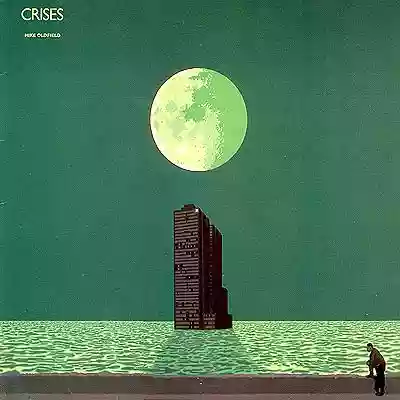
After some albums with less commercial impact, in 1983, the good Mike returned to the market with the well-received "Crises," which to this day remains his greatest success, the album with which he made the big leap. Why? Simple, the presence of "Moonlight Shadow" should suffice as an answer; however, the presence of such a chart-devoted pop song should not be misleading, as pieces like the opening suite, as well as the title track "Crises", bring us back to progressive grounds: the 20 minutes pass by without even noticing, thanks to melodies now heavily inspired by folk, now almost new age, up to avant-garde flavored jazz, all developed under the protective wing of the most classic '70s rock.
Then we continue with the already mentioned and famous "Moonlight Shadow" where the delicate and fine voice of singer Meggie Reilly rests on a musical base that unites pop and folk: more than for the actual beauty of the song, which is undeniable, I believe this episode should be noted for the splendid lyrics freely (but not too much) inspired by the death of John Lennon. Following in order are "In High Places", a successful mix of prog and new age that finds its strength in the theatrical chorus, and "Foreign Affair", perhaps the weakest track on the album, before arriving at the short instrumental "Taurus", a guitar and drum song with a groove absolutely out of the ordinary, where influences even from Spanish folk music can be discerned. Closing the album is "Shadow On The Wall", which, to be honest, I did not appreciate at all, as good Mike literally took the main riff from Blue Oyster Cult's "Don't Fear (The Reaper)" and stuck it onto this "Shadow...".
Ultimately, we can safely say we are facing a definitely essential album for the continuance of progressive music, albeit in this case heavily influenced by other styles, but even more crucial for granting Oldfield unexpected notoriety; that said, it is undeniable that the work is not without flaws, and in more than one instance, it slips into not entirely forgivable sins. The score would be a 3.5, but since I have an excessive admiration for this musician, I don't feel like rounding down, and besides, Mike can be forgiven for everything.
Loading comments slowly
Summary by Bot
Mike Oldfield's 1983 album Crises marked a successful fusion of progressive rock with 1980s electronic trends and folk influences. Featuring the hit 'Moonlight Shadow,' it balances commercial appeal with intricate compositions. Despite a few weaker tracks and some borrowed riffs, the album remains essential to Oldfield's catalog and progressive rock's evolution. The reviewer admires Oldfield's artistry, granting the album a solid rating.Tracklist Lyrics Videos
Mike Oldfield
Mike Oldfield is a British composer, guitarist and multi-instrumentalist widely associated with progressive rock and long-form instrumental suites. He rose to major international fame with the 1973 album “Tubular Bells,” later exploring folk/Celtic, ambient, pop and orchestral/symphonic directions across a long discography.26 Reviews
Other reviews
By theJOKES
Crises represents the pinnacle of his long career.
This CD proves to be a small work of experimentation that touches on multiple genres without ever boring us.
By Valeriorivoli
You know what a little song does to you... And so down came the Neapolitan tears of nostalgia tied to this great record by wizard Oldfield.
Even though I didn’t like prog, I immediately liked this record, it made me dream.
