
 •
Rating:
•
Rating:
THE REVIEW
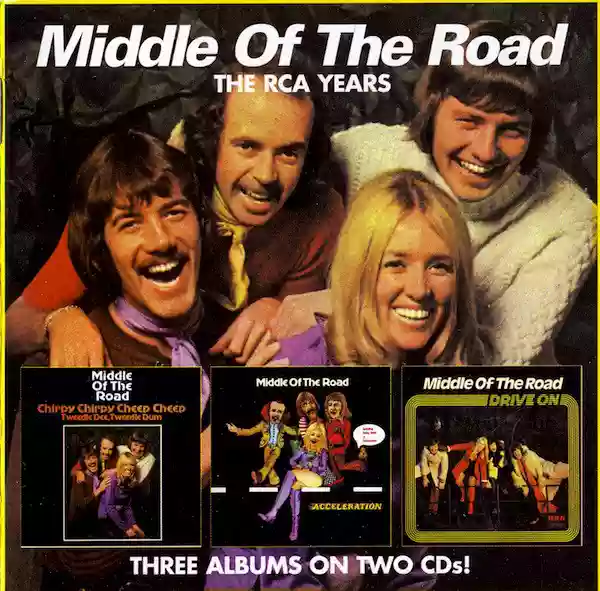
The holidays are approaching, and many of you know that for a music enthusiast, choosing the records to take on a trip is as important as packing, (having) the car checked, and ensuring your documents are in order. I have decided not to bring any heavy-duty stuff with me: no suites, no symphonies, no odd tempos, no distortions, etc. I'm in the mood for pop music, preferably with a female voice. Actually, let's make it "exclusively" with a female voice. Hence, the pioneers of Europop, Middle Of The Road, couldn't be absent, with a beautiful double CD, "The RCA Years", which includes their first three albums and the bonus tracks of the Italian edition of their debut. Stop everything: pioneers?! Yes indeed, you read that correctly. Do you know that Swedish quartet with two women on vocals that sold just a few hundred million copies and inspired musicals, films, and museums? Guess who they were initially inspired by. If you don't believe it, listen to some singles by MOTR (Tweedle Dee Tweedle Dum, Sacramento (What A Wonderful Town), Soley Soley, Samson And Delilah) and you'll agree too. If that's not enough (which at this point would mean denying the obvious), consider at least a cover in her native language by a solo Agnetha Fältskog of Union Silver and declarations of admiration from Björn Ulvaeus.
The Middle Of The Road story is a shining example of producer-driven pop, rather than author-driven, inter-European, where some Italians play a fundamental role: it's brothers Mario and Giosy Capuano, composers and arrangers, who discovered these four Scots in the summer of 1970 while performing in venues on the peninsula, and proposed them to Giacomo Tosti of the Italian division of RCA. After serving as session musicians on other people's tracks, Ken Andrew (drums), brothers Eric (bass) and Ian (guitar) McCredie, and the blonder-than-blonde and beautiful singer Sally Carr ignite the scene with a cover of a song already popular in these parts, Chirpy Chirpy Cheep Cheep by the quirky Lally Stott, another Brit seeking fortune in the Belpaese. The success is enormous not only in Italy, so Tosti entrusts them to the Capuano brothers for the music, while Stott is hired for the lyrics. They repeat the success with Tweedle Dee Tweedle Dum, a rhythmic and delightfully childlike folk-pop, another global hit: in Italy, they're an institution; in continental Europe and Scandinavia (who would have thought?!) they have everyone at their feet, their initially inattentive homeland rediscovers and learns to love them, and they are well appreciated even in Asia, Oceania, and the Americas. Sensational numbers, both for a debut band and for two Italian composers who are teaching a thing or two to the world in pop, on par with renowned authors from our country like Giorgio Moroder and another pair of brothers, La Bionda (Italians do it better?).
The first album, conveniently titled "Chirpy Chirpy Cheep Cheep," includes, in addition to the aforementioned singles, a couple more competent covers, I Can't Tell the Bottom from the Top by the Hollies and Yellow River by Christie, and a varied set list for which the four's "bubblegum" group label, assigned in virtue of their carefree and youthful singles, is rather limiting. It's a set of beautiful songs that draw from pop traditions not only Anglo-Saxon but also local. Pay attention: listen to To Remind Me and The Sun is in Your Skin, try to imagine them sung in Italian, and then tell me if they would have been out of place at a Sanremo festival of those years. Well-made songs, yet the best comes when the Scots are more Brit than ever, as in the very Kinks-like Fate Strange Fate and in a Give It Time that would surely have pleased the Small Faces.
Barely a few months after their debut, Middle Of The Road returns with “Acceleration” at the end of 1971: they are still stationed in Italy, but American roots influences are preferred instead of the Italianisms mentioned above, and the band undoubtedly feels at home, as demonstrated by the ballroom country of Love Sweet Love and the sugar-coated triplet of the doo-wop era You'll Know What Love is For. The singles Sacramento, Soley Soley, and Samson and Delilah are included, which, as previously mentioned, are more Abba than Abba before Abba, and a wonderful little bunch of colorful pop gems: the sentimental piano ballad On this Land (Maestro Baglioni, thank you for the inspiration), a Queen Bee worthy of the most playful Joni Mitchell, the mocking music-hall number in Macca's Sgt. Pepper/White Album style The Talk of all the USA, the Lennon-esque with verve Try a Little Understanding, and a Medicine Woman that is an open window on the imminent future of pop-rock, from ELO to Fleetwood Mac's Buckingham/Nicks era. Sales are still extraordinary, 1972 is spent on tour, and the band moves from the Italian division of RCA to the international one, so...
... In 1973 "Drive On" is released. Another Brit with Italian ties, drummer Mike Shepstone of the now-disbanded Rokes, replaces Stott, while the Capuano brothers remain; the band nonetheless has more say and gets involved more often in the composing phase. The coordinates are the same as the previous album, but with a touch more maturity: the ballads are still gentle, but they reveal a more contemplative and, in a sense, adult tone, while the rhythmic tracks rock a little more than before (Honey No). There are a few lapses, like the single Kailakee Kailako, an unconvincing attempt to write another easily grasped hit. Nonetheless, the album is generally more than praiseworthy and reaches its peak with a piece entirely written by Ian McCredie, a Blind Detonation between Stones and Byrds that is a little masterpiece. This time sales are not as satisfying as in the past, and the partnership between RCA and Middle Of The Road ends, with the band moving to the German Ariola. But that's another story. For what's left of this summer, there's plenty to keep you occupied.
Let's go. Cheep cheep.
Loading comments slowly
Summary by Bot
This review highlights Middle of the Road's importance as Europop pioneers, focusing on their RCA Years compilation. It praises their catchy pop singles, strong female vocals, and influential Italian producer collaboration. Notable hits like 'Chirpy Chirpy Cheep Cheep' and 'Tweedle Dee Tweedle Dum' are examined, along with the band's evolution over the first three albums. The review emphasizes their international success and lasting pop legacy.Tracklist Lyrics
01 Queen Bee (02:55)
02 Wheel of the Season (03:07)
03 Union Silver (04:07)
04 Honey No (03:21)
05 Give It Time (03:55)
06 Love Sweet Love (03:35)
09 The Talk of the U.S.A. (03:13)
10 On a Westbound Train (03:14)
11 Ain't No Mountain High Enough (06:13)
12 Fate Strange Fate (03:05)
13 Universal Man (03:27)
15 See the Sky (03:26)
16 On This Land (03:49)
17 The Way of Life (02:19)
18 Eve (03:13)
19 Places (03:34)
21 Happier Than I (03:11)
22 Medicine Woman (03:32)
23 Rainin’ ’n’ Painin’ (03:30)
25 Try a Little Understanding (03:26)
26 Do Not Cry (dal film Dropout) (03:53)
27 Nothing Can Go Wrong (03:01)
28 The Sun in Your Skin (02:42)
29 Yellow Boomerang (02:39)
30 Lingering Sounds (03:32)
31 Louise (My Little Ship) (03:29)
32 To Remind Me (03:32)
33 We Are the Founders of All That's Around Us (03:14)
34 Then You'll Know What Love Is For (03:16)
36 Superstar (02:59)
37 El Condor Pasa (03:26)
38 Blind Detonation (02:49)
41 I Can’t Tell the Bottom From the Top (03:31)
Middle of the Road
Scottish pop group formed in 1970, best known for early 1970s Europop hits and international chart success.01 Reviews
