
 •
Rating:
•
Rating:
THE REVIEW
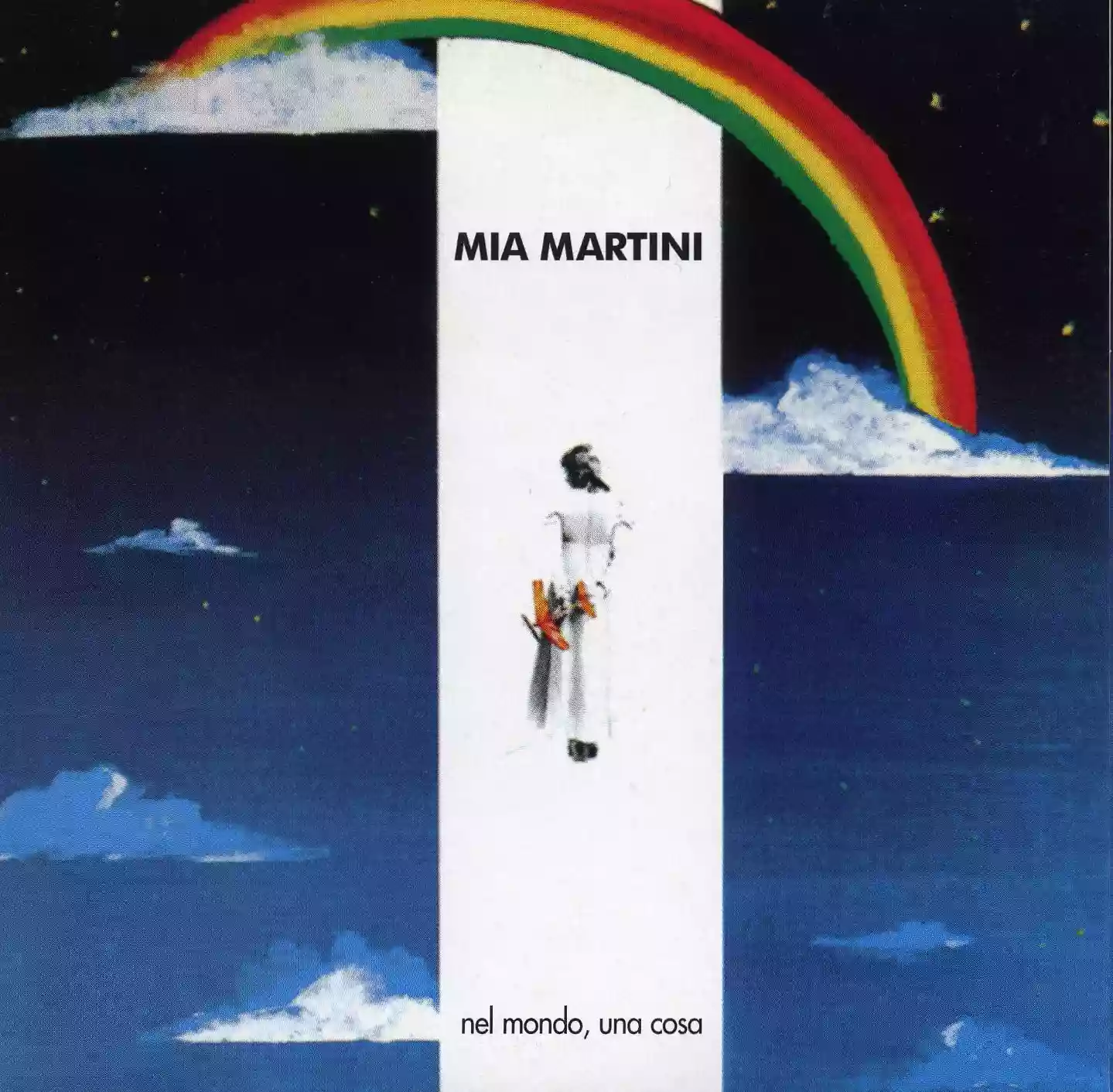
Mia Martini, or when the "belcanto all'italiana" acquires real nobility, is not understood as trills, vocal exercises, and the nonsense learned in conservatories coupled with the most total and catatonic artistic nothingness. With Domenica Bertè, the bel canto comes to life; the voice vibrates with emotion, and the musical offering is of a high level: great authors and great musicians have collaborated with this woman with a voice so beautiful and so unique, who debuted on the "landing" of Italian pop — narrow-minded, provincial, and conservative to the core — with a wonderful scandal song like "Padre Davvero," in that little village world that has always loved and now more than ever loves to gaze narcissistically into its own nothingness. Mimì was an enigma, an exception, a voice out of the chorus in every sense, and her second album, "Nel Mondo, Una Cosa" from 1972, reveals all her essence. It may be her best album as well as the one that launched her much-deserved success and notoriety before that narrow-minded and obtuse world, which has never deserved her and never will, clipped her wings.
Her debut LP, "Oltre La Collina," obtained great accolades from critics, and thus her successor can already boast collaborations with great and recognized figures in Italian music: the renowned Genoese singer-songwriter Bruno Lauzi, whose lyrics are closely tied with Mimì’s voice and especially her soul, Dario Baldan Bembo, a great musician unfortunately known for the ill-fated "Inno dell'amicizia," Maurizio Fabrizio, Maurizio Piccoli, and Luigi Alberelli. "Oltre La Collina" is a quality Italian pop record with an artisanal touch, featuring some excellent covers, much more than just a simple collection of singles plus filler material, enhanced by excellent arrangements, emphatic enough to fully showcase the voice of the Calabrian singer, and by excellent lyrics that revolve around the theme of love in a way that is never stupid, stereotypical, and banal as per Italian custom, and especially by Mimì’s wonderful voice, not hoarse and tormented as in the final years of her career but powerful, crystal clear, and above all explosive: a song of almost dramaturgical strength like "Donna Sola" is perfect for highlighting the unmistakable interpretative skills of the singer, especially thanks to a text that reflects Mimì’s personality and image like a mirror. "Donna Sola" is also the archetype of the entire album, full of songs that start quietly, with sweetness, only to explode in a Rossinian crescendo: "Questo amore vero", "poor" sister, less musically refined but more intense and direct than "Minuetto," the bittersweet "La Nave", whose melody is beautifully drawn by Dario Baldan Bembo's organ, who also signs a beautiful piano ballad full of warmth and passion like "Un uomo in più", and obviously the evergreen melody of "Piccolo Uomo", the classic that will launch Mia Martini’s album and career, a symbol of 70s Italian music with that phrase, "Io posso, io devo, io voglio vivere" sung with empathy and a vigor more unique than rare, that remains eternally etched.
One of the album’s strengths is undoubtedly its qualitative homogeneity. Even pieces more tied to a more canonical Italian pop like "Amanti", slightly marred by some excessive "na na na," and the dramatic "Tu che sei sempre tu" keep the high-quality average together with the beautiful "Neve Bianca", cheerful, engaging, perfect for enhancing Mimì’s roar, which stylistically enriches the album with the lively, almost folk, acoustic guitars of the La Bionda brothers, for which Bruno Lauzi invents a fairly allusive and allegorical text. Among the covers, besides the famous yet overrated "Madre" by John Lennon, in my view the weakest point of the album, the intense and dramatic "Valsinha" by Brazilian Vinicius De Moraes stands out, enriched with masterful orchestrations, and "Sing A Song" by Gary Wright, which becomes "Il tuo cuore di neve", a delightful excursion into pop-rock territories, even if the greatest wonder is undoubtedly "Io Straniera" aka "Holy Moses," a perfect combination: one of the most beautiful melodies by the King of Pop, Elton John, encountering its perfect interpreter, and the result is easily imaginable.
Mia Martini is, could have been, the Italian Jennifer Warnes, and coming from me, this is a huge and absolutely deserved compliment. She is certainly one of the great prides of our country's song: light years away from the Giorgies and Elises who have drawn from her repertoire with results worthy of tomatoes thrown in their faces. She, in her own way, belongs to the group of Francesco De Gregori, who dedicated a touching "Mimì Sarà" to her, of Fabrizio De Andrè, of whom she was a wonderful interpreter, of the greats of Italian music, in short. An album like "Nel Mondo, Una Cosa" demonstrates what an extraordinary artist Italy has let slip away, shamefully marginalizing her only to perform contrite cries and cover their heads with ashes after her passing in a triumph of necrophilia, useless words, and crocodile tears.
Loading comments slowly
Summary by Bot
Mia Martini's 1972 album Nel Mondo, Una Cosa is praised as a pinnacle of Italian pop and bel canto. The album features emotional vocal performances backed by renowned Italian musicians and songwriters. It contains iconic tracks such as 'Piccolo Uomo' and covers showcasing her unique artistry. Despite being marginalized during her career, Martini's legacy is celebrated as one of Italy's greatest vocal talents. This album remains a testament to her powerful, clear, and expressive voice.Tracklist Lyrics Videos
Mia Martini
Mia Martini (1947–1995) was an Italian singer from Bagnara Calabra, renowned for her powerful, emotive voice. Sister of Loredana Bertè, she achieved major success in the 1970s and returned to prominence at Sanremo in 1989 with Almeno tu nell’universo.12 Reviews
