
 •
Rating:
•
Rating:
THE REVIEW
Hello everyone, I'm new here and I know that thousands of reviews have already been written about this CD, and I understand mine will serve little purpose, but it's an album I hold dear, and I'd be pleased if my first review were about this CD—I hope no one minds...
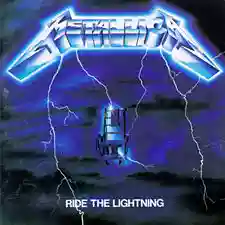
The year is 1984 when "Ride The Lightning" is released, just a year after the release of "Kill 'Em All," and the differences are already noticeable, and not insignificantly. "Kill 'Em All," along with Slayer's "Show No Mercy," was the album that kickstarted the Thrash Metal movement. However, while Slayer evolved by seeking an even more brutal sound, culminating in their masterpiece "Reign In Blood," Metallica sought to add melody to Thrash, with "Ride The Lightning" being the first result.
In this album, the speed and aggressiveness are diminished, although still present in powerful songs like "Fight Fire With Fire", "Trapped Under Ice", and "Escape", but the sophistication and technique are increased. Solos like those in "Ride The Lightning" and "Creeping Death" are proof of it. "For Whom The Bell Tolls" is an interesting track; the lyrics are based on the book by Ernest Hemingway. Musically, however, the track has a relatively simple structure compared to the other songs, but this doesn't make it less credible. Perhaps it's exactly its simplicity that makes it more accessible, capable of capturing the listener's attention.
A separate chapter must be dedicated to the two masterpieces of the CD: "Fade To Black" and "The Call Of Ktulu".
"Fade To Black", track number 4 of the album, is Metallica's first ballad, although many consider "Nothing Else Matters" the first real ballad. A curiosity: from "Ride The Lightning" onward, all Metallica ballads will be track number 4 on the CDs (except "Nothing Else Matters" which is track number 8 on the Black Album). Returning to the song, it can be divided into two parts: The first is the slower part, characterized by not-too-fast tempos and a few hard riff changes at most. This is also the part characterized by Hetfield's melodic singing, who for the first time tries singing not on purely Thrash riffs. The second part is the long solo that fades out to the end of the song, a technically great solo but highly emotional, one of the best ever executed by Kirk Hammett.
"The Call Of Ktulu": is an instrumental track lasting 8:55 minutes, the longest song ever written by Metallica. Part of the "paternity" of the track is recognized to Megadeth's leader, Dave Mustaine. The track is a continuous rise and fall of rhythms; intertwining riffs, melody, power, emotion, and technical skills blend perfectly. To me, the track is second only to "Orion", which I personally consider the best instrumental track by Metallica, as well as one of the best instrumentals ever, being the last work left to us by Cliff Burton.
In essence, the album is truly high-quality. Few bands have the ability to produce a product of such craftsmanship. And whereas Metallica's masterpiece is unanimously "Master Of Puppets," "Ride The Lightning" is then the album that paved the way for the creation of the "Masterpiece." I'm not saying it's a highly recommended CD simply because I believe that every metal music listener already knows it.
Loading comments slowly
Summary by Bot
This review appreciates Metallica's 1984 album Ride The Lightning for its blend of thrash metal aggression and melodic complexity. It highlights the album's key tracks like 'Fade To Black' and 'The Call Of Ktulu', emphasizing technical skill and emotional depth. The reviewer recognizes the album as a milestone that paved the way for Metallica's future masterpieces.Tracklist Lyrics Videos
Metallica
Metallica is an American heavy metal band formed in 1981 by James Hetfield and Lars Ulrich. They rose from the Bay Area thrash scene with early albums like Kill 'Em All and Ride the Lightning, achieved mainstream success with 1991's Metallica (The Black Album), and have released a long-running and often debated catalog since.173 Reviews
Other reviews
By wwwhatemoornet
"Almost twenty years have passed since this album was released, and much water has flowed under the bridge in the meantime."
"It’s a pity that a perfect album is ruined by the qualitative void left by Trapped Under Ice and Escape."
By metaldiablo
"Ride the Lightning" is an authentic pillar of metal destined to rise and become a sort of bible for up-and-coming bands.
‘Fade to Black,’ the first poignant ballad from Metallica with equally tear-jerking lyrics: the highlight of the package that alone is worth the price of the CD.
By Sir Psycho Sexy
Ride The Lightning can be listened to by both those who are not genuine fans of the genre and by the most convinced metalheads.
Metallica manages to construct decidedly beautiful and full of character songs with only three or four riffs, not impossible to reproduce, but then they insert guitar solos worthy of the best Kirk.
By AR (Anonima Recensori)
In this second album, Metallica come into play with all their technique and fury.
'For Whom The Bell Tolls' and 'Fade To Black' are indisputable masterpieces of the Four Horsemen discography and the history of metal.
By Alvaro Il Metallaro
Ride The Lightning, released in 1984, in my opinion is a masterpiece in the history of music, mainly thanks to the genius of Cliff Burton, the bassist.
In my opinion, it is Hetfield’s best vocal performance.
