
 •
Rating:
•
Rating:
THE REVIEW
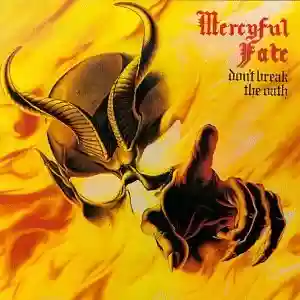
One year after their previous album "Melissa," Mercyful Fate returns with this new concentrated dose of malevolence titled "Don't Break the Oath." From the cover alone (one of the best in my opinion), you can deduce what we're dealing with here.
The blend is always between black and power, the falsetto remains predominant, but musically something has changed: a bit of expressiveness has been sacrificed in favor of power and speed.
It kicks off immediately with "A Dangerous Meeting" and its anthology-worthy main riff. It serves as an introduction song because the vocals (as always) and guitars take the lead, leaving the rhythm section to accompany. It's a different story for "Nightmare," six minutes of constant rhythm changes with King exploring all the tones of his voice (from falsetto to an ogre's grin). The third and fourth songs ("Desecration of Souls" and "Night of the Unborn") only reinforce what's been said. This leads us to the first of the album's two masterpieces: "The Oath." After a two-minute intro with distorted bass, organ, and death knells, the actual song begins. The guitars repeatedly bring back the main riff during the remaining five minutes with the help of bass and drums. The lyrics are nothing more than a long oath made by King to Satan. Truly chilling. The next song is "Gypsy," the shortest on the album but with a truly compelling guitar loop and a King who plays with his voice. At the end of the album, we find "Welcome Princess of Hell," a song that needs no introduction and has one of the best solos on the album, the instrumental interlude "To One Far Away," under two minutes, and, closing, the beautiful "Come to the Sabbath," the album's second masterpiece. It features at the beginning some heavy riffs alternating with acoustic arpeggios, which will become a celebrated ploy in all black groups inspired by MF. The continuation of the track is very fast, and about halfway, everything stops for about ten seconds to make way for a Gregorian chant before starting again.
Following a disagreement between King Diamond and Hank Shermann over the type of music to propose in other albums, the group split. King Diamond would continue his solo career and, after 10 years, would also reform MF, but the levels reached with this album would never be achieved again.
Loading comments slowly
Summary by Bot
Don’t Break the Oath, Mercyful Fate’s second album, stands as a landmark in black and power metal. The album balances speed and power with melodic expressiveness, showcasing King Diamond's vocal range. Key tracks like "The Oath" and "Come to the Sabbath" highlight the band’s musical mastery and dark themes. Despite later band tensions and splits, this album remains unmatched in their discography.
Mercyful Fate
Mercyful Fate is a Danish heavy/black metal band formed in Copenhagen in 1981 by vocalist King Diamond and guitarist Hank Shermann. Noted for occult themes and Diamond’s distinctive falsetto, they were pivotal to the first wave of black metal. After splitting in 1985, they reunited from 1992 to 1999 and resumed activity in 2019.04 Reviews
