
 •
Rating:
•
Rating:
THE REVIEW
One thing is certain: MDC is one of the angriest bands that hardcore punk has ever spawned.
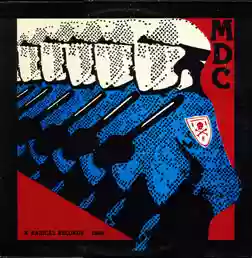
In 1980, vocalist Dave Dictor (a committed anarchist and vegetarian New York squatter, also openly homosexual) formed the group in Austin, Texas. Initially, they were called Stain, but soon changed their name opting for the acronym of a much more direct "Millions Of Dead Cops" (in the future, they'd enjoy adopting different names practically for each new album: More Dead Cops, Millions of Damn Christians, Missile Destroyed Civilization, Millions of Dead Congressmen, etc.). Within a year, they had already founded their own label, the glorious R Radical, and self-produced a 45 rpm record. When they moved to San Francisco in '82, after finishing recording this first LP, they played a blazing fast and essential thrash, characterized by a raw and distorted sound that favors aggression over technical skill. They had much in common with the Dead Kennedys, the sound, and the harsh social critique, first and foremost. But MDC's music was more violent, faster, and the critique even more direct and radical. While Jello Biafra's lyrics were soaked in sarcasm and black humor, Dictor's were pure declarations of hatred. No irony or double meanings, just a lot of anger.
The 14 deadly hardcore splinters making up the record (which altogether lasts just over 20 minutes) shook (indeed, let's say gave a good kick in the balls to) the reactionary soul of Reagan's America. Nothing is forgiven to today's ruthless society: the rotten capitalism of the corporations ("Business On Parade", "Corporate Deathburger", "Greedy & Pathetic"), hatred towards any form of authority, especially cops (harshly insulted in the furious "Dead Cops/America’s So Straight" and "I Remember", explicit incitements to revolt), the tragic awareness of living an empty life in a gray and hostile world ("American Achievements"). The themes touched upon are varied, some of which were discussed for the first time within a punk song: such as homophobia and vegetarianism, but also contempt for work (the overwhelming and super-fast "I Hate Work") and for typical southern USA redneck bigots, ridiculed in the furious ride "Violent Redneck", just 39 (intense) seconds long. Not even the family is spared, whose progressive degeneration is described with a grotesque caricature in "My Family Is A Little Weird", which nevertheless represents one of the more "light-hearted" episodes of the album, vaguely similar to early Circe Jerks' works.
But the real cherry on top is the vitriolic portrayal of a genuine icon of the American (and therefore universal) imagination, all machismo and warlike violence: none other than John Wayne. He is paid tribute, on the occasion of his death, with a song destined to become the group's symbol and a milestone of the genre: "John Wayne Was A Nazi". Introduced by a bass line that follows an almost funk rhythm, it continues relatively slow until the first chorus, when the barely contained rage erupts wild and liberating ("he was a nazi / but not anymore / he was a nazi / life evens the score / (...) you're roastin' now well John, we’ve got no regrets as long as you died a long and painful death"). A classic.
The album was co-produced by Jello Biafra who, through his Alternative Tentacles, also took care of distribution (and even wanted them as the opening band for a long European tour of the Dead Kennedys).
It is worth mentioning that Dictor's voice, which manages to stand out and emancipate itself from the surrounding sound holocaust, is (almost) always clear and understandable: a detail that suggests the group's precise desire to make the words as clearly understood as possible. Precisely because of the "strong" lyrics, many within the punk hardcore scene of the time criticized the band, accusing them of excessive politicization, in their view alien to the ideals of punk. Indeed, unlike what happened with many of their contemporary groups (like Adolescents, Descendents, Social Distortion or others), the repudiation of any form of authority and the rage against injustices did not end in typical nihilistic and self-destructive attitudes but became an invitation to lift one's head and rebel: against oppressive society, against conformism, but especially against violent and fascist police. All of this in a period when punk was something important, a true movement that scared the bourgeois and right-thinking people, and not just a trend to exploit or a musical genre to cash in on.
Loading comments slowly
Summary by Bot
MDC’s debut album Millions of Dead Cops delivers some of the angriest and most politically charged hardcore punk of the early 1980s. With blistering speed and raw sound, the band fiercely confronts capitalism, authority, and social injustices. Vocalist Dave Dictor’s clear, uncompromising lyrics call for direct rebellion rather than nihilism, making this a landmark in punk music history. The album is noted for its radical themes including critiques of homophobia and vegetarianism, and became a staple of politically motivated punk.Tracklist Lyrics Videos
MDC
Formed around 1980 by vocalist Dave Dictor in Austin, Texas, MDC are an American hardcore punk band known for extremely direct, political and anti-authoritarian lyrics and a fast, aggressive sound. Early releases were associated with the R Radical label; the band moved to San Francisco in 1982.02 Reviews
