
 •
Rating:
•
Rating:
THE REVIEW
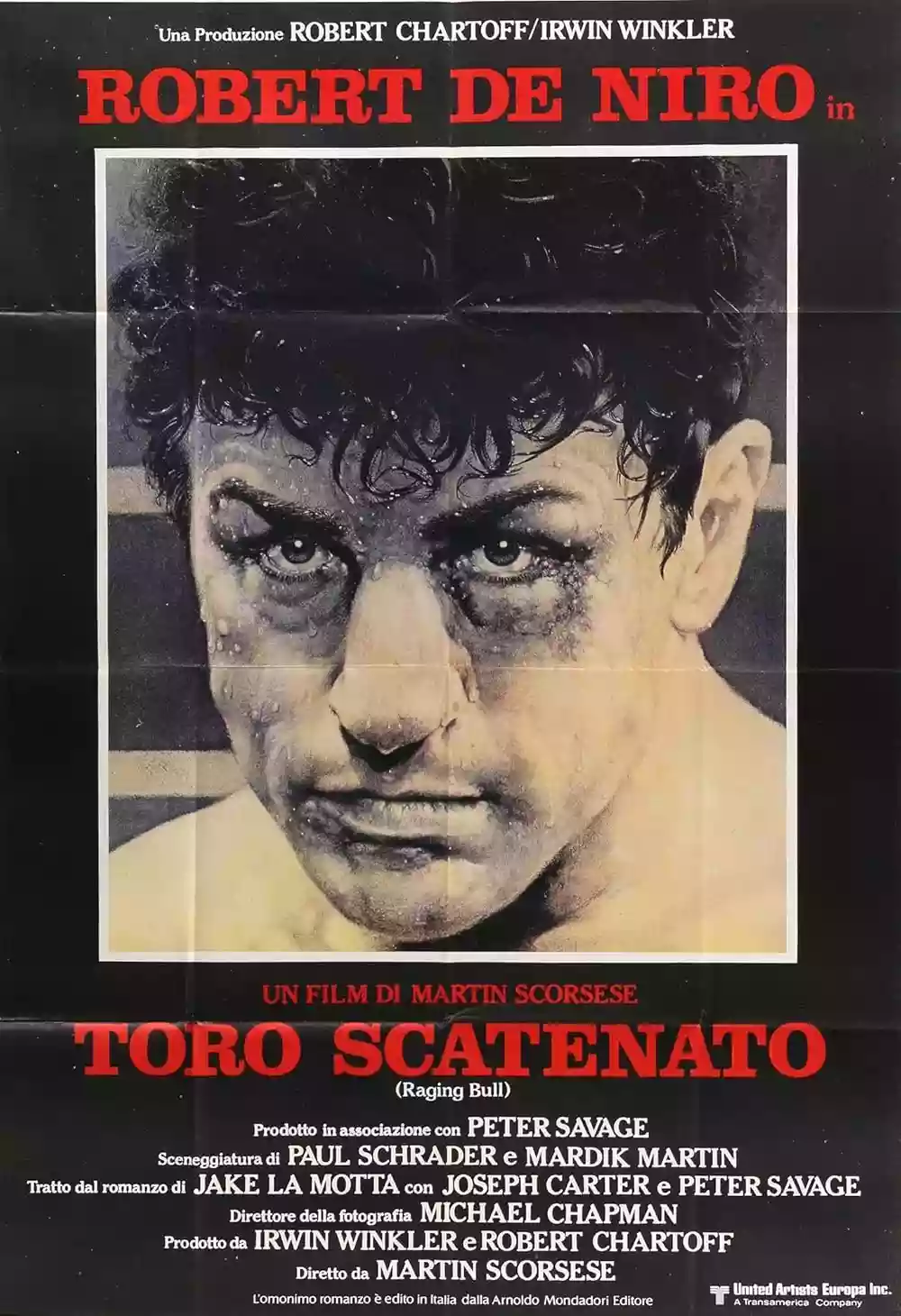
There is a clear gap between “Raging Bull” and Martin Scorsese’s other films. In telling the story of Jake LaMotta, Marty decides not to soften the tragic-farcical aspect in any way with aesthetic flourishes. Black and white, minimal soundtrack, emptied, almost abstract spaces. The characters appear on screen as if on a stage, naked before their own dramas.
The Tragic
Scorsese pursues a deeply problematic reading of the athletic parabola. The anguish, the paranoia, the long silences before and after the matches, the sacrifices that force Jake to so many renunciations, which then reverberate on his family. The cost of success is extreme, it takes the whole life of the man and not just his, as long as his brother and wife manage to stay by his side. A continuous spasm, physical and psychological, to reach the top. And then, the vertical fall, even more ruinous, only apparently softened by a comic filter. In reality, we are in the realm of Pirandellian humor, where the clownish veneer of the ex-champion has the effect of amplifying the drama, the tragedy.
A Man Against
Jake LaMotta both acts out and suffers his own ferocity. The raging bull only knows how to fight, not just in the ring. He does nothing but wage war, to everyone. Just as he crushes his rivals, so he annihilates those around him, forcing them to constantly endure his paranoia, jealousy, his desire to make it on his own, without compromise. His strength is his doom. For him, this is normal—fighting the world—but not for others. For his wife it’s an unending torture, for his brother a daily torment.
A Malicious View
Jake exercises constant censorship and control over his wife. She can hardly express herself, she must be under the watchful eye of his brother if Jake himself cannot supervise her directly. This paranoia, amplified by the sacrifices imposed on him by boxing, however, does not signal a pure conscience, a need for transparency. On the contrary. Jake is dirty, rotten, and therefore he sees malice in the behavior of others, sometimes rightly but often wrongly.
This is especially evident in his second life as a comedian, because his jokes are nothing but a reversal of the moral order: Jake sees the underlying meanings that corrode apparent reality, and by bringing them out with his jokes, he sparks the audience’s laughter. People laugh because someone is finally saying what they think, the uncomfortable truth, that rot exists a bit in all of us. Therefore, the boxer’s paranoia was not delirious nonsense—rather, it was a clear and thus problematic view of reality.
Anti-rhetorical Sports
With this film, Martin Scorsese presents his most anti-rhetorical vision. Sport, boxing, often used as a banal parallel to success, to the realization of the American dream, is here narrated in an anti-climactic form: triumphs are muted, never truly celebrated. Long struggles, sacrifices, pain, wounds, and then moments of fury, never lucid, never calm, always driven by anger, paranoia, indignation. The athlete is an irrational beast, strong because he can endure suffering, but incapable of mediating with his own competitive fire. Only the obsession with victory exists, before and after is ice, darkness, and silence. The black and white, the blurry frames (Thelma Schoonmaker’s abstract editing), the minimal music: there is no triumph, only an animal outburst paid for at a very high price. Jake is pure, in a certain sense, and that makes him so unbearable. He does not know mediation, and when he must intentionally lose, to accommodate his criminal protectors, he experiences his deepest drama—that of having compromised his authenticity.
Space and Silence
Scorsese’s film does not really show the world around its protagonist. Anonymous interiors, generic venues, dimly lit rooms, a ring with an indistinct crowd that shouts, communicates its approval or disapproval with animalistic sounds. There is no reality in this film, only the protagonist’s perception. And as I mentioned at the start, no embellishment. Color is absent, but so is Scorsese’s typical narrator voice. The music is almost absent. A Marty film without rock music is a sensational thing, but it’s a very well-measured choice, fundamental to the film’s economy. Those long silences serve to get to the real drama, the muteness of the soul in the face of everyday pain, the horror of domestic violence, which is not softened in the slightest. On the contrary, in the background we hear clangs, objects breaking, metallic friction. By comparison, the crimes of the “Goodfellas” gangsters almost seem like pranks or little more.
Unmediated Narrative
There is no narrator voice, because never before is truth so complex, so ambiguous. Jake’s vision is unique and peculiar, unrepeatable, and does not need explanation. The bull’s furious gaze cannot be rendered by a narrator’s words but is expressed in gestures, punches, broken phrases. His speech is primitive because, after all, his vision of the world is just that: lacking those filters that society teaches us or imposes on us. He sees and understands the contradictions of his brother and wife because he has, if you will, a more elementary gaze, and precisely for this reason is closer to the essence of things.
Such an immersive, unmediated narration is constructed also in dialogues that closely mimic street talk, the language of the Bronx’s sons. Much of the boxer’s drama—strong yet fragile, violent yet honest, loved by all yet terribly alone—lies in these communication breakdowns. It is no coincidence that this is one of the most vulgar films in the whole of Scorsese’s work. Because the fragility of these men is also the result of their cultural poverty, their “low” perception of everything.
In the final scene, Jake is about to go onstage for his show. He now frequents the underworld, does comedy for a handful of customers who even make fun of him. He dates women who are no longer so attractive. After prison, after naïve affairs with minors, the end of his marriage, the sale of his champion belt at the pawn shop, we see him still there, miming a fight in front of the mirror. A comic, overweight copy of himself. And it is before the mirror that Jake reveals his fragility.
“You coulda helped me out a little bit, you coulda looked after your brother… I coulda been a contender. I coulda been somebody, instead of a bum, which is what I am.” (Marlon Brando’s monologue in “On the Waterfront”).
Thus, the raging bull who destroyed rivals and family with equal savagery, perhaps only ever needed to be understood, protected, listened to.
Loading comments slowly
Summary by Bot
The review praises Martin Scorsese's 'Raging Bull' as a cinematic masterpiece. The film stands out for its intense storytelling, masterful direction, and brilliant performances, especially by Robert De Niro. The reviewer gives the movie the highest possible rating, highlighting its enduring impact on cinema. The review underscores the film's raw realism and emotional depth.
Martin Scorsese
Martin Scorsese (born November 17, 1942) is an American film director, producer and screenwriter known for influential films exploring crime, guilt, redemption and faith.51 Reviews
Other reviews
By dennigi
"You didn’t knock me down... did you hear, Ray!?!? You didn’t knock me down."
"Raging Bull is not a hagiographic reconstruction but a deeply personal parable of survival and self-crucifixion."
By VU
One can certainly debate the realism of the fights, but from all other perspectives, the film is impeccable.
The black and white makes this film even greater than it would have been in color.
By Kenny.Club
Raging Bull is the raw and violent mosaic of Jake La Motta, where each tile finds its natural place.
De Niro’s interpretation materializes in an identification with the part that leads him to build a boxer’s physique, to then gain thirty pounds, risking in fact serious breathing problems.
By Rax
A masterpiece on human self-destructiveness.
Making this film saved my life.
By Poldojackson
The greatest boxing movie of all time (so they say, and so do I) doesn’t just happen by a stroke of luck.
Raging Bull isn’t really a movie about boxing. We see the man, half-animal, we see America between the 40s and 70s.
