
 •
Rating:
•
Rating:
THE REVIEW
Discussing the importance of the number three in Mark Knopfler's history, besides mentioning his highly decorated career with one of the most esteemed and respected groups in the music world, cannot ignore that parallel musical journey along the great highway of business. This journey consists of smaller roads where soundtracks (from "Local Hero" to "Shot For Glory"), spontaneous groups (Notting Hillbillies), and brilliant collaborations (Mark & Chet) blend and merge. With the Dire Straits (with the exception of the initial overflowing years of their career), releases gradually became less frequent over time. However, our artist's solo career, at least regarding the release schedule, seems to have embarked on a path of regularity, respecting that unflagging artistic life that has always distinguished him.
Today more than ever, to understand this artist, one needs a real telescope capable of analyzing even those details of his career that might initially seem inconsequential but actually distill the few certainties from apparent objectivity. That Mark Knopfler could have established a strong solo identity was by no means certain. The significant commercial success of the previous "Sailing To Philadelphia" has incisively revealed how crucial it was to capitalize on the aggressiveness of the sounds of "Money For Nothing or Heavy Fuel" in favor of more tenderly folk and country sounds.
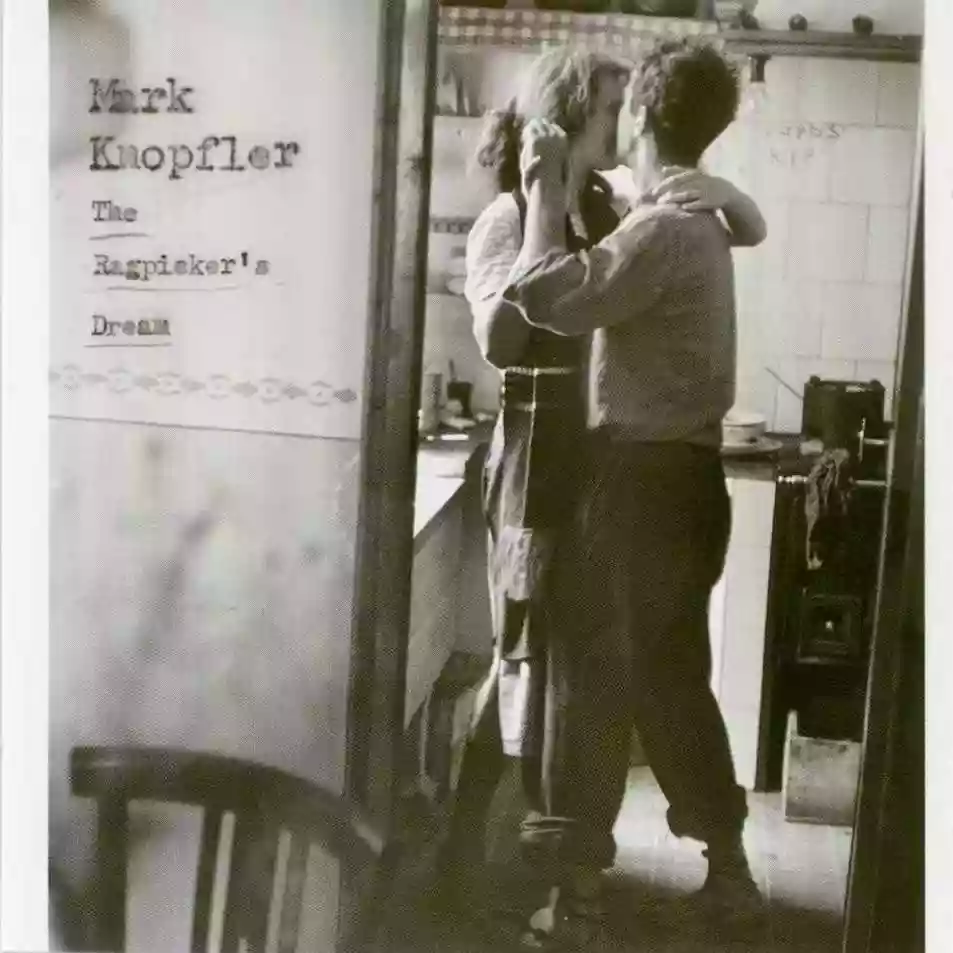
With "The Ragpicker's Dream," the eclectic guitarist creates what, in a chronological sense, can be considered as the simplest and moderately electric record he has released. If "What It Is" with a direct Straits-sound represented an easy gateway to STP, for this latest effort, the challenging task of leading off is left to the exquisite folk of "Why Aye Man" (meaning: well, of course), which becomes live as captivating as few others. "Devil Baby" is tasked with presenting a track with a perfect electro/acoustic combination where pedal steel, bouzouki, and violin help put into notes a challenging text about the television exploitation of human eccentricities in reality shows ("See the pig-faced man and the monkey girl - Come see the big fat lady - 'Gator slim with the alligator skin - Come see the devil baby"). With "Hill Farmer's Blues" introduced by an elegant caress to the instrument reminiscent of the immortal "Brothers In Arms," it is the intoxicating Knopfler narration that draws the listener into that limbo of auditory pleasure, where verse and chorus blend perfectly with evocative simplicity. The sober "A Place Where We Used To Live" guides us with its calm rhythm into a subdued atmosphere, where the flexibility of the notes of a quiet piano can lead to the analysis of a text with autobiographical tones ("Now in another town - You lead another life - And now upstairs and down - you're someone else's wife - Here in the dust - There's hot trace of us - Everything is gone - But my heart is hanging on").
Is there perhaps a desire to cut with the past? No, Knopfler has no intention of severing ties with his past. This is a resolutely Knopflerian record where old loves are focused on. It is indeed so, both with the (longer) "Fare Thee Well Northumberland" which combines American tradition vibrations with English folk resonances adorned by a melody of bygone times, and by listening to the tender title track, where poetry and music convey an inner well-being to those who can enjoy the genuineness of an essential song format. Greater appreciation will require a few more listens for the profound "You Don't Know You're Born" and the invocations of "Marbletown," while the bluegrass of "Daddy's Gone To Knoxville" (born thinking of Chet Atkins' stories of when he traveled the country far and wide) leads us by the hand to "Old Pigweed" whose delightful delicacy makes it a perfect concluding gem.
Mark Knopfler has never liked half measures, not when he was strongly "under pressure" (... so to speak), nor since the cover of the records started to simply feature his name. This is a record where the path the artist has taken presents no parallel lanes—it's simply one-way, a one-way consisting of reliable, integral, and authentic music, whose bulbs find in the traditional American and English lands, the right sap to revitalize and take shape again. Nowadays, we are more snobbish; this music we call "roots music," in the sixties it was simply pronounced folk, but perhaps to give the proper recognition to this work, it would be enough to simply rely on a moving declaration from the artist:
"I imagine paradise as a place where folk music meets blues music."
[For those who have made Knopflerian fetishism a mission of their existence, know that there is a "limited version" of the album that includes a second live CD, with unmissable versions of the tracks listed below: "Why Aye Man," "Quality Shoe," "Sailing To Philadelphia" and "Brothers In Arms," plus the live video of "Why Aye Man" recorded at Shepherds Bush Empire in 2002.]
Loading comments slowly
Summary by Bot
The review highlights Mark Knopfler’s album The Ragpicker’s Dream as a beautifully crafted blend of folk, blues, and country. The record showcases Knopfler’s artistic maturity and his dedication to roots music, with intimate storytelling and rich instrumentation. Noted for its moderate electric sound, the album balances tender acoustic moments with evocative narratives. It’s praised for authenticity and depth, appealing strongly to fans of traditional and Americana influenced music.
Mark Knopfler
Scottish guitarist, singer-songwriter and composer; founder and leader of Dire Straits and later a solo artist and soundtrack composer.31 Reviews
Other reviews
By BORNTORUN1976
"The RPD did the opposite of what 'Sailing To Philadelphia' had done, that is, it grew over time with each listen."
"If we want, perhaps it is Knopfler’s most melancholic album but certainly not the least beautiful for that reason!"
