
 •
Rating:
•
Rating:
THE REVIEW
Nobody thought: "if I die"; but everyone felt an anguish that oppressed and we all thought: "how many kilometers will it take to get home?"
The anguish of common men, some teachers, some carpenters, some accountants, first and foremost men, who had seen the Duce only painted in photographs. 230,000 men, of whom less than twenty thousand returned home. That incessant thought of home. "Sergentemagiù ghe rivarem a baita?" (Sergeant Major, will we make it home?): a question that becomes an obsession and brands the desperate fugitives. Some had already been sent to Ethiopia, Spain, Albania, or Greece. Tired of the war, tired of Italy. That Italy which was still the only place they could define as home, so distant and remote. Unthinkable that by the will of a single man, so many had to perish.
Because the Italians engaged in this absurd military operation had to suffer the torments of a white and endless hell, icy and cruel, so far from their daily reality, just as the previous generation had to endure in the trenches on the Carso and at Caporetto. Even on the Don they had to suffer the tragic life of trenches, with scabies and lice, with disgusting rations and the meager quarter of a liter of wine at Christmas, which seemed like a gift from Heaven to them. For what? For a war that none of them wanted and that they all had to passively endure.
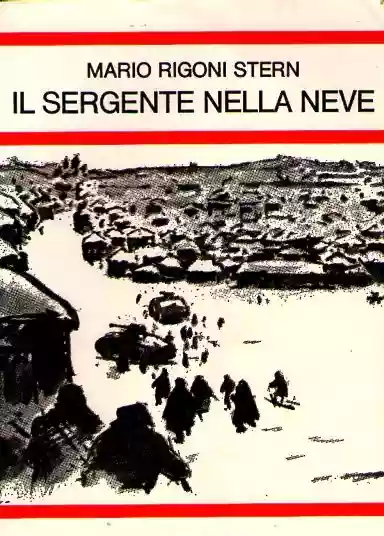
From this hell, Mario Rigoni Stern returned and made his literary debut by recounting this venture accomplished on foot along with a few thousand desperate and scattered men. The novel begins right in the middle of the action, in the trenches, without introductions or lengthy prologues: there was war, period. The why and the how do not matter.
Rigoni Stern acknowledges the Russians' right to defend their own and manages to understand the enemy, cornered by invaders. He empathizes with the Soviets. But at the same time narrates his own drama, in which it is evident that in war, two opposing sides are two faces of the same coin. No winner, no loser. Then Stalingrad, of which he can only discern the glows that light up the sky at night, and that the alpini glimpse faintly on the horizon. And then the surrounded front of the alpini, the 17-day march, the Tridentina division breaking the encirclement, a breakthrough dictated not by valor or heroism, but by pure desperation, and finally the long return home, the constant thought of reuniting with loved ones, defying dukes, führers, fascisms, national socialisms, and other similar abominations. January 26, 1943, in Nikolaevka. That cursed Nikolaevka with 40 degrees below zero, where almost all the comrades he befriended perish. The exhausting march in the cold of the steppe, among the small villages. Above all, the great difference between Italians and Germans emerges in their attitude towards the poor Russian peasants, machine-gunned by the Nazis, while the alpini politely said "Spaziba" to those who offered them a piece of bread. "Italians, good people," for better or worse. Chilling.
Rigoni Stern tells it all with incredible naturalness, in a dialectal style, as if he were recounting everything by the fireplace in his hut. A dramatic autobiographical passage that represented a burden on the heart of the author, at least until the moment of publication.
A great point for reflection, in my humble opinion: let us realize what kind of golden times we live in now, caught up as we are in luxury problems, while these people were forced to eat potato skins in the ashes of an abandoned izba. Let's think of the more than 180,000 men who never embraced their families again and who fell on the cold Russian soil, forever.
"We, band of ragged men. Tattered, dirty, long bearded, many without shoes, frozen, wounded."
Loading comments slowly
Summary by Bot
This review praises Mario Rigoni Stern's poignant memoir recounting the harrowing retreat of Italian soldiers from the Russian front during World War II. It highlights the human struggles, brutal conditions, and the relentless hope for home amid desperate circumstances. The narrative is appreciated for its natural style and powerful emotional impact. The reviewer reflects on the value of peace today contrasted with the sacrifices endured by soldiers.
Mario Rigoni Stern
Italian author (1921–2008) from Asiago, known for memoirs about his WWII experience as an Alpini and for writings on mountain life.02 Reviews
