
 •
Rating:
•
Rating:
THE REVIEW
In the 1960s, Marianne Faithfull was the girl of the Stones. In those days of excess and drugs, she rolled from one "stone" to another, and her most tumultuous relationship was with the head honcho, Jagger. Some time after Brian Jones's death, she swallowed a few hundred tranquilizer tablets and for six days took a peek into the afterlife before awakening from the coma. Funny for a girl whose surname is "full of faith" and yet feels the need to self-destruct.
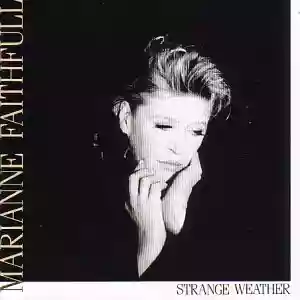
Her limbo lasted for nine years when she decided to get back in the game with a couple of good albums, including the rightly celebrated "Broken English". When in 1985 the never too praised producer Hal Willner called upon a group of great artists for a tribute album to Kurt Weill's music, he was struck by the version of "Ballad of Soldier's Wife" delivered by Marianne with the flair of a German cabaret singer à la Marlene Dietrich. So he decided to produce an album of hers infused with this atmosphere and in 1987 the extraordinary "Strange Weather" was ready, taking its title from a song written specifically by Tom Waits and his wife. Her voice is like a female Waits, even darker than before, hoarsened by a troubled life, in one word: fascinating.
Just as, indeed, the songs chosen for the album are full of charm. Some old classic from the 1930s gathering dust on the shelves of memory like "Boulevard of Broken Dreams" and "Penthouse Serenade"; a beautiful version imbued with melancholy of the song "Yesterday" by Jerome Kern, made unforgettable by Billie Holiday; an intense blues (Ain't Goin' Down to the Well No Mo') sung a cappella derived from Alan Lomax's recordings of the great Leadbelly; a gospel (Sign of Judgement) made bare by the piano and Marianne's drunken voice; the title track (Waits himself will later record it in his "Big Time") that is a poignant ballad rich with those bohemian atmospheres typical of Willner's productions; an old blues like "Love, Life and Money" crafted in 1957 for the young voice of Little Willie John and still redolent of smoky venues where the love for life costs a quarter of a dollar; the beautiful liquid opening of the guitar for a minor ballad by Bob Dylan (I'll Keep It with Mine) which was also chosen by Nico for her first solo album; an unreleased track (Hello Stranger) by Doc Pomus and Dr. John with a soft jazz sound that highlights Marianne's interpretative abilities but perhaps not in tune with the rest of the album.
In the end, an intense version of "As Tears Go By" by Jagger/Richards, which had already appeared on Faithfull's debut album way back in 1965! It's just like someone tore out a piece of heart to place it in the palm of your hand, closing your fingers around that shred of life offered in sincerity.
If ever sadness and beauty had a common sound, it would certainly be that of "Strange Weather".
Loading comments slowly
Summary by Bot
Strange Weather showcases Marianne Faithfull’s deeply transformed voice, darkened by years of hardship, in a blend of blues, jazz, and cabaret. Produced by Hal Willner, the album features striking covers and an original title track by Tom Waits. The music captures a melancholic yet captivating atmosphere, with Faithfull’s evocative performance at its core. This record is a haunting exploration of sadness and beauty in music.Tracklist Lyrics
01 Stranger Intro (00:32)
02 Boulevard of Broken Dreams (03:06)
03 Ain' Goin' Down to the Well No Mo' (01:11)
04 Yesterdays (05:21)
05 Sign of Judgement (02:54)
07 Love, Life and Money (04:08)
08 I'll Keep It With Mine (03:48)
10 Penthouse Serenade (When We're Alone) (02:37)
12 A Stranger on Earth (03:48)
Marianne Faithfull
British singer and actress who emerged in the 1960s with As Tears Go By, later reinventing herself with the stark, influential Broken English (1979). She explored cabaret, blues, and literate pop on albums like Strange Weather (1987) and returned to acclaim with Negative Capability (2018). Co-writer of Sister Morphine and a noted film/stage performer.08 Reviews
