
 •
Rating:
•
Rating:
THE REVIEW
In the whirlwind of more or less legendary artists who have passed over the decades, it's normal for someone to be left behind, forgotten by the masses of listeners. However, it is amusing that it is always the great artists, those with the greatest sensitivity, who become "niche". It is a pity because certain albums would bring great pleasure to many people, but it always ends up being just a few who discuss them.
This is the case with Marianne Faithfull, remembered more for a fateful Mars bar than for her exceptional talents as a performer. One can easily divide Ms. Faithfull's career into two distinct and defined parts: one clean and straightforward, filled with beautiful covers and led by a crystalline and childlike voice; the other filled with many liaisons dangereuses, heroin addiction, suicide attempts, but above all, beautiful songs interpreted with a new voice. The new voice of Marianne Faithfull is one of experience, of innocence fleeing chased by cocaine stripes and cigarette butts.
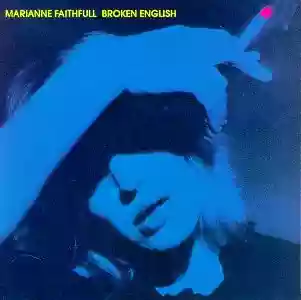
In 1979, "Broken English" was released, an undisputed masterpiece by Marianne Faithfull. Those who followed this artist at that time surely raised their eyebrows at the cover: a completely blue-saturated photo portraying her in an almost bored and depressed attitude, careless; the only point of color in this sea of blue is the ember of a cigarette lazily held between her fingers. The album starts with the title track: Cold War scenarios and obsessive rhythm transport us to lands where English, German, and Russian blend. The hoarse and tarry voice breaks often, adding expressiveness and uncertainty. It is followed by three gems: "Witches' Song", "Brain Drain", and "Guilt", where the album's sound direction becomes clear, oriented towards a perfect fusion of Punk's anger, Reggae's rhythm, and New Wave innovations. Then stands out "The Ballad of Lucy Jordan", where we confront the shattered dreams of a woman, oppressed by family routine and pervaded by a longing desire to escape. "Working Class Hero", a John Lennon standard, lives a second life reinterpreted by Marianne Faithfull, who transforms it into a sincerely indignant piece splashed with a rock sound. The album (short, with only 8 tracks) concludes with what I consider the best and most representative piece of this Faithfull period: "Why'd Ya Do It". Marianne Faithfull here indulges in all kinds of profanity: explicit sexual references and stevedore curses follow one another for almost 6 minutes, telling a story of obsessive jealousy and grave betrayal by a man ("Why'd ya do it, she screamed, after all we've said / Every time I see your dick I see her cunt in my bed"). The anger is palpable and compelling, Faithfull's j'accuse is powerful and oddly liberating even for those who listen. Anyone who should experience betrayal by their partner can easily memorize some verses of this song and then spit them in the face of the adulterer: it would make a splendid impression!
Anyone who considers themselves a music enthusiast cannot miss this album, if only for Marianne Faithfull's importance in the '60s as a muse of the Rolling Stones (Sister Morphine who do you think wrote it?) and as a friend of the Fab Four. Ms. Faithfull is an artist from another time, one of those who were not afraid to be seen disheveled or with dirty nails. Completely alien to any divaism, she never cared about presenting herself as a model of righteousness. For her, no glittering and winking songs, just so much decay and depravity. No bare breasts and seductive dances, just a cigarette, a microphone, and vocal cords hot as asphalt in August. "Broken English" is one of the many unrecognized and buried milestones waiting for the listener-archaeologist to come and dust it off.
Loading comments slowly
Summary by Bot
This review praises Marianne Faithfull's 1979 album Broken English as a groundbreaking fusion of punk, reggae, and new wave. It highlights her transformed voice, raw emotional expression, and the album's powerful storytelling, particularly in tracks like "Why’d Ya Do It". The album is described as an underappreciated milestone, essential for music enthusiasts and fans of ’70s rock and punk.Tracklist Lyrics Videos
Marianne Faithfull
British singer and actress who emerged in the 1960s with As Tears Go By, later reinventing herself with the stark, influential Broken English (1979). She explored cabaret, blues, and literate pop on albums like Strange Weather (1987) and returned to acclaim with Negative Capability (2018). Co-writer of Sister Morphine and a noted film/stage performer.08 Reviews
Other reviews
By luludia
"Suffering has forged it and now it is sharp as a sword, harsh as a sentence, and hoarse as a cough from Mary the coquettish."
"Danger is a great joy and darkness is bright as fire — only someone like Marianne could sing it."
By DBMsonic1
Marianne Faithfull’s 'Broken English' is one of those rare records that marks a true, bold turning point.
Faithfull pours raw emotion into each track, making the album an unforgettable listening experience.
