
 •
Rating:
•
Rating:
THE REVIEW
Marduk, having entered a new artistic era as orphans of singer Legion, return with a new work that, in my opinion, what it gains in production, it loses in quality.
The new singer, with the emblematic name of Mortuus (former Funeral Mist and Triumphator), is light years away from Legion's characteristic voice, which doesn't mean it's a good thing.. on the contrary, it makes one miss him, and a lot as well.
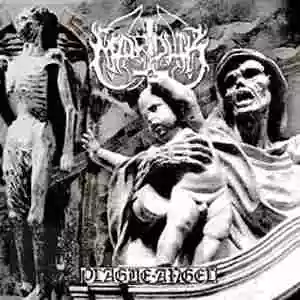
Thus, in my hands, their new work, with a beautiful cover and titled "Plague Angel," which also presents some significant innovations that, on the first listen (but also on the second and third, and so on), left me very perplexed. If comparisons with the band's past had to be made, we could say it presents small elements from the band's past, like "Panzer Division Marduk" or "La Grande Danse Macabre," definitions to be taken with a grain of salt because, indeed, the album stands far from the glories of its predecessors. However, the analogies, in terms of sonic power and speed, are all there: the first two tracks "The Hangman of Prague" and "Throne of Rats" are of truly remarkable speed and power. But the rhythms slow down with "Seven Angels, Seven Trumpets," being an almost atmospheric and evocative piece.
"Life's Emblem" returns to accelerate in an appropriate and also good manner, like the following "Steel Inferno," only to fall into cadences that feel obsessive and repetitive with "Perish in Flames." So far there's little room for melody, but it's worth noting the finally good production, with sounds and instruments being heard in a clear manner. Violence returns forcefully with "Holy Blood, Holy Grail" and "Warschau." So far the album has really offered nothing new: the sensation of "already heard" is present in every song, and as mentioned in the introduction, comparisons with the past abound. "Deathmarch" breaks the aggressive atmosphere to give us a doom track, dominated by orchestrations and filtered voices full of echoes. No guitar, drums, or bass, just screams and wails. The only successful experiment on the album, because it returns to monotony with "Everything Bleeds" and "Blutrache."
The previous "World Funeral" was certainly a good black album: besides being well-played, it presented successful experiments, but this "Plague Angel" is monotonous, devoid of real ideas, and above all, it seems like a copy and paste of old tracks. I find it almost useless as an album, if it weren't for the fact that the production is finally done as it should be.
For die-hard fans.
Loading comments slowly
Summary by Bot
Marduk's Plague Angel album features a new vocalist, Mortuus, whose style differs significantly from his predecessor Legion, disappointing longtime fans. Although the album boasts improved production and moments of impressive speed and power, it falls into monotony with repetitive rhythms and lacks innovation. Some experimentation is present, notably in the doom-inspired 'Deathmarch,' but overall, the album feels like a less inspired copy of earlier works. Recommended mainly for die-hard fans.Tracklist Lyrics Videos
Marduk
Marduk are a Swedish black metal band formed in 1990 in Norrköping by guitarist Morgan Steinmeyer Håkansson. Known for relentless speed, blasphemous themes and martial aesthetics, they became a cornerstone of the Swedish scene with albums such as Those of the Unlight, Opus Nocturne, Nightwing and Panzer Division Marduk. Vocalists have included Legion (1995–2003) and Mortuus (2004–present); later albums include Frontschwein (2015), Viktoria (2018) and Memento Mori (2023).09 Reviews
