
 •
Rating:
•
Rating: THE REVIEW
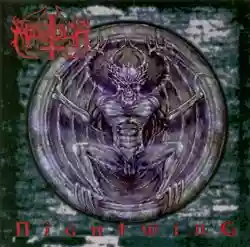
With this album, the Swedes Marduk want to pay homage to the great Bathory (founding father of black metal) and one of his most important albums, namely "Blood, Fire Death," by following a well-defined trilogy made up of albums.
The first is the bloody "Nightwing," the second the devastating "Panzer Division Marduk," and finally the funereal "La Grande Danse Macabre." With this review, I want to focus on "Nightwing," the first of the trilogy. First of all (for those who don't know), let's start by saying that Marduk plays Swedish-style black metal, which means it's extremely fast, very violent, and without compromise, with strongly blasphemous and anti-Christian lyrics.
A noteworthy factor is that this album is divided into two parts. The first five tracks are totally inspired by the malign. It starts with "Dictionnaire Infernal," a brief instrumental intro that seems to herald the beginning of a storm, namely "Bloodtide xxx," the second track, which is extremely fast with blast-beat drumming by Fredrik Andersson, powerful and captivating riffs, and Legion's agonizing and irreverent screaming. The lyrics speak of adepts gathering in a dark forest to invoke ancient pagan deities under the watchful eye of Satan. The piece changes towards the end with pressing rhythms to launch into "Of Hell’s Fire." A violent song with turbulent and damnably disharmonious riffs; the central part of this track is devastating and, of course, the lyrics speak of total devotion to Satan. The text states: "Thou The arcangel who fell from the heavenly empire, Thou the hand that wound with evil and unholy desire, Thou the black lord of the un light in which we all belong, From the deepest part of gehenna tormented souls sings damnations song". The fourth track, titled "Slay the Nazarene," as the title suggests, is extremely and unreasonably blasphemous to the point of being unimaginable. The first part concludes with the title track "Nightwing," which starts slow and drawn out before exploding into a brutal blast-beat accompanied by a melodic and malicious riff that extends throughout the piece.
The second part of the album opens with a slow and sinuous guitar riff by Morgan that catapults us into 15th century Romania at the court of Vlad III Tepes Dracul, at the beginning of his career as king and heinous murderer, when he and his brother Radu (who will soon become the favored lover of the sultan) are left as "guarantees" of loyalty to the Turks by their father Vlad II. The musical aspect of this piece is complex, the slowest, heaviest, and darkest, almost highlighting the feelings of hatred that grew in young Dracula's mind following the death of his father and brother Mircea. The next piece is "Dracole Wayda," which blends perfectly with the last notes of the previous song. The strongly cadenced rhythm and bloody riffs accompany Vlad Tepes's ascent and his desires for power. Loved by his compatriots for defeating the Turks of Mohammed the Second and those who threatened his country, he committed what we see as terrible crimes that our sensitive and modern minds rebel against. He was also known by the name Tepes, which in Romanian means "impaler." Impalement was a form of torture/execution that involved inserting a sharp, usually honey-greased stake into the rectum of the condemned and then slowly and gently pushing it through the mouth or shoulder blade, scrupulously avoiding damaging vital organs. The luckiest died immediately (the usual lucky ones!), while for some, the agony could last for days. When Mohammed the Second was defeated by Dracul, he was made to pass between two rows of twenty-five thousand impaled Turks and Bulgarians. Vlad Tepes had a real passion for impalement, although his imagination also delighted in other gruesomeness. Vlad was used to attending all the tortures he devised and often organized open-air banquets during which some condemned were impaled to entertain his meal and that of the disgusted diners (a bit like a piano bar today). This is the theme of the track "Kaziklu Bay the Lord Impaler" and the subsequent "Deme Quaden Thyrane," the first a cruel song with a furious assault of drums, scratching guitars, and agonizing screams, the second with a more melancholic and arpeggiated riff, the lyrics speak of capture and subsequent trial for damnation. The concluding track is "Anno domini 1476," where a military-rhythm drum and a saturated-sounding guitar presage the end of the reign of terror with the death of Count Vlad. The piece concludes with an almost lyrical part and with the rhythm of a sinister and melancholy Mazurka.
A decidedly important album for the history of black metal, especially for its compositional variety.
Loading comments slowly
Summary by Bot
Marduk's Nightwing album serves as the first part of a trilogy paying homage to Bathory's Blood, Fire Death. Characterized by fast blast beats, aggressive riffs, and blasphemous lyrics, it is divided into two parts: the dark evil-inspired opening tracks and the Vlad Tepes-themed historical journey. The album is praised for its musical complexity and strong thematic cohesion, making it a landmark in black metal history.Tracklist Lyrics Videos
Marduk
Marduk are a Swedish black metal band formed in 1990 in Norrköping by guitarist Morgan Steinmeyer Håkansson. Known for relentless speed, blasphemous themes and martial aesthetics, they became a cornerstone of the Swedish scene with albums such as Those of the Unlight, Opus Nocturne, Nightwing and Panzer Division Marduk. Vocalists have included Legion (1995–2003) and Mortuus (2004–present); later albums include Frontschwein (2015), Viktoria (2018) and Memento Mori (2023).09 Reviews
