 •
Rating:
•
Rating:
THE REVIEW
After four Saturday nights spent watching him play the same pieces (sorry, again, this obsessive alliteration) I decided that I like him. He is one of those great people you have under your house, whom you can see whenever you want, available, open, but above all, communicative.
Marco Zurzolo (alto sax), "fratello d'arte" (Rino Zurzolo is a well-known double bassist, Francesca Zurzolo sings in the Ensemble Vocale di Napoli) has been playing for a long time, he has played with Pino Daniele, Zucchero, Chet Baker, more recently with Solomon Burkes, and opened Van Morrison's last UK tour... But this album is a bit different, both stylistically (evidenced by the different lineup compared to previous records) and in its success and recognition from the press.
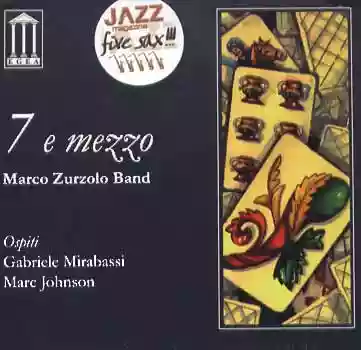
Recorded in September 2004, the music of "7 e mezzo" has a very strong impact, full sounds, and sinuous melodies; now lively, now more lyrical, or "romantic," as he likes to define them. A composite ensemble (in addition to various winds, also a cello and even an oud, an Arabic lute) integrates perfectly, playing now on rhythmic interlocks, now on third overlays, or both, to create real gems like the opening "Torno a Sud" (the very first notes are played by Erasmo Petringa's oud) or the cadenced 3/4 of "E Duje Piscature", with two fascinating intertwined motifs alternated by almost abrupt breaks, or again "Napoletana a Coppe" (the name of the combination of ace, two, and three of cups), which I prefer: initially disorienting and hypnotic rhythm and melody, then more linear, then back to as before...
Zurzolo and his cohorts' melodic lines capture you, they flit in front of you to be chased and understood, but they never let themselves be predicted, always unpredictable but, most importantly, of noble beauty (far from the sober even in the ballad "Sofia"), of a courteous vigor... which becomes a bit more impolite truthfully, in pieces like "Cinque e un po'", or "E Sto Bbene" (an expression to indicate that no more cards are needed), the title track in which the tangle of winds has something orgiastic, of shimmering, elusive vitality.
The metaphor of the game holds a precise meaning for Zurzolo, it is the metaphor of a hectic life in which what are commonly understood as shared goals polarize one's existence, functioning like blinders: preventing you from appreciating the journey, but straight to seven and a half, with the anxiety of making mistakes but with only that in mind. In the refusal of all this lies Marco's warm and hedonistic Neapolitanness, which also includes in this recording his wife (Gabriella Grossi - his former student) on the baritone sax and their little one, who performs a vocalize-cry in "Sofia" (which is actually a lullaby, Zurzolo's last resort in his role as an "inexperienced father").
Vucumprà?
Loading comments slowly
Summary by Bot
After repeated live encounters, the reviewer grows to appreciate Marco Zurzolo’s approachable and communicative style. His album '7 e mezzo' features lively and lyrical jazz with a unique blend of instruments like oud and cello. The music captures unpredictable beauty and energetic rhythms, evoking the warmth of Neapolitan culture and a metaphorical take on life’s hectic pace. Personal touches, including contributions from his family, add emotional depth.Tracklist
Marco Zurzolo Band
Marco Zurzolo is an Italian alto saxophonist and bandleader (Marco Zurzolo Band). The review for the album 7 e mezzo (recorded September 2004) highlights his melodic, communicative style and the ensemble's varied instrumentation.01 Reviews
