
 •
Rating:
•
Rating:
THE REVIEW
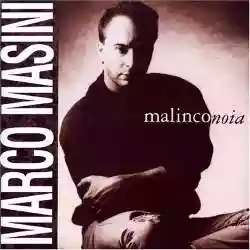
Browsing through albums that were either unreviewed or reviewed in a more or less "peculiar" manner, I noticed that there was a lack of a semi-serious review for what can arguably be considered the most beautiful album by the Florentine artist in terms of musical completeness and the themes addressed in the lyrics.
The album opens with the song performed at Sanremo 1991 (final third place) which definitively established him among the best Italian singers of the time: Perchè lo fai addresses, like much of Masini's songs from that period and especially from that album, themes that were always little considered until that time in a country where the (not so) noble art of hypocrisy reigns and where to be considered good artists one had to sing songs like "Tiamomimanchitutututututu".
It is followed by Il niente, the longest song on the album (over six minutes), in which Masini unleashes all his grit and anger towards a world based "on nothing" indeed, moving from one moment to another in a person's life, with numerous autobiographical insights (And I meet my mother who has been dead for a year, with the usual big sorrowful smile she says "it'll pass," she says "endure, you have to learn to love even the nothingness")
It continues with one of the most well-known tracks even today (on which a short film was also made, sponsored by Masini himself): Cenerentola innamorata, the story of a girl who became pregnant and was left alone, who decides, thanks also to the help of people dear to her, to keep the baby. Here too, a theme addressed, in the most bigoted country in the world, before him only by Guccini in Piccola storia ignobile, contained in the album Via Paolo Fabbri 43 from 1976, with the substantial difference that the happy ending that is present in Masini's song is not present in Guccini's (despite some still enjoying promoting the idea that Masini is a sad-sack depressive, when, objectively analyzing his lyrics, it can be noted that often, despite the bitter taste of the stories he sings, a happy ending is often present at the end of the song). Of completely different flavor is the fourth track: in Chi fa da sè Masini explains that everything can be achieved simply by relying on oneself, except for feelings, because those cannot live alone.
Then comes the title track, Malinconoia, a word born from the union of the terms "Melancholy" and "Paranoia," a heartbreaking but incredibly and terribly truthful text, a piece very close to the Blues in a crescendo that highlights Masini's vocal (and also piano) skills
The album then takes a completely different turn with Fuori di qui, where a man who is repeatedly betrayed initially decides to react and kick the unfaithful one out (Out of here, with that magnificent bottom of yours, looks like a heart you know, you who have no heart) only to then surrender to the too strong temptation of having her with him, accepting, once again, the continuous betrayals, a very catchy and therefore also appreciable and understandable song on the first listen (something that often doesn't happen in Masini's songs).
Then comes what can be considered the only love song of the album (Fuori di qui, although having a love story in the background, ends up focusing on human weakness and the inability to react to wrongs suffered): Ti vorrei, a song that recounts love and infatuation in all its simplicity, funny and catchy, still known and sung live today (like many tracks from this album) by the Tuscan artist.
The album closes with two more strong lyrics, Il giorno dei perdenti is the simple but truthful account of the wandering of society in the daily routine, followed by, to close the album, La voglia di morire, a piece essentially divided into three parts, where the theme of depression is addressed with references also to anorexia (If the fork goes back up but with no food because it knows your mouth cannot handle it), in which a young man suffering from this terrible illness (If you feel all these "if" inside you, you feel like dying) nearly reaches the point of no return, only to react (With all these "but" you'll see you'll get over the desire to die), and thanks to love, often seen by Masini as the only thing capable of giving true happiness to man, he manages to overcome it (But if one day you meet her who invades your eyes and you don't know what to say, there will be no "but," love will kill the desire to die)
Perhaps the most beautiful album by the Tuscan singer-songwriter (though it's hard to choose among the first four of his career), certainly the one most focused on social themes, with the only flaw: the presence of only one real love song, which in today's musical world would make it unsellable in a market populated by commercial music (and not even of quality anymore, as until the '80s even "Easy" music in Italy still had its charm, charm that, thanks to De Filippi's "talents" and the record companies of Zerbi&Co., seems to have totally disappeared)
Loading comments slowly
Summary by Bot
This review praises Marco Masini's album Malinconoia as his most musically complete work, rich in deep social and emotional themes. It highlights key tracks that focus on realistic life stories and mental health. The review appreciates Masini's mature songwriting and ability to balance harsh realities with hope. Though containing mostly social issues, the album's one real love song remains memorable. Overall, Malinconoia is considered a timeless and important Italian album.Tracklist Lyrics Videos
Marco Masini
Marco Masini is an Italian (Tuscan/Florentine, per multiple reviews) singer-songwriter associated with early-1990s success, emotionally charged lyrics, and recurring public talk about him “bringing bad luck.” Reviews cite major career moments including Sanremo appearances and a 2004 Sanremo win with “L’uomo volante,” plus a stylistic shift with the 1998 album “Scimmie.”19 Reviews
Other reviews
By Saltuario
If he made me sleep, he was good, because you can’t sleep with a dog in your ears.
Then I thought that if my mom met Masini, he would tell her she was the little Cinderella in love and instead of leaving me by the dumpster she would keep me with her and my grandparents.
