
 •
Rating:
•
Rating:
THE REVIEW
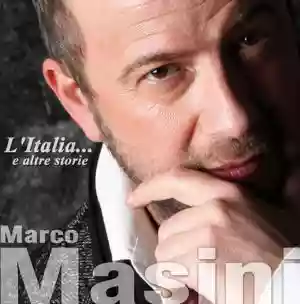
Well aware of the fact that the DeBaser crowd does not particularly appreciate this artist, I have decided to embark on this risky adventure by reviewing the latest work of the Tuscan singer-songwriter Marco Masini, titled "L'Italia... e altre storie."
Masini's ninth album of original songs comes four years after "Il giardino delle api," an album that is perhaps too relaxed albeit lyrically appreciable. The album opens with the Sanremo track "L'Italia," a love-hate declaration towards one's country. Musically well-executed, but from a literary point of view, it is too filled with clichés. Surely this coincides with the fact that it was brought to the Ariston stage, and thus, it wouldn’t have been allowed to overdo it. A bit like what happened last year to rapper Frankie Hi NRG, who with "Rivoluzione" criticized the Italian political system but did not make much of an impact. This is followed by the beautiful "No professore!" Here we are faced with the classic angry Masini. He targets the teachers responsible for educating children, whose old-fashioned and uninterested methods will bring no advantages to the youth. Next is "L'ultimo giro di giostra," a beautiful ballad that tells the story of a love that has come to an end.
"Gli anni che non hai" is an interesting track because the lyrics were written by Giorgio Faletti. In fact, the style of the actor (and recently writer) is recognizable. And now, here’s what I find the surprise of the album: "Com'è bella la vita." It is rare to hear a Masini so cheerful and carefree. It is a song that brings joy and disenchantment, thanks to the use of trumpets and accordion that make up a truly well-orchestrated soundscape. I recommend everyone listen to this song, even Masini's detractors, because, I repeat, it is a surprise. The sixth track is "Lontano dai tuoi angeli," and it is the most beautiful ballad on the album. Very sweet music and one of the most successful lyrics of the album. "Fortuna" is also a cheerful song, supported by a good rhythm. It is one of the catchiest episodes of the album, in which the singer-songwriter displays his vocal talents quite impressively in the chorus. The last three songs "Beato te," "Un po'," and "Binario 36" slip away without leaving particular marks. The first stands out for its lyrics that offer a pessimistic view of a boy’s future, while the second is a musically well-executed ballad but nothing more.
You should know that I was a big fan of Masini in 2000-2001. Then over time, I slightly set him aside, but I still find every one of his releases interesting. And this album was a pleasant surprise for me. It pleases me to see that it is one of the best-selling albums to come out of Sanremo. If you are fans of Masini, you will not be disappointed, if you don’t particularly love him, then you can do without listening to it, although I recommend listening to the tracks that diverge a bit from his usual style, like "Com’è bella la vita," because you might find it interesting.
Until next time....
Loading comments slowly
Summary by Bot
The review offers a detailed look at Marco Masini's ninth album, appreciating its musical execution and some lyrical moments while noting occasional clichés. Standout tracks include 'Com’è bella la vita' for its cheerful sound and 'Lontano dai tuoi angeli' as a beautiful ballad. Though some songs are less memorable, fans of Masini will find the album rewarding.Tracklist
Marco Masini
Marco Masini is an Italian (Tuscan/Florentine, per multiple reviews) singer-songwriter associated with early-1990s success, emotionally charged lyrics, and recurring public talk about him “bringing bad luck.” Reviews cite major career moments including Sanremo appearances and a 2004 Sanremo win with “L’uomo volante,” plus a stylistic shift with the 1998 album “Scimmie.”19 Reviews
