
 •
Rating:
•
Rating:
THE REVIEW
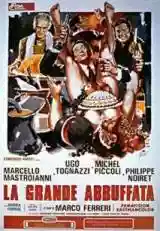
This film is an Italian-French production from 1973, directed by filmmaker Marco Ferreri.
MAIN ACTORS: Ugo Tognazzi, Marcello Mastroianni, Michel Piccoli, Philippe Noiret, Andréa Ferréol.
BRIEF PLOT OVERVIEW: Ugo, Marcello, Michel, Philippe (N.B. the names are the same as the actors) gather in a villa to indulge in the pleasures of the palate and the flesh, aided by the elementary school teacher Andréa*. The film ends with the death of the four male characters.
This is a film that is bitter and paradoxical: food, normally a source of life, here becomes a tool of death. Similarly, the desire of the four characters to escape is realized by enclosing themselves in a villa, an island, or rather a golden prison**. There are few contacts with the outside world (the encounter with the elementary school teacher), even the butcher delivers at home. In other words, the will to live of the protagonists, who leave their professions to indulge in debauchery, transforms into a slow and inexorable self-destruction. Another paradox: Ferréol, who accompanies the four towards death and caters to all their vices, is an elementary school teacher (and thus should educate), while the three prostitutes invited to the villa (who should satisfy the vices) refuse to participate in the pathological and abnormal binge and leave annoyed.
Ferreri shows us the characters in their corporeality. Nonetheless, the excesses to which Ugo, Marcello, Michel, and Philippe succumb stir in the viewer a sensation of unnaturalness, as well as disgust. It almost seems as if one can breathe an air of decay in this villa isolated from the rest of society.
The object, whatever it is, always prevails over the subject. Photographs, statues... everything is reduced to matter. Very likely a critique of the consumer and welfare society.
Significant is the death of Ugo (which for obvious reasons I will not reveal) at a moment that should be the peak of pleasure.
It is also a film strongly critical of the myths of the bourgeoisie: just think of the manic attachment Marcello feels towards the Bugatti or Michel who practices gymnastics exercises to grasp the "bourgeois spirit" hovering in the villa.
Marcello, the "successful man," empty and superficial (though he will be the only one to attempt rebellion against this sort of programmed suicide that unfolds over time); Ugo who devotes extreme meticulousness to the composition of gastronomic art pieces; Michel, a TV producer, obsessed with epiphenomena; Philippe, a judge, continuously tormented by useless feelings of guilt. These characters seem like caricatures, yet at the same time, they appear realistic to us, considering the many banalities and absurdities that characterize our social life.
In some ways chilling and unfortunately very relevant, a cynical and provocative look at man, a fist that awakens the conscience. ABSOLUTELY A MUST-SEE!
* I apologize, but I do not remember if that was her name in the film.
** N.B. Note well the contrast between escaping and prison.
Loading comments slowly
Summary by Bot
Marco Ferreri's 1973 film 'La Grande Abbuffata' explores themes of gluttony, self-destruction, and societal decay. The story follows four men retreating into hedonistic excess, which paradoxically leads to their deaths. Ferreri critiques consumerism and bourgeois values through vivid, unsettling imagery and characters. The film blends dark humor with a chilling exploration of human nature and social critique. It's regarded as a must-see for its provocative and timeless message.
Marco Ferreri
Italian film director and screenwriter (Milan, 1928 – Paris, 1997). After early work in Spain (El pisito, El cochecito), he became known for provocative, satirical films such as La grande abbuffata, Dillinger è morto, and La donna scimmia, often skewering consumerism, bourgeois rituals, and gender power plays.10 Reviews
