
 •
Rating:
•
Rating:
THE REVIEW
"If God exists... he hides in the eyes of a cow" (Manu Chao)
After the long wandering in every corner of the world, after wandering among colors, scents, rhythms, traditions, after carrying the flag of equality and cultural contamination, after being the musical emblem of the anti-globalization movement, after touring all the social centers and festivals of the world, Manu Chao has returned home, to Paris.
In Paris, among the shadowy alleys, where black cats meet beneath a streetlamp that no longer lights. In Paris, on the steps of Montmartre, chasing a light raincoat and two high-heeled shoes that click on the cobblestones. In Paris, inside a crowded bistro where everyone is shouting to be heard, in front of a steaming croque-madame. In Paris, along the Seine, browsing the stalls of used books, in search of an old photo album.
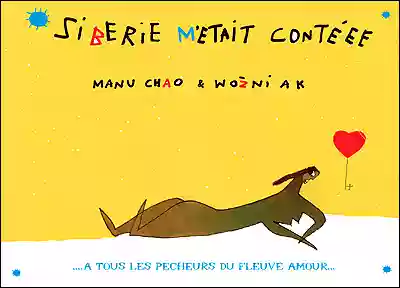
Manu Chao has found his city again, in the company of a friend, the Polish-Belgian illustrator Wozniak.
It all started like this: Manu's father (the Basque writer and journalist Ramon Chao), a hobbyist winemaker, showed his son the new label designed by Wozniak for a wine of his production. Thus was born this friendship that led Manu to open his secret drawers, where he kept hidden some unpublished compositions and scraps of music. Given to Wozniak, these pieces became drawings, many drawings.
Initially, the idea was to publish a booklet with some illustrations and a CD of four tracks, to be sold in the typical Parisian kiosks. A "romantic" idea then successfully realized. Then, considering the scope of Wozniak's work that Manu was reluctant to sacrifice, they decided on this Sibérie m'était contéee, a book+CD of 123 pages sold in bookstores, published in "only" 150,000 copies. I found it by pure luck, the only copy in the bookstore.
Sibérie m'était contéee includes a CD with 23 songs and is an hour and a half of music and readings, lost in the wonderful and delicate world that springs from Wozniak's pencil. A dream, a journey, this time not outside of France, but within its heart, Paris: here you do not find fast rhythms and Latin sounds, there are no bongos and maracas. No Spanish or any language other than French, that is, Parisian, the language sung by Brel and Gainsbourg, where hidden in its melodic and impertinent harmony lie pain and solitude.
A melancholic album, acoustic, with guitars and accordion, voices from a bistro, and some imperceptible digital tweaks. Guests include the trumpet of Roy Paci and the trombone of Rosario Patania in the song "Helno est mort," a heartfelt tribute to the unforgettable singer of Les Négresses Vertes.
Prostitutes and underworld, impossible loves, friends who leave, vagabonds, and the circus, children in the courtyard, 'les flics' in the alleys, stray dogs, Paristanbul, the women of Mali... Quand je te vois/ je me sens mieux/ Quand tu t'en vas/ Je me sent vieux... Manu tells us that "Love is the true Revolution," and he does so with his typical verve, but not as frantic as usual, rather calm, serene, flowing. Perhaps a bit naïve, but finally mature.
Manu recounts how this project developed: "We would meet and say to each other: let's go for a walk in Ménilmontant or around Père Lachaise... Wozniak drank his wine, I smoked my joint, and we found inspiration on the spot...".
The result is a splendid, perfect work, where the music warms the heart and the illustrations warm the soul. Unmissable for those who love Paris and its secrets hidden in the winter mist: an unmistakable gaze, full of affection and respect, that reveals the magic of a city with a universal spirit. A spirit that is candid, simple, yet terribly and mercilessly profound at the same time.
In this work, Manu Chao and Wozniak have put their hearts into it. It is visible and palpable.
Only for the fishermen of the River Love, on Siberian evenings, closed indoors, while outside everything is freezing.
(Siberie m'était contéee is not distributed in Italy. For those interested, it is available online)
Loading comments slowly
Summary by Bot
Manu Chao's 'Sibérie m'était contée' marks a calm, acoustic return from his world travels, focusing on Paris's intimate and melancholic atmosphere. Collaborating with illustrator Wozniak, the album is a delicate blend of music and art evocative of Parisian life. The work feels mature and heartfelt, featuring contributions from Roy Paci and Rosario Patania and containing songs in French alone. It is a unique cultural and emotional homage to the city’s undercurrents, love, and solitude.Tracklist Lyrics
01 Le P'tit Jardin (04:03)
02 100.00 Remords (03:29)
03 Trop Tot, Trop Tard (02:37)
06 Les Rues De L'Hiver (03:36)
07 Siberie Fleuve Amour (04:14)
08 Les Petites Planètes (04:12)
09 Te Souviens Tu (02:34)
10 J'Ai Besoin De La Lune (Remix) (02:27)
11 Dans Mon Jardin (05:33)
13 Merci Bonsoir (00:51)
14 Fou De Toi (02:26)
15 Les Yeux Turquoise (03:18)
16 Siberie (04:22)
17 La Valse A Sale Temps (03:41)
18 Les Mille Paillettes (04:05)
21 J'Ai Besoin De La Lune (02:46)
22 L'Automne Est Làs (02:57)
23 Si Loin De Toi ... Je Te Joue... (02:50)
Manu Chao
Manu Chao (born 1961 in Paris) is a French-Spanish singer-songwriter and former frontman of Mano Negra. His solo work blends reggae, ska, rumba, rock, and chanson, sung in multiple languages. Breakthrough albums include Clandestino (1998) and Próxima estación: Esperanza (2001).06 Reviews
