
 •
Rating:
•
Rating:
THE REVIEW
"Submission is a permanent suicide"
Manu Chao
Manu Chao is not (only) a slick operator, let me make this point.
Even before the album was released, he broke the rules of the music market and made the single Rainin paradize available for free on the internet.
After the events of the G8, he was unanimously consecrated to the pantheon of the "a-lot-of-left" crowd by hordes of long-haired, spaced-out, nu-no-global, fake-no-global types, etc., who flock to his concerts to partake in a tacit 'leftist' collective ritual.
And perhaps even beyond his intentions.
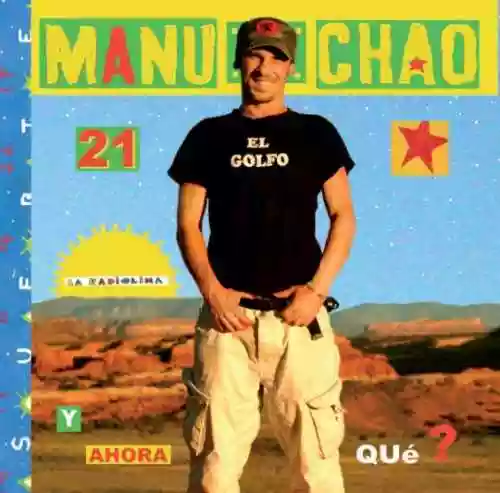
In the end, La Radiolina is a well-made album, slender in terms of creative impulses, despite the vibrant fusion of other genres like uptempo, rumba, rock, and ska. Many prefer to remember him in the previous lineup, as the eternal Mano Negra, for whom the current experience is nothing but a minor "how we were", a constant rehash of themes, and music. In short: with Proxima... estacion... esperanza, he had already overstepped the mark. And by a lot.
The flurry of small controversies and disappointed voices, as read in September's Mucchio Selvaggio, claiming that Manu Chao always makes the same two or three songs "even at the risk of becoming today's Inti Illimani," do not do justice to this latest album. In it, the presence of guitars and rock elements is more significant. Overall, it is an enjoyable record.
21 tracks, many of which are dedicated to themes dear to the genre: political commitment, social denunciation, a measure of self-promoting fellatio, which the multilingual Mr. Chao sings in Castilian, French, Italian, and Spanish. Among the most inspired tracks (oh!) Rainin paradize, already a single with a video directed by Emir Kusturica, Tristezza Maleza, with appropriately sad and gloomy tones, Siberia, copied from Rainin paradize, El Kitapena, copied from Siberia which was copied from Rainin paradize, and La Vida Tombola, dedicated to Maradona.
Like a crayfish, Manu Chao alternates lively episodes with moments of monotony that scrape the bottom of the barrel. Unfortunately, the latter are more frequent than the former.
Loading comments slowly
Summary by Bot
Manu Chao's La Radiolina blends political themes with a fusion of rock, ska, rumba, and multilingual lyrics. While the album contains vibrant moments and inspired tracks like 'Rainin paradize', it also suffers from frequent monotony. The record is seen as enjoyable but not groundbreaking, with some critics noting repetitiveness compared to his earlier work. Overall, La Radiolina continues Manu Chao's legacy of leftist social commentary wrapped in a diverse musical style.Tracklist Lyrics
02 Tristeza maleza (02:54)
05 Besoin de la lune (01:54)
06 El kitapena (01:55)
09 The Bleedin Clown (01:54)
10 Mundorévès (01:48)
11 El hoyo (03:22)
12 La vida tómbola (03:16)
13 Mala fama (04:07)
14 Panik Panik (01:46)
15 Otro mundo (02:47)
17 ¿Y ahora qué? (01:45)
18 Mama cuchara (01:42)
20 Soñé otro mundo (01:19)
21 Amalucada vida (02:25)
Manu Chao
Manu Chao (born 1961 in Paris) is a French-Spanish singer-songwriter and former frontman of Mano Negra. His solo work blends reggae, ska, rumba, rock, and chanson, sung in multiple languages. Breakthrough albums include Clandestino (1998) and Próxima estación: Esperanza (2001).06 Reviews
