
 •
Rating:
•
Rating:
THE REVIEW
Let’s be clear, the Manic Street Preachers of the “Richey James Edwards era” are not just those of “The Holy Bible” or “Generation Terrorists”. They might be a part, but certainly not the whole. I believe there was a quote by E.E. Cummings in the booklet of “Generation Terrorists” that said, “Progress is a comfortable disease.”
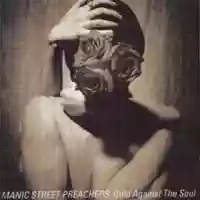
“Gold Against The Soul” starts from there, building an ethic on discomfort: between one string section and another, between a riff and another by the skilled James Dean Bradfield, this damned rose with its poisoned petals, the lyrics of Richey James, is born. Indeed, “Gold Against The Soul”: a symphony of discomfort (“Symphony Of Tourette”).
Perhaps their most philosophical and poetic album together, with a thousand facets, where between one track and another, the Welsh elegance of Philip Larkin and Dylan Thomas becomes almost tangible. But here, listen, those who truly abandon themselves to listening don’t care that much, they let themselves get carried away. That’s all. “A memory fades to a pale landscape.”
And then, it’s impossible not to consider “Sleepflower” a masterpiece. Minute after minute, it drags you into its gloomy atmospheres (the same as “Small Black Flowers That Grow In The Sky”, the most beautiful song ever). Rimbaudian echoes, a faded “Season in Hell.”
Man in rebellion seeking to reconcile himself with the natural elements, to find himself in the world, and when he surrenders to the realization that all this is impossible, he becomes the “absurd hero” of “From Despair To Where”, an eternally split character who cannot discern whether his human condition is real or not (“Cannot tell if it’s real or not”).
Every possible revolt, “metaphysical rebellion,” to use Albert Camus’ words, is denied, not yet allowed, it is not possible to conquer oneself or the world. Yet this reality becomes common to all, even to the valiant soldier of “La Tristesse Durera (Scream To A Sigh)” who decides to sell his medal for valor to pay an insignificant bill, or to the protagonist of “Yourself” for whom it is impossible to find meaning in the repetitiveness of everyday gestures, in the false illusions upon which self-awareness is built (“You go on day after day/ oh- ooh/ Dreaming on a lie/ That you keep locked inside”).
Once, during an interview, Edwards said that the only perfect circle is represented by the human eye when there is an eyelid to protect it: upon opening it, one finds oneself facing a sort of descending spiral where everything is born, grows, and then dies.
Like the eyes of the child in “Life Becoming A Landslide” when they peer into the world, and immediately the impact with the light becomes something wonderfully violent, fascinating. And then love, jealousy, the perfect decay proceeding from childhood (“I don't wanna be a man”), a mythical, ideal, happy age, to senility (“Everyday more numb to agony/ This the howl this the sigh of the lonely”), decrepit, corrupt. A text halfway between Nietzsche’s myth of eternal return and William Blake’s poetry.
Even from manure, flowers are born: this is the sense of “Roses In The Hospital”, the strange idea that a piece of happiness and life can sprout even from a place of death and pain such as a hospital might be. What matters is accepting death, like Camus’ Meursault in “The Stranger,” wanting death, freeing oneself from hopes (“Nostalgic Pushead”), from the futility of the everyday. There is no more hope, no more adventures or false chimeras: “Gold Against The Soul” and the catharsis of rock’n’roll: the epilogue of an album.
We must seek, become, profess our truth. Only that.
“Rock’n roll has a conscience”.
Richey James, thank you.
Loading comments slowly
Summary by Bot
The review highlights 'Gold Against The Soul' as a deeply philosophical and poetic album by Manic Street Preachers. It emphasizes the lyrical complexity introduced by Richey James Edwards and the blend of poetic influences such as Philip Larkin and Dylan Thomas. Songs like 'Sleepflower' and 'La Tristesse Durera' embody themes of existential rebellion and human condition struggles. The album is portrayed as a cathartic, rock 'n' roll journey filled with metaphysical depth and emotional intensity.Tracklist Lyrics Videos
Manic Street Preachers
Manic Street Preachers are a Welsh rock band formed in 1986, widely associated with 1990s British alternative rock and Britpop. The group’s history is closely tied to the disappearance of guitarist and lyricist Richey Edwards in 1995; he was declared legally dead/presumed dead in 2008. Their work is known for politically charged themes, literary references, and shifts from early abrasive guitar rock to more orchestral and pop-leaning records and later reinventions.22 Reviews
