
 •
Rating:
•
Rating:
THE REVIEW
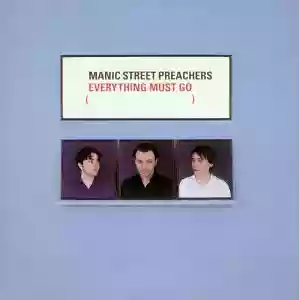
Spring of 1996 - A sign announces: "MANIC STREET PREACHERS - EVERYTHING MUST GO" ("everything must go" note).
Below are three pictures resting on a shelf, showing the headshots of: Sean Moore, James Dean Bradfield, and Nicky Wire. The background is faded, dull purple. February 1st, 1995 - Richey James leaves the London hotel where he was staying and disappears. His body was never found, but his car was, at a certain place famous for suicides, on a very high bridge, to be precise.
Richey was the guitarist of the MSP, and probably his photo should have been on that shelf as well, but probably without his disappearance, this "Everything Must Go" would never have been born. But anyway, everything must go, with or without Richey. The Manics have gathered the last lyrics of the missing guitarist, added their stuff, and then gave the songs their usual imprint, adding however violins, harps, violas, and various strings, subtly approaching the Brit matrix and distancing from the early hard rock style. The album might make fans wrinkle their noses, but it represents, in my opinion, the beginning of the band's maturity.
It's not a masterpiece but it's a great album acceptable as it is, though it contains songs that could have been avoided. "Elvis impersonator: Blackpool pier" starts acoustic and then punches you in the gut, albeit softened by the use of the harp. "A design for life" is an example of how the Manics have steered towards a more listenable britrock, it's clear. With "Small black flowers that grow in the sky" there's a highlight on James's excellent lyrics and the excellent music written by the remaining Manics, acoustic music with just the guitar accompanied by a divinely played harp. "Removables" has a great classical guitar riff at the beginning but the song itself then gets lost after a few seconds. The chorus of "Further Away" stays quite a bit in your head and we just need to wait till the end to have the confirmation of the album's masterpiece "No surface all feeling". In my opinion declared the most beautiful of the album. The distorted guitar of the chorus becomes sweet when Bradfield starts singing the verses. Beautiful verses, beautiful words (this time written by Nicky Wire) and in the chorus you get lost in a blend of notes that the guitar emits. Then there are two other noteworthy songs like "Kevin Carter" and "Enola/Alone" and among the ones that could have been avoided are "Interiors" and the "title track" probably.
Loading comments slowly
Summary by Bot
Everything Must Go is a significant album in Manic Street Preachers' history, born from the tragedy of Richey James' disappearance. The band blends classical instrumentation with Britrock, showcasing maturity beyond their earlier hard rock roots. Though not flawless, it contains memorable songs that highlight introspective lyrics and evolving sounds. The review praises key tracks like 'No Surface All Feeling' as album highlights while acknowledging a few less impactful songs.Tracklist Lyrics Videos
Manic Street Preachers
Manic Street Preachers are a Welsh rock band formed in 1986, widely associated with 1990s British alternative rock and Britpop. The group’s history is closely tied to the disappearance of guitarist and lyricist Richey Edwards in 1995; he was declared legally dead/presumed dead in 2008. Their work is known for politically charged themes, literary references, and shifts from early abrasive guitar rock to more orchestral and pop-leaning records and later reinventions.22 Reviews
