
 •
Rating:
•
Rating:
THE REVIEW
Among the list of my daughter's school books, you won't find books on grammar, mathematics, or geography, but only novels, a poetry book, and a biography.
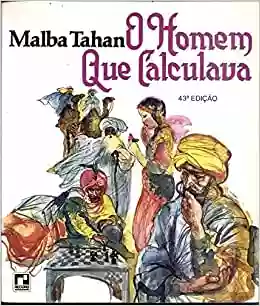
The Man Who Counted was the one that immediately caught my attention; on the cover of the used and faded edition are men in turbans, a chessboard, and the inevitable camel in a design dating back to the first edition of 1972. The one I hold in my hands is the 38th edition from 1990. Curiously, it is not found among the cover notes that it was first published in 1937.
The man who knew how to calculate was also able to count flocks of birds, legs, and ears of herds of horses. It was a natural gift, nurtured by a great teacher, that also embraced calculation and logic. For him, it was easy to get the sequence of algorithms from 0 to 9 using only four fours with the four basic operations (e.g., 44-44=0, 44/44=1, etc.), and he knew why the numbers 256 and 169 have a square friendship.
All things we ignore but that with a certain effort we could deduce and solve, like the problem of the 21 jars, 7 full of wine, 7 half-full, and 7 empty, which must be divided among three people so that everyone has the same number of jars and the same amount of wine.
The author recounts through anecdotes and everyday events the unfolding of some fascinating problems without dwelling on illustrating the solutions that our illustrious calculator finds with little effort, so as not to embarrass us with the unpleasant sensation of being less sharp than our protagonist.
Of course, the more curious and attentive ones could, before reaching the solutions, try to tackle and solve the puzzles, challenging their own intelligence or as a pastime to devote to moments that today this situation we are experiencing offers us.
With simple and elegant language, Malba Tahan distills lessons in morals and ethics that are no longer found today except in some Japanese anime and offers us a simple and curious reading, showing us a different angle from which to appreciate mathematical science and amaze us in the face of originality applied to what, beyond death, is one of the few objective certainties.
Loading comments slowly
Summary by Bot
The Man Who Counted by Malba Tahan is a charming novel that combines mathematical puzzles with moral lessons through engaging anecdotes. The protagonist’s natural gift for calculation invites readers to explore logic and problem-solving in an accessible way. The book encourages curiosity and intellectual challenge while maintaining simple and elegant language. It offers a unique perspective on mathematics as both a science and an art.
Malba Tahan
Malba Tahan is the pen name of Júlio César de Mello e Souza (1895–1974), a Brazilian mathematics teacher and author best known for the collection of mathematical stories O Homem que Calculava (The Man Who Counted).01 Reviews
