
 •
Rating:
•
Rating:
THE REVIEW
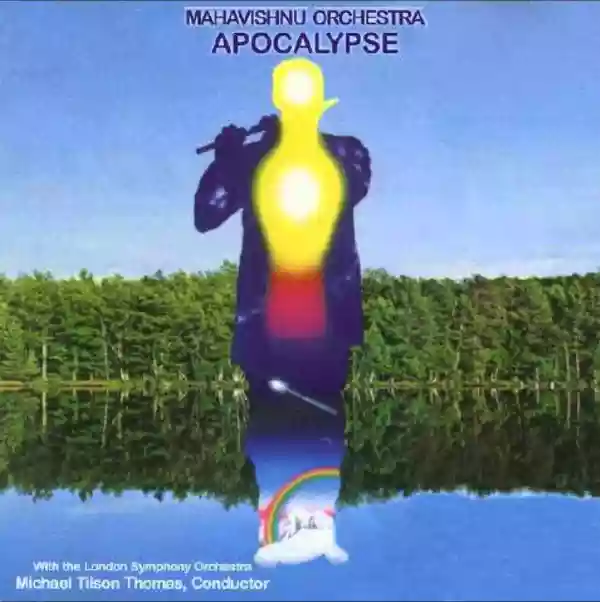
Mahavishnu Orchestra - Apocalypse 1974
Many attempts have been made over time to combine rock with classical music. The marriage between the rock band and the orchestra, more or less large, seemed to aim at giving a symphonic touch, softening the guitar solos or simply adding an unexpected section to already performed pieces. Initially, the idea might have seemed to belong to the foresight of some and was read within the broader concept of experimentation, but in reality, and perhaps more prosaically, the goal was to win the favor of people usually distant from the rock band tout-court.
Deep Purple, Caravan, New Trolls, Moody Blues, Jethro Tull, Elton John … many over time tried the experiment in studio or live, even highly questionable and rather improbable attempts at Heavy Metal + Orchestra.
In 1974, daring on different tracks, even the quintessential jazz rock band, the Mahavishnu Orchestra, decided to propose their music by expanding their lineup with the famous London Symphony Orchestra.
Of course, the idea was not brand new, given the various examples of some jazz big bands that had already been leaning towards symphonic jazz schemes for some time. There was also the mega super group Centipede, which in 1971 proposed a record filled with those intentions, but with clear differences in the scores: mostly improvised for the latter and absolutely written and punctually performed for the Mahavishnu Orchestra.
The choice to perform unreleased pieces with an orchestra was also the final blow to the band, already in strong conflict during the recordings of the previous album “Between Nothingness and Eternity” and that managed to continue only because John McLaughlin owned the name. So Billy Cobham, Jan Hammer, Jerry Goodman (drums, keyboards, and violin), not at all agreeing with the recording of an album that would be, in their opinion, too distant from the first discographic episodes and that would therefore alienate the audience from the band's concept, definitively left. In light of the facts, it is more likely that behind an apparent fear of a symphonic turn, their problem could be traced back to the fear of being less visible on a record with orchestral features.
McLaughlin began putting together all the necessary pieces. At the production desk, he wanted none other than Sir. George Martin, who obviously brought with him the “number one” sound engineer Geoff Emerick. In the new lineup, Jean Luc Ponty, with credentials from Mr. Zappa, on violin, the very young and highly technical Michael Walden (from the late '70s Narada) on drums and the young and unknown Gayle Moran, with credentials of Chick Corea married in 1972, on keyboards and vocals. The bassist also changed, with Ralphe Armstrong replacing Rick Laird. With this powerful team, jazz rock scores by McLaughlin himself, and symphonic scores by conductor Michael Gibbs, the recording quickly began and the result, full of strength and contrasts, was remarkable.
Five tracks of varying length, from the four minutes of “Power of Love” in which a subtle orchestration prevails over McLaughlin's electro-acoustic architectures, to the almost twenty minutes of “Hymn to Him”, a true orchestral suite with violin raids and continuous chases with the guitar, in a truly effective dualism, on powerful and complex rhythms. If we want to find a track more linked to the past and the first production, we must refer to “Vision is a Naked Sword” with Walden pushing like crazy to make sure Cobham is not missed. The exercise is not the simplest and the magical touch of “Fourstick Man” is missing, but Walden does his job very well, his technique is truly remarkable.
A somewhat separate tale on the record is “Smile of the Beyond”, a subtle watercolor where Moran's dreamlike singing, although very precise and technically perfect, is guilty of a certain drop in tension and shifts listening to more spiritual shores and, if we can say it, new age avant la lettre.
An unusual episode in the career, as it has been for anyone who wanted to try their hand at the combination of band + symphony orchestra, but the result is there. “Apocalypse” cannot be called the band's best record, but it remains a highly recommended, intriguing work that can be savored for the great and warm mastery of McLaughlin and company and for the great and positive symphonic openings that often illuminate and temper the typical sharpness of the jazz rock of the Mahavishnu.
Sioulette p.a.p.
Loading comments slowly
Summary by Bot
Mahavishnu Orchestra's 1974 album Apocalypse boldly combines jazz rock with the London Symphony Orchestra, producing a rich and complex symphonic fusion. Despite internal band conflicts and lineup changes, John McLaughlin led the project with a stellar new ensemble and George Martin's production. The album features varied tracks blending orchestral arrangements with intense jazz-rock elements, making it an intriguing though not their best record. Apocalypse remains a recommended listen for fans seeking a unique orchestral-jazz rock experience.
Mahavishnu Orchestra
Mahavishnu Orchestra is a multinational jazz‑fusion group formed in 1971 by guitarist John McLaughlin. The classic early lineup included Billy Cobham, Jan Hammer, Jerry Goodman, and Rick Laird, delivering high‑voltage albums like The Inner Mounting Flame and Birds of Fire. Later incarnations featured Jean‑Luc Ponty and Narada Michael Walden, exploring orchestral and funk‑fusion directions before disbanding in the mid‑1970s and briefly returning in the mid‑1980s.06 Reviews
