
 •
Rating:
•
Rating:
THE REVIEW
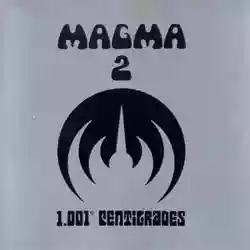
Despite the grey cover, you hear all sorts of colors in this album: the second work for Magma, a French group from the '70s comparable to progressive but always seeking to distinguish themselves from Anglo-American bands by treading unusual paths. For example, by inventing their own planet of choice, Kobaïa, and a related imaginary language, Kobaïan, in which they sing the lyrics of their songs, and it's a much more serious matter than it might seem (there are orthographic and grammatical rules, and a Kobaïan/French dictionary, for those who want to delve deeper).
The titles of the three tracks on the 1971 record promptly project us into this parallel universe. "Riah Sahiltaahk" is a long composition by Christian Vander, the band leader. Over 21 apparently deconstructed minutes, where brief modules repeat a few times to immediately make way for the next ones. They sound like sonic cells glued to each other, overlapping in a whirling and frantic manner and constantly changing.
But in this labyrinth, the foundational elements can be clearly distinguished: at the time, Magma was a group of seven musicians, each with a precise role. There's a mini brass section (clarinet, sax, flute of Teddy Lasry; sax and bass clarinet of Jeff Seffer; trumpet of Louis Toesca), acoustic and electric piano for Francois Cahen, electric bass for Francis Moze, and finally Christian Vander on drums (and vocals) plus the mellow voice of singer Klaus Blasquiz. As you can notice, there are no guitars, but the result is an uninterrupted magmatic flow of extreme density.
The other two songs are not penned by Vander, which has generated skepticism among the die-hard Magma fans. "Iss Lansei Doia" is by T. Lasry, "Ki Iahl O Liahk" by F. Cahen (the latter would leave the group right after this album to form, with J. Seffer, the band Zao). In both cases, you find less nervous and more singable melodies, a less experimental cut, and generally a sound structure influenced by jazz-rock.
Original in their poetics, more than a rock group, Magma resembles a group of druids intent on celebrating a pagan rite. "1001° Centigrades" is an excellent album, despite the grey cover: there exists a much more colorful alternative, where red and orange prevail: the colors of volcanic magma, of fire, of over a thousand centigrades...
Loading comments slowly
Summary by Bot
Magma’s 1001° Centigrades is a landmark 1971 album blending progressive rock and jazz influences, distinguished by its invented Kobaïan language and unique sonic textures. The album’s three tracks showcase experimental compositions by band leader Christian Vander and others, creating a dense, dynamic, and immersive experience. Despite some skepticism from fans over contributions from other band members, the album remains a vibrant and original musical journey, likened to a ritualistic celebration.Tracklist Videos
Magma
Magma are a French progressive rock band centered on drummer/composer Christian Vander, known for creating the zeuhl style and performing a long-running science-fiction mythology sung in the invented Kobaïan language.12 Reviews
