 •
Rating:
•
Rating: THE REVIEW
The anticipation of both the public and critics for Madonna's new musical work was sky-high: in 1998, Ciccone had penned with William Orbit one of the absolute masterpieces of modern pop, namely "Ray of Light," which had sold 18 million records and earned the singer glowing critical reviews as well as four Grammy Awards; an absolute success, essentially confirming the singer's status as a "classic" in pop.
Everyone eagerly awaited to see what would happen next, whether she would collaborate again with William Orbit, the electronic wizard who helped her create "Ray of Light," whether she would continue to embellish her works with electronic sounds, or if she would continue her path of spiritual exploration that she had embarked on years earlier.
Well, Madonna managed to astonish everyone once again.
First of all, she set aside Orbit with whom she produced only two songs for "Music" and "hires" another electronic sound wizard, Mirwais, a French musician. For the first time in years, she doesn't create a concept album but produces a kaleidoscopic work where the songs cover different themes and styles, unified by a single idea: musical originality. In other words, anything goes as long as it's new. In short, Madonna proves herself to be a fearless musician once again, takes bold risks and opens the dances in the August of the new millennium with a stunning dance piece, the eponymous title-track "Music." It had been years since Madge composed pure dance music: this time she does, and she gets the entire world dancing. The track quickly climbs the global charts and stays there for several weeks, selling around 3.5 million copies.
In the United States, Madonna reaches the peak of the most sold and broadcast singles, the formidable Billboard chart: something that hadn't happened since 1994 with the track "Take a Bow." "Music" is an energetic, irresistible track: a grand invitation to dance and a declaration of love towards music. It is filled with electronic sounds, with vaguely funky influences. The journey continues with "Impressive Instant," another irresistible dance track that talks about the chaos of existence and the difficulty of living and expressing oneself. The third track of the album corresponds with the fifth: they are the only tracks produced together with William Orbit and are quite similar in style and themes. They talk about love ("Runaway Lover" and "Amazing") and are both hyper-electronic with strong references to the music of the '60s and some nods to the little Orbit-Madonna jewel of '99 "Beautiful Stranger." Unfortunately, the magic does not repeat itself this time, and the partnership between the two feels somewhat sterile: rhythms already heard too many times and lacking originality.
Suddenly, the singer surprises us and almost takes our breath away: the fourth track is a fantastic ballad about her love for her new husband Guy Ritchie, "I Deserve It", entirely acoustic. Madonna abruptly abandons the electronic beats of "Ray of Light" and the early tracks of "Music" to immerse us in this magical atmosphere that vaguely hints at the cowboy world. Madonna performs the piece live on her best-selling 2001 tour, where she plays the guitar herself to accompany the melody. The material girl has grown up a lot, demonstrating absolute confidence with the music sheet. The sixth track is yet another surprise. "Nobody's Perfect" talks about betrayal and the possibility of it occurring in a relationship. The track is an electronic ballad, occasionally crossed by a high computerized sound reminiscent of the engine of an airplane. Suddenly towards the end of the piece, after one of these "rumbles," the acoustic guitar returns to play some verses of the song. The track is emblematic of the musical tendency of the album: the contrast between old and new, acoustic and electronic.
The seventh track "Don't Tell Me" was the second single released from the album and had a fantastic success worldwide. Thanks to the music video directed by the great Jean-Baptiste Mondino (the legendary photographer-director with whom Madonna had launched some of her biggest scandals), it sparked the cow-chic trend, a modern style inspired by cowboy fashion. The piece, a cheerful pop track inspired by American folk, is an elaboration of a track by Madonna's brother-in-law Joe Henry, "Stop," which is duly mentioned in the album's booklet. The eighth track was the third and last single extracted from the album and is one of Madonna's gems. The track is a melancholic overview of the difficulty of being a girl nowadays. More than the words, what matters here is the music: an elegant pop ballad continually accompanied by electric guitar. Two extramusical peculiarities: the piece starts with the insertion of a cinematic excerpt from "The Cement Garden" (1993) performed by Charlotte Gainsbourg. Additionally, the video (based on a remix version of the track, inferior to the album version) directed by the singer's husband shows a platinum blonde bobbed Madonna who, embittered by the mistreatment endured, commits several crimes. The video was considered so violent by MTV that it was banned from musical rotation.
The ninth track is a beautiful and enigmatic ballad titled "Paradise (Not for Me)," which mixes various tonalities and alternates English and French singing. Closing the album is "Gone," a splendid rocking ballad that again alternates acoustic and electronic sounds (though few, in truth). The song is one of the most intense and touching of Madonna's entire career, which she performed brilliantly in the aforementioned tour.
In essence, "Music" is an innovative, kaleidoscopic, and highly original album. The only flaw noted is that the songs are not homogeneous with each other; they are mixed together and in general listening, this fact is noticeable and slightly irritating. With a closer analysis, isolating each song from its context, they come to life and amaze with their full power.
An interesting fact: the European version of the album contains an eleventh track "American Pie." This track had already been included in the "The Next Best Thing" soundtrack and circulated with great success as a single throughout Europe, selling around 2 million copies and quickly becoming one of Madonna's most successful singles. The singer strongly opposed the inclusion of the track in "Music" as she felt it did not align with the rest of the work and might distract the listener from the rest of the album. She only managed to succeed in the States, where the track was discarded. However, dissatisfied with its inclusion in the European "Music," Madonna categorically excluded it from her second greatest hits "GHV2" (proving how less commercial she is compared to what many believe, as the huge success of "American Pie" would have only benefited the collection).
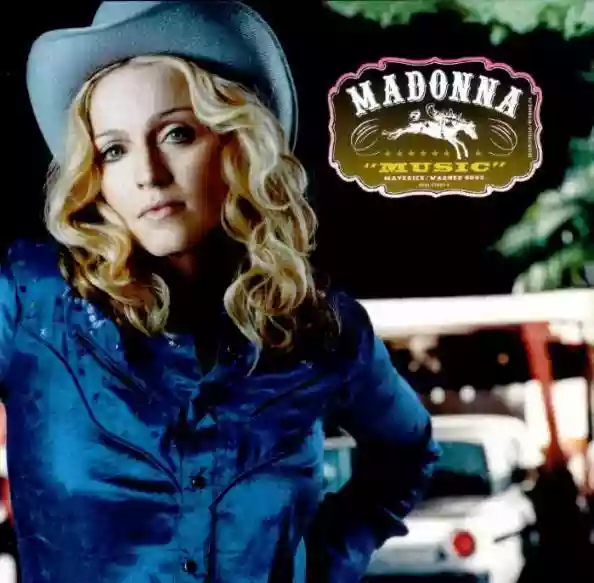
In conclusion, "Music" represents Madonna's grand farewell to the United States: on the cover, she is dressed as a cowgirl, and references to American culture are numerous and widespread across many parts of the album. That year, Madonna left the United States to move to Europe, to London. The grand farewell indeed.
Loading comments slowly
Summary by Bot
Madonna’s 2000 album 'Music' marks a daring departure from her earlier work, featuring a mix of electronic dance tracks and acoustic ballads. Produced mainly with Mirwais, the album embraces originality and diverse styles. Hit singles like 'Music' and 'Don’t Tell Me' achieved global chart success, while the album explores themes like love, chaos, and self-expression. Though sonically varied, the tracks individually shine, culminating in a bold and innovative pop record.
Madonna
Madonna (born Madonna Louise Ciccone, August 16, 1958) is an American singer, songwriter, actress and cultural icon who rose to prominence in the 1980s and has had a multi-decade career marked by stylistic reinventions.55 Reviews
