
 •
Rating:
•
Rating:
THE REVIEW
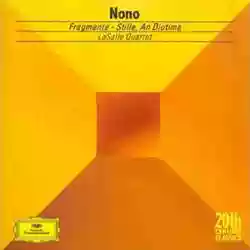
The birthplace of Luigi Nono in Venice overlooks the Giudecca canal, facing the Molino Stucky. An inscription on the wall of that house remembers the composer as a "master of sounds and silences." And sounds and silences appear, right from the title, in "Fragmente - Stille, An Diotima," a string quartet written in 1980: the work of the turning point, as many have said. Nono, a communist composer who had made political commitment (on the left) his banner from the early days of his career, realized in the '70s the emptiness of the ideological utopias that had driven him and directed his search towards a new utopia: that of sound. For all the '80s, years in which he wrote music of poignant beauty, his stylistic hallmark was that of fragments and silence: the announcement of this poetics can be found in this work.
The quartet lasts about half an hour, characterized by dynamic often in piano and pianissimo but sliced by a sudden forte, by the use of pizzicati that give expressiveness to the sound, rough and dark passages obtained from the low strings of the instruments, which alternate with brighter and more rarefied others. The pauses have already been mentioned: they are so full of pathos that they effectively take on the same importance as the sound.
And then there is the forest of hidden quotations in the music, a kind of inaudible sound that (strangely enough) enriches the quartet with further meanings: the reference to Diotima, the woman loved by the poet Hölderlin of whom Nono scattered 52 fragments in the score, not to be recited during the performance but kept in the musicians’ hearts as a compass of emotions; and then the references to the "enigmatic scale" of Verdi from the "Four Sacred Pieces," the song "Malor me bat" by the Flemish Ockeghem, written around 1500, and much more.
"Fragmente-Stille" is a difficult listen, requiring a significant effort from the listener, and is strongly discouraged for those who interpret music as a comfortable "escape." Before seeking it, let these words of Luigi Nono resonate within you: "I have not changed at all. Even tenderness, even the private has its collective, political side. Therefore, the string quartet is not the expression of a new line of mine, but of my current level of experimentation. I want to achieve the maximum message of rebellion with the minimum of means."
Loading comments slowly
Summary by Bot
Luigi Nono's Fragmente-Stille, An Diotima is a landmark 1980 string quartet characterized by the interplay of sound and silence. Reflecting Nono's shift from political utopias to a new utopia of sound, the piece relies on nuanced dynamics and hidden musical references. Its complexity demands attentive listening and rewards those open to experimental music. Nono’s work aims to convey deep emotional and political messages through minimal means.Tracklist
Luigi Nono
Luigi Nono (1924–1990) was an Italian avant‑garde composer from Venice, a leading figure of the postwar Darmstadt generation. Renowned for politically engaged works, tape and live‑electronics, and later a poetics of fragments and silence, he collaborated with Experimentalstudio Freiburg; key works include Intolleranza 1960, La fabbrica illuminata, Como una ola de fuerza y luz, Fragmente – Stille, An Diotima, and Prometeo.04 Reviews
