 •
Rating:
•
Rating:
THE REVIEW
I will surely be a dissenting voice here, but Ludovico Einaudi's music has always seemed to me like an artfully constructed phenomenon, amplified in every possible way and essentially self-referential. An excellent shelf product, inflated by cultural marketing.
Years ago (before Covid), a famous conductor told me that if Einaudi weren't named Einaudi, he wouldn't have made it so far. Heir to a noble, extremely wealthy family, well-connected everywhere, he managed—albeit at a late age compared to the average of many of his peers—to impose himself on the international scene without actually producing anything new or original or, at any rate, artistically exceptional. If his name had been Ludovico Berruti, he wouldn't have reached a tenth of the milestones he's achieved over the past two decades.
I've listened to quite a lot of Einaudi, both strictly piano pieces and more complex, orchestral works. Sometimes I've come across his work without knowing it was his, and I've realized that the aura of mystical reverence surrounding him subconsciously influences the audience. When you listen to a piano piece without knowing it's his, you could confuse it for anyone else's. Incidentally, if I listen to music by Eno, or Mertens, or Debussy, I can instantly recognize the author's signature.
His scores may well be pleasant, endowed with a certain sensitivity, well packaged, but musically they're banal, predictable, identical to those of hundreds of other composers working in a similar style. If you browse through some library of music for soundtracks or background music, you find a torrent of pianists doing the exact same things. And if you know a bit about the evolution of contemporary piano and its leading figures, you can plainly see that Einaudi is following in the footsteps of names who did the same things at least a decade earlier. And did them better.
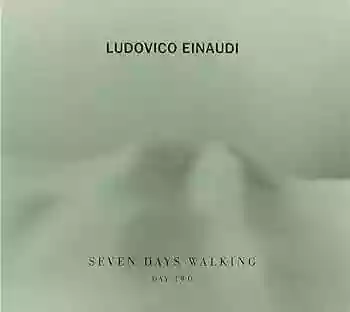
This second chapter of the Seven days walking project, released in 2019, is no exception. A piano anthology that immediately reminded me of a rehashed mélange of authors like Michael Jones, Gary Lamb, Wayne Gratz, David Lanz. The effect is undeniably powerful because the touch is there. The atmosphere, the evocation... Low Mist, Ascent, Birdsong: new age of the new millennium that bridges natural ambient and romantic minimalism in a captivating way. But the technique certainly doesn't cry out for a miracle, and there is no sign of genius. I say genius because thousands of Einaudi’s fans truly consider him an absolute genius, in fact. An unrivaled master of the instrument and of sonic writing in the twentieth century and beyond.
Come on, really?...
The fragments of this album follow one another in a dainty, picturesque way, immediately presenting themselves as something magical by default. It's signed by Ludovico, so it must be wonderful. But if you compare them to the very, very similar pieces by pianists like Cesare Picco or Roberto Cacciapaglia—to name two great authors from our own country—you realize that Einaudi doesn't surpass any of the others in any aspect of musical style. On the contrary, when the scion turns to orchestration, embroidering string sections over the piano, the level of derivative banality increases even more.
That doesn’t take away from the fact that his production can be appreciated by a vast audience: no one is saying his records are ugly or poorly made. But honestly, I don’t see the enormous gap that's supposed to exist between him and so many other artists who are doing exactly the same things; maybe even better, maybe for even longer.
The media and insiders have long targeted Giovanni Allevi for a range of more or less legitimate and well-founded reasons. No one has ever targeted Einaudi because Einaudi has maintained a different profile, presenting and selling himself more shrewdly, with much more backing than the less fortunate artist from Marche. He donned the genius costume with class, leaving it to others to recognize his supposed high standing. But musically speaking, Einaudi is open to the same criticisms aimed at Allevi.
Seven days walking: day two is, in the end, an insignificant work. It adds nothing to what was already very little. Hats off to Ludovico, who managed to conquer half the world, fame, and fortune with this bouillon cube passed off as freshly made consommé with mirepoix.
Loading comments slowly
Summary by Bot
The review critically assesses Einaudi’s 'Seven Days Walking: Day Two.' The album receives a low rating, indicating disappointment with its musical direction or execution. Aspects such as musical repetition and overall impact may have been questioned. Fans are encouraged to reflect on whether the release delivers on Einaudi’s usual artistic standards. The review aims to guide potential listeners toward informed expectations.
Ludovico Einaudi
Ludovico Einaudi is an Italian composer and pianist associated in these reviews with minimalist/ambient-leaning piano music, soundtrack work, and occasional collaborations.13 Reviews
