
 •
Rating:
•
Rating:
THE REVIEW
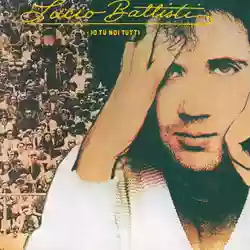
After "Anima Latina", Battisti once again astonishes the Italian audience with the abrupt change of direction of "Lucio Battisti, la batteria il contrabbasso eccetera".
No more orchestral scores or progressive layers; the new language chosen is more immediate, synthetic, and stylistically seems to have more than one point of contact with the emerging American disco-music (listen to "Il veliero").
Compared to its predecessor, "Io Tu Noi Tutti" continues the study of the perfect international pop song; tracks that, before the vocals start, could be heard on a radio in any Western country.
To give this breadth to his new project, Lucio, after some initial recordings with the same group from the previous album at the Mulino studios, moves to RCA studios in Hollywood and surrounds himself with a band of American session musicians.
The funky rhythmic structure is perfectly blended with the typically Battistian melodic taste; the arrangements (by Battisti and keyboardist Mike Melvoin) display a cleanliness and confidence that were partly missing from the previous record, and the musicians prove effective in creating smooth and appropriately flowing instrumental blends.
At the forefront are always the three rhythm guitars consistently supported by an always impeccable and imaginative drum, with Mike Melvoin's synthesizer ready to chisel and give a touch of modernity where needed.
Battisti's stature as an author is also revealed in seemingly light and certainly catchy songs, but always characterized by melodic evolutions (instrumental or vocal) that are absolutely never obvious or trivial.
The tendency to construct small screenplays finds its full expression in eight fragments of everyday life (bourgeois, one might say...), scattered with keen annotations; standouts include the inner conflict between denial and evidence in "Ami ancora Elisa" (an evolution of the dialogue structure of other tracks from the early 70s), the triumphant joy of feeling like "L'interprete di un film" after a conquest, the carefree ode to the pleasures of driving in "Sì, viaggiare," and the unconventional reflection between biological predestination and existential responsibility in "Questione di cellule".
The voice appears definitively aware and more than ever capable of effectively exploiting its own limitations.
The expressiveness is reinforced by the very refined off-key notes (how many times I've rewound the record needle on the disconcerting refrain of "Ami ancora Elisa"...) and by the skillful vocal modulations between immersion and detachment.
We are still far from Panellian sarcasm, even if certain images reveal a certain irony that sometimes borders on misogyny ("parlar di comprensione, evoluzione, elevazione, mentre pensi ai tacchi alti che hai"
).
One of the best examples of how pop music (in its highest sense, Italian and beyond) can be immediate and singable while at the same time brimming with creativity and intelligence in every note.
Loading comments slowly
Summary by Bot
Lucio Battisti's album Io Tu Noi Tutti marks a bold stylistic shift towards a synthetic and disco-influenced sound. Recorded partly in Hollywood with American session musicians, it refines his melodic and rhythmic approach, blending funk and pop seamlessly. Battisti's vocal delivery is both aware and expressive, enhancing the lyrical storytelling. The album shines as an intelligent, creative, and accessible example of international pop music.
Lucio Battisti
Lucio Battisti (5 March 1943 – 9 September 1998) was an Italian singer, composer and producer from Poggio Bustone. With lyricist Mogol he shaped Italian pop in the late 1960s–70s; from 1986 he collaborated with Pasquale Panella on the experimental ‘white albums’, culminating in Hegel (1994).101 Reviews
Other reviews
By Luciano63
"'Io tu noi tutti' is simply Battisti's best album."
"The talent of the guests in the studio is evident, the sound is international."
By mrbluesky
Lucio, somehow, managed to enter every home.
Lucio was a bit like one of the family, everyone knew everything about him without ever having bought anything, a great man.
