
 •
Rating:
•
Rating:
THE REVIEW
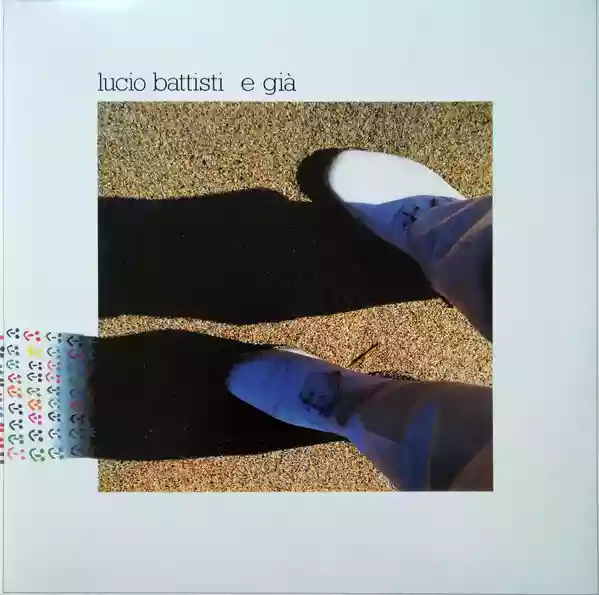
1982. Two years have passed since the end of the artistic partnership Mogol-Battisti and there is, on the part of the already mentioned artist from Rieti, a desire for complete change. And so it is that, after the success of the last album "Una Giornata Uggiosa" (1980), Lucio Battisti releases in September '82 "E Già", the album that marks a definitive turning point in his discography. It all starts with the concept of the title: that "E già" that almost seems to say "I did it", a heartfelt "I managed to do it despite everything". Results? The album, with lyrics written by his wife Grazia Letizia Veronese - using the pseudonym Velezia - manages to reach the peak of first place in the first week of release, settling, later, at the fourteenth. The single released, "Eh Già/Straniero", the last ever officially published in the singer's discography, lands at the fifty-fourth position, resulting in a flop.
For many fans, both of the Mogol period and the post-Mogol period, "E già" is considered a nonsensical album, soulless: not just a flop but a record that, reiterating the "lack of ideas," says little to nothing, highlighting Velezia's shortcomings as a lyricist. Well, listened to today, "E Già" is not exactly a terrible album, quite the opposite. Although in my first review, I exalted "Don Giovanni" (1986), which I personally consider an improvement over "E Già," the latter is, in my opinion, a underrated record. It has many merits as well as many flaws, but they should be admitted. Let’s start from the premise that Battisti emerges from a long period of "suffocation," given by the commercialism of certain records ("La Batteria, Il Contrabbasso, Eccetera", "Io Tu Noi Tutti", "Una Donna Per Amico", "Una Giornata Uggiosa"), a period, indeed, more vibrant in terms of sales, somewhat less so in terms of initiative spirit.
"E Già" is a second rebirth for the artist, who makes a great step forward: with its characteristics, it almost seems like an indie record, considering the electropop/synth pop as an avant-garde element and the arrangements by Geoff Westley. The inner cover, the last with Battisti "in view," recalls the atmosphere of the sea: not coincidentally, the photos for the album were taken on the beaches of Cornwall. The main theme of the album is, therefore, change: this theme is reiterated in tracks like "Scrivi Il Tuo Nome" - "write your name / on something that matters / show yourself / that you are not a vegetable" - "Mistero", "Non Sei Più Solo", "Una Montagna", and the title track. The sea remains, however, a very present element: besides representing the album's aesthetics, it is almost a philosophy ("Rilassati ed ascolta") - "la vita dal mare venuta al mare ritornerà" - a passion ("Windsurf Windsurf"), a call ("Slow Motion"). Here it is: "E Già" seems like a leftfield (anti-commercial) album to listen to in full daylight on the beach; with it, we penetrate the singer's spirituality.
However, the negative aspects of the album should be reiterated. Velezia, although many think the lyrics were written by Battisti himself because they are autobiographical, shows her ability to pair one rhyme with another in a rather simplistic and banal way, most of the time: an example could be "profondo o leggero / quando c'è il gusto è bello / usa le gambe / utilizza il cervello". The lyrics are very, perhaps too, direct and less metaphorical compared to "that flashy intellectual type," who wrote for the artist, thus serving truth rather than interpretations to the listener, something Battisti will avoid doing in the next partnership. Beyond the lyrics, the music aims for a pop/minimal aspect that, to the ears, might sound repetitive, just like the experimental albums of the seventies by Franco Battiato.
"E Già," in all its merits and flaws, represents a second debut for the former Don Giovanni: it is certainly not a masterpiece, but surely a good album that will open the doors to Battisti 2.0, a being entirely different from the guy who sang ditties.
Loading comments slowly
Summary by Bot
Lucio Battisti's 1982 album 'E Già' marks a significant artistic shift with avant-garde electropop sounds and themes of change. Despite initial criticism over simplistic lyrics by his wife Grazia Letizia Veronese (Velezia), the album is an underrated rebirth for Battisti post-Mogol era. It features sea imagery and introspective tracks, highlighting his move away from commercialism toward a more experimental and personal style. Though flawed, 'E Già' opens the door to a new chapter in Battisti's musical journey.Tracklist Videos
Lucio Battisti
Lucio Battisti (5 March 1943 – 9 September 1998) was an Italian singer, composer and producer from Poggio Bustone. With lyricist Mogol he shaped Italian pop in the late 1960s–70s; from 1986 he collaborated with Pasquale Panella on the experimental ‘white albums’, culminating in Hegel (1994).101 Reviews
Other reviews
By Eneathedevil
"An album to make it clear that nothing is over, that everything is yet to be accomplished."
"Electronic experimentations... have been popular in Italy for some years, and perhaps with more comforting and consistent results than those achieved with this LP."
By London
It is a reclaiming of his identity as an experimenter.
Battisti is a composer open to the world, the cold and icy sounds, hypnotic and obsessive in the jarring melody are the manifesto of an artist ready to move beyond.
By Caspasian
"Here there is liberation from vanity, a mature relaxation, cleansing our selfish egoism of wanting expectations to be met."
"The true Battisti is rejected, 'Take it as it is' one might say..."
By Cris
This is the rough draft of a beautiful novel. It was published without refinement.
What came out sounds bad. And only because Lucio Battisti’s name is on the cover, it hasn’t been torn apart by critics.
