
 •
Rating:
•
Rating:
THE REVIEW
The year 1970 is one of the most defining in Lucio Battisti's career. Besides benefitting - as in all the early years of his career - other Italian colleagues with his excellent chart-topping songs (see Mina, Patty Pravo, Formula 3, Bruno Lauzi, etc.), the troubadour from Poggio Bustone completes two albums, almost the A-side and B-side of his music-making, two complementary faces that, when put together, reveal the multiplicity of the intentions of the early-period Lucio.
“Emozioni” is already a ready-and-packaged greatest hits, a "killer" album that, with record sales, establishes itself as one of the Italian best sellers, thereby condemning our artist to be identified by many with the lovely little songs for the rest of his life (and beyond).
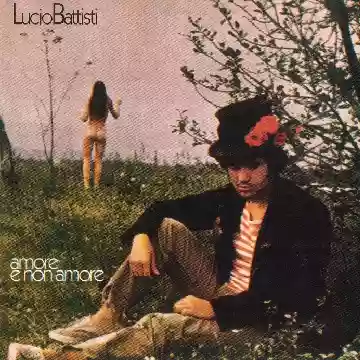
But in the same year, the project of “Amore e non amore” is also developed, a prog-folk divertissement considered so anti-commercial that it remains locked in Ricordi's drawers until the following year. However, the album is anticipated in '70 by the single “Dio mio no”, the future opening track of the 33 rpm, a torrential psychedelic story of a quickie that ends up attracting radio censorship due to existing blasphemy against religion (because of the exclamation in the title!). Battisti, in the Christian Democrat bigotry of the era, even ends up being seen as a "cursed artist," a reputation furthered by the fantastic cover (the first in a wonderful mystical-hippie series leading up to “Anima Latina“), with Lucio in the foreground on a field, looking ragged with a beard and Superga sneakers, with his future wife Maria Grazia naked with her buttocks showing (in some reprinted covers, she has panties!) and on the back, a pair of horses (perhaps a comparison between couples?). From this alone, we have clues to the album's themes.
Only eight tracks, of which four are magnificent instrumentals with huge titles (perhaps an outburst of Mogol?), like “7 agosto di pomeriggio. Fra le lamiere roventi di un cimitero di automobili solo io, silenzioso eppure straordinariamente vivo”. Incredible. And these small symphonies or these imaginative interludes, besides reflecting the huge titles dealing with a tormented existence, post-economic boom politics, and ecology, are sonic gems, full of experimentation planted on the traditional form of the guitar-based songwriter. The other four tracks, besides the already mentioned “Dio mio no”, attempt everything that even a Celentano or Morandi couldn't imagine: the proto-absurd song “Una”, one of the most beautiful love songs ever written, where Pfm’s Hammond organs (here in support band role) play the leading part (hallucinated); “Se la mia pelle vuoi”, a hard-rock song with wild solos by Alberto Radius and a nearly possessed Lucio, lamenting the excessive sexual activity of his lady... and finally comes “Supermarket”, a Rosetta Stone for all subsequent Rino Gaetani, in the blues gallop of a love story with a banana department clerk... Can we ask for more? If your answer is yes, you will just have to wait for the following year with "Umanamente uomo: il sogno".
But "Amore e non amore" remains an unrepeatable album, unique even in its flaws. It will forever be considered a lesser album of Lucio's in his most wild and polemical output, overlooked by everyone, but not by those who have understood and loved it with those roses on its worn-out cylinder.
Loading comments slowly
Summary by Bot
Released in 1971 but conceived in 1970, Lucio Battisti's 'Amore e non amore' is a bold, experimental album contrasting his commercial hit 'Emozioni.' Mixing prog-folk, psychedelia, and thematic depth, it features striking instrumentals and controversial tracks like 'Dio mio no.' Though often overlooked, the album is cherished by fans for its unique artistic vision and raw emotion. It remains a testament to Battisti’s willingness to push musical boundaries in a conservative era.Tracklist Lyrics Videos
02 Seduto sotto un platano con una margherita in bocca guardando il fiume nero macchiato dalla schiuma bianca dei detersivi (03:09)
03 Una (03:49)
04 7 agosto di pomeriggio, fra le lamiere roventi di un cimitero di automobili solo io silenzioso eppure straordinariamente vivo (04:05)
05 Se la mia pelle vuoi (04:10)
06 Davanti ad un distributore automatico di fiori dell'aereoporto di Bruxelles anche io chiuso in una bolla di vetro (02:17)
08 Una poltrona, un bicchiere di cognac, un televisore, 35 morti ai confini di Israele e Giordania (05:57)
Lucio Battisti
Lucio Battisti (5 March 1943 – 9 September 1998) was an Italian singer-songwriter, composer and producer from Poggio Bustone. A central figure in Italian pop, he partnered with lyricist Mogol in the late 1960s–70s and later with Pasquale Panella for a radical electronic-leaning phase. He withdrew from public appearances around 1979–1980 and left a catalog spanning 1969–1994.103 Reviews
Other reviews
By maxgit
I, who don’t listen to rock, and avoid progressive rock, find myself enchanted listening to wild organ riffs, electric guitar, drums, mixed with celestial arpeggios, sweet pianos, sudden openings of strings.
The whole album is pervaded by a beautiful irony, and treats love like a slightly reckless boy... always playing, scratching.
By withor
"Long live sex and to hell with politically correct!"
"A very experimental album, both in the lyrics and in the music, that starkly differed from previous Battisti works."
