
 •
Rating:
•
Rating:
THE REVIEW
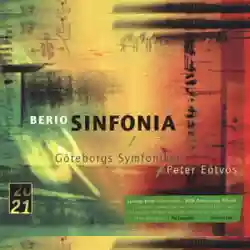
1968: a year of great dreams, great changes, but also contradictions. A receptive musician like Luciano Berio (1925-2003) could not be indifferent to it, and that year he wrote his most famous work, a "symphony" very far from the principal form of classical music. The title must indeed be understood in the etymological sense, that of making "sounds together": and to make sounds together, in this piece that lasts just over half an hour, are an orchestra and eight amplified voices (four male and four female, each with a microphone in front). And it is above all the incredible overlap of musical and linguistic states that gives life to a rushing river that sweeps the listener away with it.
The piece is divided into five parts: in the first, the eight voices elaborate fragments from a text by Claude Lévi-Strauss; in the second, they articulate sounds without a supporting text, culminating in the final declamation of the name "King," that of civil rights leader Martin Luther King, assassinated in April 1968.
The third part entirely recaptures a movement from a Mahler symphony and riddles it with quotations that form a small "history of music" (from Bach to Brahms, Boulez, Berlioz, Schoenberg, Stravinsky, Strauss, Stockhausen, etc.) and linguistic quotations, using as text fragments from Samuel Beckett's "The Unnamable." This third part of "Sinfonia" is the best example of Berio's unrestrained fantasy, which, like an antenna, captures signals from everywhere, from tradition as well as from contemporaneity and reworks them into a new musical organism of teeming vitality.
Again Mahler and Lévi-Strauss emerge and disappear, true sonic and semantic ghosts, in the fourth part, while the fifth, composed by Berio in 1969 after being convinced of its necessity, reworks musical and textual fragments from the four preceding parts, thus closing the circle.
How much of this is perceptible to a distracted or hasty listener? Very little, but those who wish to venture into this musical journey full of surprises will be amply rewarded.
Loading comments slowly
Summary by Bot
Luciano Berio's Sinfonia, composed in 1968, redefines the symphony by combining orchestra and amplified voices with rich textual and musical references. The five-part work weaves together fragments from Mahler, Lévi-Strauss, and Beckett into an innovative sound tapestry. Its blend of tradition and avant-garde elements offers a complex yet rewarding listening experience for those willing to engage deeply.Tracklist
Luciano Berio
Italian composer (1925–2003) renowned for innovative vocal, orchestral and electronic works, including the Sinfonia and the Sequenze cycle.04 Reviews
