
 •
Rating:
•
Rating:
THE REVIEW
We are in the south, in the early 60s. There's this town, Palazzo San Gervaso (Potenza). It's hot, it's summer, after lunch the controra is sacred. After lunch, people sleep, and if they don't sleep, they stay in bed. It could also be autumn or winter though... because the controra is always observed.
Here with us, this is the custom, after eating, everyone goes to lie down. When it's controra, everyone falls into the arms of Morpheus, who in this town should be made a Patron Saint and paraded instead of Saint Anthony. I don't sleep – and who can manage to? In my head, questions without answers keep circling.
The voiceover of a young woman, not coincidentally the only positive character in the story - she's the only one trying to escape the town's lethargy by attempting to set up a farming cooperative - and perhaps for this reason, the only one entitled to tell it like it is, accompanies the opening images of the film and presents us its characters.
Even before the opening credits, magnificent, with characters being introduced à la Tarantino while an old melodic "terrona" song is mixed with a child humming "twist again" and it already reeks of masterpiece.
Stunning debut by Lina Wertmuller, to whom I want to give an extra round of applause for being female. I believe that 50 years ago, women in Italy didn't have many chances to venture as film directors (the director is in charge).
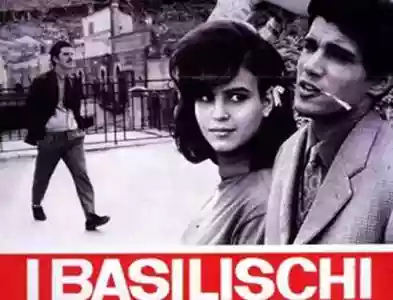
So, there's this town and there are three young men, friends, who do nothing but loiter up and down trying to pick up girls. There's the one who studies, the one who's a farmer, the one who's ugly and introverted.
The one who even listens to jazz...but only the music though, I don't like it when they sing.
There's the "cultural" club where more than anything, people drink a glass and play cards.
And they talk.
They talk, they talk, they talk.
The town.
A dimension of its own, so much so that today the town, especially in the south, is not that different from 50 years ago, in fact, it's more or less the same.
Wertmuller's social critique is very clear: yes, in the south, it's tougher, it's hot, there are fewer resources but you do NOTHING to progress or improve. You bask in your ignorance and immobility because deep down, you are fine with it. Many young people left the town to study and work in the north, but many stayed.
I want to leave, I feel like I'm bursting, I can't take it anymore says the guy who listens to jazz.
No! We must stay instead; it's here that we need to change things! his friend replies during a walk.
The film, in the best Wertmuller tradition, is also highly entertaining, with a young Stefano Satta Flores, with his perpetually empty cigarette holder in his mouth...do you have a stub? in great shape.
Brilliant dialogues, you laugh well and often but you reflect even more, if you want.
Unmissable, I would say.
Loading comments slowly
Summary by Bot
Lina Wertmüller's debut film 'I basilischi' captures the lethargy and social stagnation of a small southern Italian town in the early 1960s. Through sharp dialogues and vivid characters, it presents both humor and deep social critique, focusing on youth disillusionment and the struggle between leaving and staying to change the community. With memorable performances and a distinctive narrative voice, the film remains relevant today. The reviewer highly praises the film's depth and entertainment value.
Lina Wertmüller
Italian film director and screenwriter (1928–2021), known for satirical and social-realist films; first woman nominated for the Academy Award for Best Director for Pasqualino Settebellezze (Seven Beauties).02 Reviews
