
 •
Rating:
•
Rating:
THE REVIEW
1990s. Filtered through Debaser or other specialized music sites, they seem like a "new Eden," a return to the centrality of rock and experimentation, compared to the mediocre 1980s, which perhaps were not mediocre at all, as the readers of this site well know.
The 1990s ideally open with Slint and Fugazi, with the reestablishment of a naked and solipsistic rock, contemplating itself without renouncing to send messages; they mark the maturity of those Sonic Youth who served as a bridge between the New York avant-garde and grunge; record the explosion of the Seattle scene with Nirvana, Soundgarden, Alice in Chains, not least the great Mudhoney; the rise of the ingenious Billy Corgan and his magnificent Smashing Pumpkins; the stoner rock of Kyuss; the rise of At the Drive In from remote El Paso. I could go on for pages and pages without exhausting the buried treasures in memories, discovering gold nuggets whose glows still echo today, with names like Mars Volta, Queens of the Stone Age, and others, but I'll stop here.
Rather, I would like to debunk a myth: if a time machine existed, and those in their thirties and older [as well as younger] went back to 1992-93, they would find a music scene unknowingly neglected, which is not the one described and chosen by our selective memory, which precisely saves from the Maelstrom of memories what better legitimizes and gives meaning to our present, but something worse.
They would find some shards of Guns 'n' Roses, some remnants of Aerosmith from airplay, some grain of Seattle Sound and Pumpkins, the Sonic Youth in an epic episode of Dandini's Avanzi (!) little else and then... the void vacuum.
The average listener of the time, the youngster approaching music in those years didn't have great record resources, great sources of information (the internet was far from coming, computers worked in DOS, Word is from '95, everyone despised PCs and preferred the Amiga...) and was somewhat at the mercy of the resources of their trusted shopkeeper: and, here, it was one thing to live in big cities, quite another to live in the province, where most of us lived in the province.
The music that was around, in short, let's say it without hypocrisies and nostalgic feelings, was mostly dancepop, residual techno, instant music to be consumed over a summer and then recycled, perhaps, in the November squares of early Fiorello karaoke. Those who wanted to emancipate themselves had to have older siblings or gurus willing to introduce them to the aforementioned artists, or rely on the safe past, on those classics cited as a model by the well-known Cobain: Led Zeppelin, Black Sabbath, Deep Purple, etc.
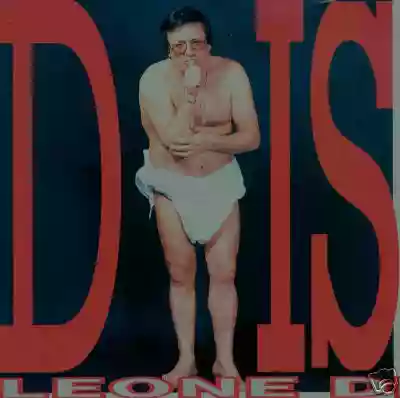
I, personally, didn't love that cheap pop at all, but, at least on one occasion, I found myself tapping the time to the tune of that music. It was an August day, I was in a small side street of a well-known Apulian center, when I heard from the flaming red Alfa '75 of a guy a piece by Ace of Base, All that She Wants, with great melodic appeal: only it was sung in Italian; only it referred to a certain Giovanni (Giuan); only it was rowdy; only it was the result of the outrageous dementia of a guy, Leone di Lernia, who, having set off from his native Puglia, had settled in Milan’s radio undergrowth.
It was a flash: I asked my cousin Pino to get me the vinyl [then possible in some shops that "rented" albums] and to duplicate it for me on cassette.
All the tracks were parodies, between vulgarity and idiocy, of the pop of the time, with a translation of the original English into Pugliese/Tranese dialect - a language that indeed lends itself to this, as natives and their kin well know: I quote, in order, the tracklist: Cumba' Giuan (All that she wants) - Davide (It's gonna be a lovely day) - Mo' le pigli (Love 'n' peace) - Nanz e reit (Would I lie to you) - Hauz - Ho fame (Informer) - Bevi stu-chinotto-to (Samba reggae) - Tu si pazze (Rhythm is a dancer) - Giù giù trovi a Beppe (Dur dur d'être bébé) - Aspettando Rita (I can make it).
Reflecting on that work, fifteen years later or so, now that I've lost the tape and haven't seen my cousin in some years, nostalgia does not take me. But I think Leone di Lernia was, unknowingly, the last true Italian punk: the Great Pop 'n' Dance Swindle.
A myth. Get (legally) some of those tracks thanks to modern technology, since the work is entirely out of print.
Those who were young in the '90s, and only saw Sonic Youth on TV, will benefit.
P.S.: the review was ready well before our protagonist, as I discovered last night at midnight, participated in the island of the famous.
Loading comments slowly
Summary by Bot
This review revisits Leone di Lernia's 1990s album Disco Hauz, a collection of irreverent parody tracks blending Italian regional dialect with dancepop hits of the era. It reflects on the neglected and largely provincial music landscape of early 1990s Italy, contrasting it with global rock movements. The album’s raw humor and unique cultural twist position Leone di Lernia as an unexpected punk figure and a legend in his niche. The review encourages rediscovery through modern means despite the album’s out-of-print status.Tracklist
01 All That She Wants (Cumbà Giuàn) (02:25)
02 I Can Make It (Aspettando Rita) (03:13)
03 It's Gonna Be A Lovely Day (Davide) (04:02)
04 Love 'N' Peace (Mo' Le Pigli) (03:40)
05 Would I Lie To You? (Nanz E Reit) (04:25)
06 Hauz (03:43)
07 Informer (Ho Fame) (04:15)
08 Samba Reggae (Bevi Stu Chinotto-to) (04:24)
09 Rhythm Is A Dancer (Tu Si Pazze) (04:30)
10 Dur Dur D'être Bébé! (Giù Giù Trovi A Beppe) (04:25)
Leone Di Lernia
Italian singer and radio personality known for comic and parodic covers of popular dance-pop songs, often performed in a Pugliese/Tranese dialect.02 Reviews
