
 •
Rating:
•
Rating:
THE REVIEW
It has been exactly thirty years since the release of this album, which cannot be said to be the most acclaimed or well-known of the Canadian songwriter, but it is still a significant testament not only to Cohen's poetic measure, but to how he, as only great artists can, is capable of reaching timeless heights and touching common inner strings, elevating intimate notes to lyrical existentialism.
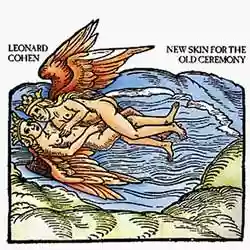
"New Skin for the Old Ceremony" in some respects represents in its own way a sort of singularity in Cohen's discography: starting from the cover, for example (the only one, apart from "The Future" from 1992, in which he does not appear portrayed) and from the title (formally devoid of the functional and sober essentiality of those of previous albums, as well as those that followed it).
From a strictly musical standpoint, it is in this album that Cohen, possibly to meet production needs, abandons the essentiality of the accompaniments of the first albums, to place the songs in a more articulated orchestral setting (sensitive and fundamental in some songs, the emphasis given to banjos, mandolin, clarinet, strings, or percussion...).
The style is nonetheless always that stark and unadorned one, sometimes sweet and enchanting, sometimes biting and incisive, marked by an extremely high poetic measure, that does not disappoint.
Cohen's songs evoke silence, recall truths, common existential numbers, whispered into the listener's ear, or asserted as an insistent refrain, by a voice sometimes suave, sometimes sharp, for which, really, it is difficult to find an adjective that does not end up punishing and limiting it, despite the best intentions of those who try to write about it.
In this album, some tracks appear for the first time which later became part of Cohen's "classics" repertoire: I think of "Chelsea Hotel #2" (an intense India ink sketch on white paper about the songwriter's fleeting relationship with Janis Joplin), "Lover Lover Lover," "Take This Longing," and the fluted, psalm-like "Who by Fire" (magical and delicate to listen to, yet so realistic and inexorable in its underlying message).
In the songs where love is the protagonist ("Is This What You Wanted," "There is a War," the already mentioned "Chelsea Hotel #2," "I Tried To Leave You," and "Leaving Green Sleeves" are eloquent examples) traces of sometimes fleeting relationships are found, consumed in passion, which seem necessarily to have been realized in union and completed in subsequent detachment, having transience as a common trait.
There is no happy ending in the liaisons Cohen sings about, but only the disillusioned, sometimes resentful and bitter realization that they have been and are no more. Even the surrender to memories, if there is any, is almost never heartfelt, but a cold, objective verification of the inexorable necessity for which two people meet, brush against each other, and then part. This inevitability of separation, however, seems almost to be exorcised by the cover image: a copulation that refers to mysterious alchemical-esoteric meanings.
Alongside love, it is certain that in this album Cohen also gives voice to reflections that concern strictly his sphere as an artist. If it is true that "New Skin..." was born after a personal artistic-human crisis, I would be inclined to believe that there is an echo of this in "Field Commander Cohen" and "A Singer Must Die," songs in which the artist also provocatively and mockingly questions himself, perhaps in response to alleged detractors ("You guardians of beauty / your vision is right / my vision is wrong / I'm sorry for smudging / the air with my song").
This year Cohen turns seventy, most of which dedicated to music, as well as literature and poetry. It's almost needless to say how many artists have paid him tributes: from Nick Cave, to Jeff Buckley, to our own De André; or are more or less worthily indebted to him: from Ian McCulloch, to Morrissey (with regard to the latter, I point out a suspicious echo of a verse from "Take This Longing," in "Hand in Glove" by The Smiths).
"New Skin..." remains an album that I find useful to fully understand the journey of this precious and intense artist, and to listen to, perhaps, on less sunny days. Just like happened to me the first time: watching a spring sky that didn't want to give way to the sun, preferring the clouds and a faint drizzle. Some say there is no better condition to listen to Cohen... despite the misfortune of the weather.
Loading comments slowly
Summary by Bot
This review celebrates Leonard Cohen’s album New Skin for the Old Ceremony as a significant, poetic work marking his musical evolution. It highlights the album’s orchestral richness and timeless themes of love, loss, and existential reflection. The reviewer sees it as essential to understanding Cohen's artistic journey, praising its lyrical depth and emotional resonance. The album is recommended especially for contemplative listening.
Leonard Cohen
Leonard Norman Cohen (born 1934 in Montreal) was a Canadian poet, novelist and singer-songwriter who released his debut album in 1967 and recorded and performed through the 2010s. He died in 2016.33 Reviews
Other reviews
By DBMsonic1
The whole album seemed insubstantial to me.
"There Is a War," for me the most beautiful song, with its ruthless metaphor of love as a battlefield.
