
 •
Rating:
•
Rating:
THE REVIEW
Well, where to begin. Let's give a bit of historical background. This album, released in 1970, follows a very intense period for Led Zeppelin. Having fulfilled all contractual obligations under the name of the New Yardbirds, the band began to shine in its own right, mainly thanks to the second album. The younger generation, especially the American one, saw in the Dirigible an absolute synthesis of overcoming modesty, freedom of customs, that hippie philosophy with which Robert Plant's voice and Bonzo's drums were impregnated. For Page, a solid yet ingenious musician, doubts about Plant had subsided: the boy, younger than Page by a few years and without much experience, managed to be effective on stage, and his charm as a young Greek God, as a fascinating ephebe, convinced even the hard and perfectionist Page, who had softened his stance precisely because of the success that the exuberance of the Plant/Bonzo duo was achieving. The other half of the group (Pagey and Jonesy) were a pair of seasoned professionals who knew all the tricks of the trade very well, from recording an album to how to behave on that treacherous ring that is the stage of a concert.
After a 1969 spent riding the wave of success, Led Zeppelin found themselves at a crossroads. On the one hand, the press did not hesitate to point out that the Dirigible's repertoire unapologetically reinterpreted the blues discography (from Robert Johnson to Sonny Boy Williamson). On the other hand, the youngsters kept calling for their new album. Atlantic Records had found its golden goose. Plant, in his first real experience, nevertheless couldn't withstand the frantic pace of those days and had to forgo some dates. It was the first sign of fatigue: the band needed rest. Jonesy showed signs of dissent regarding the band's continuous precarious situation, Bonzo conveyed his frustration over being away from home by wrecking every hotel he ended up in, and Pagey (then the undisputed leader of the band) had no choice but to agree to a break. The chosen destination was a cottage in the Welsh countryside, at a place called Bron-Yr-Aur, which in Gaelic means "Golden Breast." Among the breasts of the Gaelic countryside, Plant and Pagey crafted an album absolutely unusual for the brief production of the Dirigible. They were influenced by the bucolic air of the countryside, the climate made of farms, fields, and silvery lakes. Thus was born the most controversial album in Led Zeppelin's history.
Pagey intended to immediately show that the "blues-rock'n'roll" atmosphere had not faded at all. "Immigrant Song" was a clear example of this. But regarding the lyrics and meanings, it was obvious something had changed. Page and Plant were already developing (Page especially) a particular love for Nordic mysticism or mystical literature. If Plant was a great fan of Nordic and Gaelic myths, Pagey was a huge admirer of the last great satanist, Alistair Crowley, whose objects Pagey was a great collector of. Thus, the rock atmospheres were not lost, and "Immigrant Song" was a hard ride of the Dirigible that was returning to be the "overlord" of the music of those times. The press would never understand. It continues with "Friends," a pleasant acoustic piece, with a text that is a product of Robert Plant's classic philosophy. A hymn to friendship, love towards others, an intense life to be lived with joy and hope. It continues with "Celebration Day," which is yet another different song from the previous two: a pure piece, without too many frills, that makes the technical wisdom of Jimmy Page and the carefulness of John Paul Jones as an excellent and experienced composer its best weapons. This leads to the best piece of this album: "Since I've Been Loving You." This song is extremely controversial: on one hand it might seem like a text by Jimmy Page, in the early part of his extremely misogynistic musical life (read the lyrics of Dazed and Confused for further explanations). On the other hand, it seems like a poignant and touching melancholic cry from Robert Plant, a master at passionately involving his listeners. The only flaw in this song is its being placed in the middle of the tracklist. This indeed is a considerable burden for the subsequent songs, which, although of good quality, do not, in my opinion, stand up to the comparison. "Since I've Been Loving You" is a cornerstone of the Dirigible's discography. No more words are needed.
It continues with "Out on the tiles," a pleasant little song that contains an intro dear to the late Bonzo, who would often use it especially as an attack to "Black Dog" from 1971 onwards. A good rhythm, but it is essentially Bonzo who shines here. The next piece is "Gallows Pole": this song is quite underrated. It is a reinterpretation of an old Gaelic nursery rhyme, masterfully interpreted by Robert Plant, especially in the final section. Personally, it drives me crazy, but it's not a classic Zeppelin song. We come to "Tangerine," another piece, this one, highly snubbed by critics and (I'm sorry to say) by some fans. This is the best fusion of the whole band in the entire discography of the Dirigible. Ladies and gentlemen, we're facing a masterpiece by Jimmy Page, who here is truly the conductor of an orchestra capable of infusing in these 3 minutes all the possible empathy, every drop of the group's alchemy. A must-have piece. "That's The Way" is an interesting ballad, with a slightly melancholic theme, which fits the album. It's a piece that Led Zeppelin used a lot in their tour setlists because it can spread a strong sense of harmony, especially thanks to Jimmy Page's acoustic guitar, a constant in this record.
It continues with "Bron-Yr-Aur Stomp," a really nice song. It’s a joyful song, dedicated to Plant's dog, talking about how simple and beautiful life can be if lived with simplicity, enjoying the little things, smiles and games, good times spent with one's life companion. Aside from the semantic discussions, Bonzo's participation in this song is also interesting. Not for the drumming, but for the voice and tambourine. I've always thought the troublemaker dog of Plant was him. It ends with "Hats off to (Roy) Harper." To me, the song doesn’t seem exceptional, but I will say one thing. I don't know how informed you are, but the song is dedicated to a "minstrel" that Pagey and Percy (Plant) especially carried with them because he cheered them up and they found him funny. There are various rumors about this Roy Harper. The first probable one is that Bonzo, Richard Cole, and Peter Grant (the drummer and lead managers of the band) wanted to break his bones, as they disliked him quite a bit. It is wrongly rumored that Harper was Page's lover (a huge falsehood). It is rumored—and this is hearsay—that it was this "petty poet" who wrote the music for "Stairway To Heaven." Sticking to the facts, Harper composed two albums with the "Swan Song" label. Anyone with more information, please step forward.
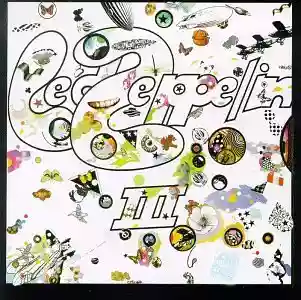
Back on topic, the album is among the best Zeppelin production. I wouldn't discard any Dirigible CD, but III is the most atypical within their production. This CD, especially at the level of lyrics, is entirely attributable to Jimmy Page and Robert Plant. The others worked on it in post-production, recording the instrumental parts. Rating: 4 It is a must-have CD, but it might not please those who are attached to Zeppelin's more rock-blues soul.
Loading comments slowly
Summary by Bot
Led Zeppelin III represents an unusual but vital entry in Led Zeppelin's catalog, blending their blues-rock roots with acoustic nuances and mystical influences. The album was crafted in respite from their hectic schedule, featuring standout tracks like 'Immigrant Song' and 'Since I’ve Been Loving You.' While some tracks are underrated, the collective musicianship shines, especially Page and Plant’s contributions. This album is essential for fans seeking a deeper and more varied Led Zeppelin experience.Tracklist Lyrics Videos
Led Zeppelin
Led Zeppelin were an English rock band formed in 1968 by Jimmy Page with Robert Plant, John Paul Jones and John Bonham. They became one of the most influential rock groups of the late 1960s and 1970s; the band disbanded after John Bonham's death in 1980.109 Reviews
Other reviews
By ROCKER88
Page achieved his dream: to make the listener compare the sound of the guitar to the relentless advance of an army.
'Since I've Been Loving You' is a blues masterpiece with Plant's voice erupting thundering after the initial sweetness.
By macciopiccio
"Among the top ten most badass riffs in the history of Rock."
"'Since I've Been Loving You' is a piece to fall in love with, like becoming enamored with a woman or a man and remaining indissolubly tied for eternity."
By claudio carpentieri
Immigrant Song, a musical monolith in which Plant’s cries of invasion propel an invincible shock wave.
Gallows Pole intensifies the narrative of the condemned prisoner escaping his unhappy fate with an ingenious blend of instruments.
By James Patrick
"Immigrant Song" is an indescribable bomb that will inspire more than half of Heavy Metal.
From this album onwards, there will be a turning point: new melodic choices, new rides, different ways of interpreting rock.
By paolofreddie
"Since I've been loving you, a magnificent and sublime blues piece, is my favorite Led Zeppelin song."
"The album is certainly not on par with masterpieces like Led Zeppelin I and IV, but it has a nice sound, and the listening is very pleasant."
