
 •
Rating:
•
Rating:
THE REVIEW
In the collective imagination of the enthusiasts, or at least the connoisseurs of the Dirigible, this elephantine and rousing expedition into Middle Eastern territories and moods holds the third absolute position in the hierarchy of the many gems in their catalog, according to the majority, preceded only by the invoking, urgent, psychedelic riff of “Whole Lotta Love” and, in the very first position, by the pastoral and visionary electro-acoustic crescendo of “Stairway To Heaven”.
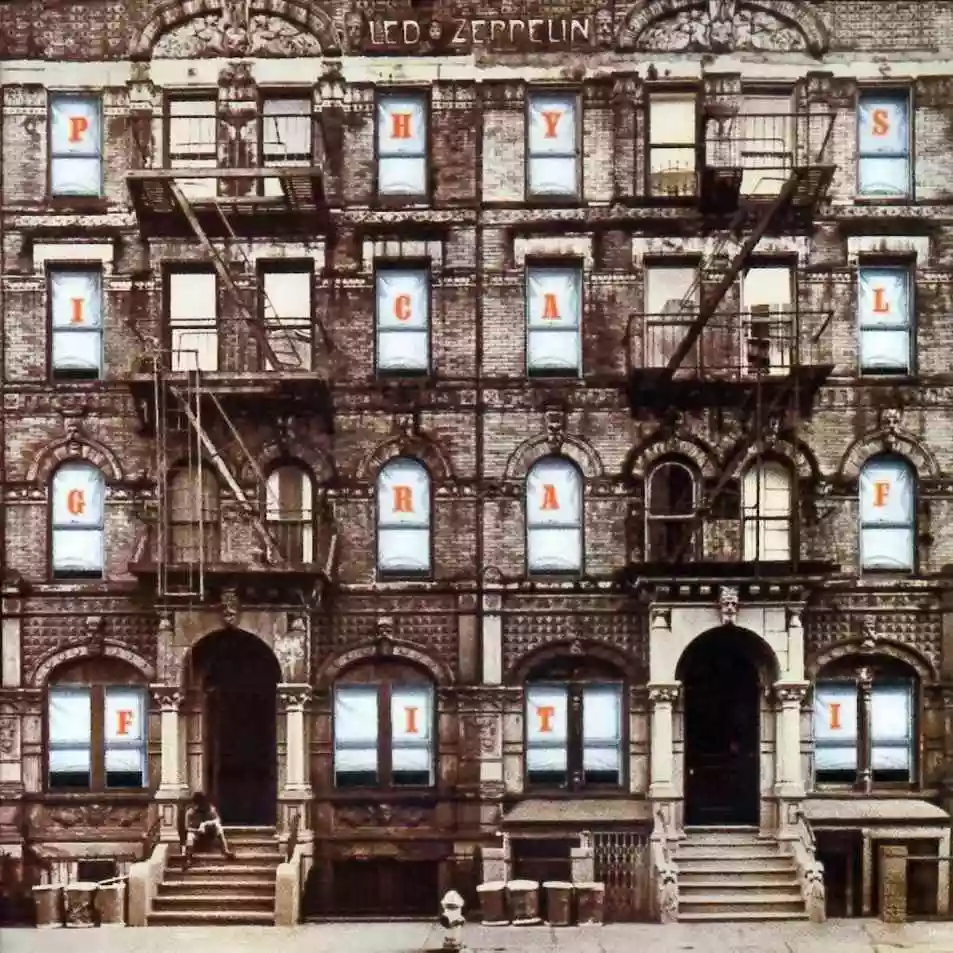
The song is, as many know, contained in their sixth and double album "Physical Graffiti", the last sensational leap upwards and towards glory, at the peak of an unrepeatable seven-year period of supreme variety and qualitative constancy, on the brink of a last five-year period full instead of problems and relative decline until the unfortunate halt in September 1980, following the disappearance of the indispensable, irreplaceable engineer John Bonham.
The main framework of this hard rock delight comes, as is customary for the Zeppelin, from the priceless musical alchemy between guitarist and drummer. Jimmy Page, wielding the guitar tuned to the Celtic way, meaning three out of six strings playing a D in open, even adds a fourth by pressing the A string at the fifth fret, thus creating a resonant drone, a D ostinato on which to embark on a chromatic ascent (that is, half a tone at a time) on one of the two remaining strings, with a vaguely Arabian flavor. This means that (almost) all of “Kashmir” can be played on a suitably tuned guitar by pressing two strings at a time and letting the others ring freely: an admirable example of excellence in simplicity.
Page brings this ascending riff in three-fourths, but his drummer pays no heed and brilliantly marches on with his four-fourths… no worries because 3x4 is like saying 4x3 so every twelve beats they meet up again, and it starts anew. The rhythmic/harmonic result is of disarming effectiveness and beauty, perceived as exotic and at the same time fascinating by anyone with ears attuned to good music, but also by those who aren't.
When it's time for the change, the chorus, the modulation, the brave Bonzo pays no heed to that either and marches right through with unheard-of genius! Page's guitar, but even more the fanfare organized by John Paul Jones's mellotron and the accompanying orchestral musicians, harmonize with descending scales and pim and pam in a triumph of emphasis, but the drums proceed like a truck, disregarding accentuation or displacement, with Jones's bass consciously following along with the same riff as the verses.
It is, in short, the old school of making good music... it's what Bonham does NOT play that makes the already excellent melodic and harmonic intuition of his guitarist unique, compelling, and priceless. Bonzo wasn't a drummer of this world... he was a kind of rhythm god capable of drawing feeling and joy and glory both through the unparalleled, explosive sound he managed to extract from his drums and from the celestial perfection, the too-right way he had of spreading bass drum and snare in the rhythmic path… a magnificent brute force combined with complete and sublime surrender to rhythmic intuition.
The verdict then is that there's no contest, even thirty-five years after his death: the best. There is no drummer in the world with the heart in the right place who isn't impressed by John Bonham's art, the Mozart of skins and cymbals.
But let's get back to the song: wanting to last beyond eight minutes, it needs additional variations beyond the verse/chorus succession (Plant is also absent in these, ousted by the grand fanfare of strings). The Zeppelin organize a couple: the first is an imperious staccato in the key of A, fertile ground for Plant's wails and some Bonham's offbeat fills, the second is a melodic opening stretched over a couple of chords, conceived by the singer but where Jones also swoops in with his real and fake strings, both musicians focused on maintaining very tight Middle Eastern scales. This bridge appears twice… the first is in the middle of the song and its exhaustion and fall back into the immense drone/riff escorted by the last moan of the singer constitutes, in my opinion, the most exhilarating point of the track. The second constitutes the epilogue, with each turn increasingly swollen with orchestra and rolls of a Bonham who only at this point lets go, until the final fade-out.
Robert Plant conceived the lyrics during a crossing of the Moroccan desert, entitling it for some reason to an Indian region that neither he nor anyone else in the band had ever visited up to that point. Remarkable is his ability to melodically insert himself between the rhythm's cannonades and the rest of the instruments in a powerful staccato, describing a serpentine and fascinating singing path (in thirds, like the guitar and disregarding drum and bass) that wraps the martial cadence in exoticism and mystery.
In five hundred years, if the human race still exists, there will surely still be theaters and places where music is performed, and then inside one of them, we will certainly find an orchestra along with some guitar, drum, and bass players, as well as a singer with a suitably stentorian voice, all grappling, before an adequate and attentive audience, precisely with these eight minutes of rock excellence, presented as they were conceived and perfectly arranged in admirable musical cohesion by the four of the Zeppelin, forty years ago. This is classical music by now, and it will be increasingly so in the future.
Loading comments slowly
Summary by Bot
This review praises Led Zeppelin's 'Kashmir' as an iconic rock piece that masterfully fuses Middle Eastern musical elements with hard rock. Highlighting John Bonham's exceptional drumming and the band's impeccable collaboration, it positions the song as a timeless classic from the 'Physical Graffiti' album. The track’s complex rhythms and orchestral arrangements are celebrated for their originality and emotional power, affirming its lasting impact on music history.Tracklist Lyrics
Led Zeppelin
Led Zeppelin were an English rock band formed in 1968 by Jimmy Page with Robert Plant, John Paul Jones and John Bonham. They became one of the most influential rock groups of the late 1960s and 1970s; the band disbanded after John Bonham's death in 1980.109 Reviews
