
 •
Rating:
•
Rating:
THE REVIEW
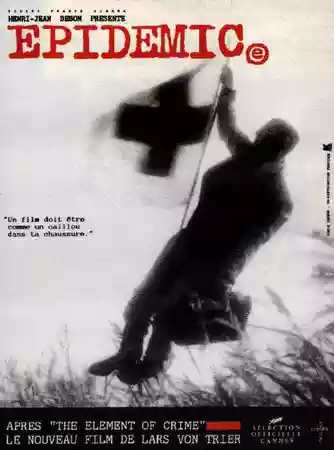
**Epidemic — Lars von Trier, 1987**
How much are you truly willing to feel, how much are you willing to stop watching and start being watched. Von Trier was twenty-seven and was already carrying within him that fundamental contradiction which would fuel all his later work: a manic, almost tyrannical formal control, and at the same time a visceral fascination for chaos, for loss, for the moment when structure gives way and lets something spill through that was never written into the script. Of all his works, Epidemic is the one where this contradiction is most exposed, most naked, most openly declared — almost programmatically, almost with the intellectual sadism of someone who builds a trap and then walks into it himself to prove that it works. The structure is already, in embryo, pure von Trier: a film within the film, a continuous metalepsis between the character Lars and the author Lars, between the declared fiction and the reality that seeps into the edges of fiction like water under a door. Two screenwriters — von Trier himself and Niels Vørsel — lose their script and write a new one in five days, while in parallel we see the film they are writing, the story of a doctor who spreads the plague across Europe while believing he is fighting it. The epidemic as a metaphor is nothing new — from Camus to Manzoni, from Defoe to Pasolini, contagion has always revealed something about social order, about the fragility of human community, about the latent violence that civilization barely contains — but von Trier embodies it, lets it contaminate the film itself, makes sure that the plague the characters are writing about escapes from the page and infects the celluloid, the set, the diegetic reality up until the finale, which is one of the most devastating and formally perfect of European cinema in the eighties. That finale — the medium, the hypnotic séance, the collapse of the distance between representation and body — must be placed in a precise genealogy: it is a direct descendant of the Carl Theodor Dreyer of Gertrud and Ordet, of that Danish ability — perhaps it’s something in the Nordic blood, in the flat and merciless northern light — to push the image to the limit of endurance through subtraction, through the silence that precedes the scream and makes it inevitable. Von Trier has always acknowledged his debt to Dreyer with a candor verging on religious devotion, and in Epidemic this debt is more visible than elsewhere — in the black and white cinematography of Henning Bendtsen, who had worked with Dreyer, an explicit poetic statement, an act of belonging to a tradition, a way of saying *vengo da qui, parto da qui, anche quando vado altrove*. The film also converses with Godard — with the Godard of Masculin Féminin and Week End, with that ability to make the film an essay on itself, using self-reflexivity as a further generator of tension — and with Fassbinder, with his preference for mechanisms of oppression hidden within the seemingly neutral structures of daily life, and more subtly but truly with Bergman, especially the Bergman of Persona, where the frontier between two subjectivities begins to dissolve, and identity reveals itself to be a fragile convention, a precarious agreement between forces that have never really met. What makes Epidemic impossible to reduce to any other work of the period is the conviction — aesthetic even more than moral — that art is honest only when it is willing to hurt itself, that form is whole only when it contains its own possibility of breaking, that cinema tells the truth about pain by letting pain in, without protection, without the safety net of well-sealed fiction. This is the phenomenology of von Trier in its embryonic and purest form: cinema as an act of total exposure, as a refusal of aesthetic distance, as a gesture that costs something — to the director, to the actors, to the viewer — and that finds its legitimacy precisely in this cost. A profound and coherent theoretical position that runs through all his later work, from Europa to Breaking the Waves, from Dancer in the Dark to Melancholia. And then 2020 arrives, and the phrase von Trier wrote in 1987 — to spread the epidemic while believing you are fighting it — regains a resonance that no film analysis had predicted and that no cinephile would ever have wished to see confirmed so literally. Because what the media did with the pandemic, for better or worse, is exactly the mechanism the film describes: the narrative about contagion itself became a contagion, information and fear spread at the same speed as the virus, often with the same indifference toward the host, and the border between prevention and emotional saturation got so thin as to become invisible, as to become the kind of boundary you cross without realizing it, like the doctor in Epidemic entering villages with the certainty of bringing salvation. Collective sensibility — already fragile, already frayed after years of continuous emergency information — underwent a particular twist in those years: the excess of danger’s visibility led many not to deeper awareness, but to a form of anesthesia, the very same anesthesia von Trier diagnosed in his 1987 audience when he asked them, with the steady voice of one who already knows the answer, how much they were really willing to feel. The question remained open. It is still open. And it is still, in 2026, the most uncomfortable question that cinema is able to ask.
Loading comments slowly
Summary by Bot
This review explores Lars von Trier's 'Epidemic', focusing on its experimental approach and striking narrative. The film is praised for its haunting atmosphere and innovative storytelling. The reviewer acknowledges both its influence on cinema and its capacity to provoke strong audience reactions. Overall, it's recommended as a memorable viewing experience.
Lars von Trier
Lars von Trier is a Danish film director and screenwriter known for provocative, formally innovative cinema. He co-founded the Dogme 95 movement and has made acclaimed works including Breaking the Waves, Dancer in the Dark, Dogville, Antichrist, Melancholia, and Nymphomaniac.24 Reviews
Other reviews
By lorenzo tore
The nightmare triumphs over the dream, and reality over imagination.
The disease represented by the director is the same unhealthy desire to race towards a future... that leads to madness, mental discomfort, and the physical need for situations and things that can only harm.
