
 •
Rating:
•
Rating: THE REVIEW
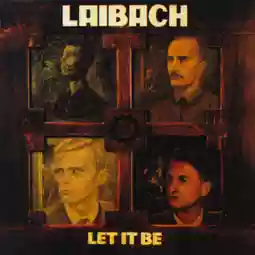
"Let It Be", as can be inferred from the title and the cover, is a remake of the Beatles' album of the same name.
Knowing the desecrating spirit that has always distinguished the Slovenian formation, we are not overly surprised: the entire work of the industrial act Laibach, if you look closely, is a ruthless process of transfiguring rock conventions, especially in its most canonical and commercial dimension. We have caught them red-handed multiple times, violating top chart titles ("One Vision" by Queen, "The Final Countdown" by Europe, "Dogs of War" by Pink Floyd, the famous "Jesus Christ Superstar" from the musical of the same name, "Life is Life" by Opus, "Sympathy for the Devil" by the Stones, shredded into seven hallucinatory versions). And in this massacre game, where the originals are overturned and stripped of their original meaning, not even Lennon and his companions, the most untouchable of all, are spared.
However, one should not think of it as a simple prank by a group of merry pranksters. Laibach's music actually has a well-defined conceptual value, and it is no coincidence that their choice fell this time on the Beatles, an immortal icon of popular rock, and on their last album, certainly not the best, a product of the disintegration that was already affecting the band in recent times and would end the dazzling career of the four from Liverpool. In this choice, it is evident, an attack on institutions (because the Beatles, like it or not, have become an institution). Reproducing in full the swan song of the most acclaimed rock band on the globe becomes an opportunity to celebrate the decadence of rock in its entirety and reflect on the meaning of this phenomenon in our society.
Always masters of provocation (they were among the first to adopt a warlike iconography, a choice that exposed them to ideological criticism from the start of their career) and intent on drawing parallels between totalitarian regimes and Western "democracy", Laibach decide to target rock, a symbol of a society that flaunts well-being, freedom, and opulence. Are we sure this isn't just a parade, I mean rock, that acts as a screen (like the entire entertainment apparatus) to shady dealings passing over our oblivious heads?
Laibach responds by dehumanizing rock, blending it in their ruthless operation of sound butchery and returning it to us in a "totalitarian" form, bare and limping, devoid of all pathos and poetic intent. The creativity of the artist is thus replaced by machine programming, Lennon and McCartney's love song turns into robotic and inhuman verses, the libertarian joy of live happenings becomes the echo of mass rallies held by mad demagogues.
You may have guessed that, among martial rhythms, mighty wagnerian orchestrations, and driving Soviet choirs (the true trademark of the band), very little remains of the original compositions by Lennon/McCartney. Milan Fras' cavernous voice completes the picture, removing any trace of humanity from the whole. Fras' hoarse baritone singing, worthy heir to Eldritch (Sisters of Mercy) and a reference point for a myriad of artists to come (from EBM to Gothic, with Rammstein leading), paradoxically manages to embody the megalomania of a haranguer and at the same time the degradation of a deportee, stripping the decadent spleen from the dark tradition from which he evidently draws. And hearing him sing makes us wonder: is it possible that through rock speaks the voice of an occult persuader? A power that evidently no longer needs a face and a shining uniform? The cult of personality thus transfers to the current idol, the political allegiance ritual in the swaying gestures of the hysterical audience, which becomes a delirious mass sublimating its frustrations in an exercise of collective annihilation. And I am reminded of Freud's mass psychology and Marcuse's revolutionary sociology.
"Let it be so", don't change, don't think about it: don't think. This seems to be the new message of "Let It Be", which, mockingly, wasn't even included in the collection, yet another bad taste joke by Laibach, who decide to leave out the most famous track of the lot. It thus starts with an unrecognizable "Get Back", pressing percussion and tragic progress, and the refrain doesn't change: decaying iron curtain industrial, where the only episode recalling Beatles echoes is "Across the Universe", for female choirs only: a melodic parenthesis in a grotesque and threatening world. The rest is a slaughterhouse of samples, drum machines, military chants, and distorted guitars that contaminate an overall still electronic setting.
Moreover, the concept itself requires more rock-oriented nuances, since the Laibach creature (and we'll see it well in the future in works like "Jesus Christ Superstars") does not fear having to change its skin to pursue its conceptual goals. Laibach writes following a precise path (the very birth of the band, in 1980, the year of Tito's death, assumes a strong symbolic value), their albums are thesis essays and the apotheosis of the new sound is in "I’ve Got a Feeling", which reproduces the mood of a live performance, with such an applauding audience, thus apparently denying the band's electronic vocation.
The sounds (we are in 1988) are in reality bare and crude and could date back five years earlier, but these too play into Laibach's hands, who wisely recreate the tense and elephantine atmospheres of an enormous bureaucratic machine that inexorably crushes the individual and his emotions. Alienation, therefore, but also the suffocating stench of steam, the roughness of rust, the unbearable weight of the steelworks that go along with the incontrovertible imperatives of the Machine. To close the dance, we find the only piece that is not by the Beatles: the march "Maggie Mae", a revisitation of an air from the Slovenian folk tradition.
To prevent any ideological observation, it's important to clarify that Laibach, unlike other formations dedicated to the same atmospheres, embody the provocative spirit of early industrial, which shows and extremistly exaggerates what is to be demonized. Labeled as sympathizers of both the extreme left and extreme right, the true key to understanding Laibach's art is found in their satirical intent. And if it's true that our friends, by pushing the provocative spirit to the extreme, have mockingly managed to walk the fine line of ambiguity (famous is Fras' statement: "We are fascists as much as Hitler was a painter"), it is also true that penetrating the mind of those who have truly lived through dictatorship, especially in a screwed-up context such as former Yugoslavia, is really a difficult thing.
What makes it all even more confusing is that Laibach's visual art (album covers, posters, but also images projected during concerts — let's remember Laibach originated as a multimedia project) is reminiscent of the art of Helmut Herzfeld (aka John Heartfield), an anti-Nazi and communist German artist, known for his satirical photomontages aimed at ridiculing Nazi propaganda.
Are Laibach just pulling our leg? In doubt, all that's left is to bow to the power of the Machine. Long live Laibach!
Loading comments slowly
Summary by Bot
Laibach's 'Let It Be' is a bold and provocative industrial remake of the Beatles' last album. Known for their satirical and conceptual approach, Laibach deconstructs rock music, replacing its humanity with mechanical, totalitarian soundscapes. The album criticizes the decadence of rock as an institution while delivering a powerful statement on society and control. Milan Fras' commanding vocal performance enhances the album's dystopian atmosphere, making it a compelling cultural critique.Tracklist Lyrics Videos
03 Dig a Pony (04:43)
07 Maggie Mae (Auf der Lüneburger Heide & Was gleicht wohl auf Erden) (03:43)
Read lyrics
Laibach
Laibach is a Slovenian industrial/avant‑garde music group formed in 1980 in Trbovlje and a founding member of the Neue Slowenische Kunst (NSK) collective. Renowned for provocative use of totalitarian aesthetics, they deconstruct popular culture through radical reinterpretations and multimedia work.06 Reviews
