
 •
Rating:
•
Rating:
THE REVIEW
One hot June day, I found myself wandering around a well-known flea market in Rome. Here, I often find the most amusing and bizarre things to buy, but above all, I take the opportunity to stock up on books, DVDs, CDs, and occasionally LPs. In the mix of titles, I never really expect to find the album of my favorite bands, but of course, you never know: "Venditti", "Disco samba", "Bimbo mix", "Mixage", "Lando Fiorini", and all of a sudden: "Krokus - Metal rendez-vous"! I didn't hesitate, paid the moderate price of 3 euros, and brought home the unthinkable relic.
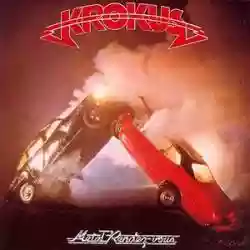
A cover that’s too 80s, with two cars colliding, rising up at the impact and releasing some artificial smoke, and inside, a lovely little poster of the band performing live. But the "Top" is the back: The credits are printed like a police report: what a spectacle! I already knew Krokus, not very well, but I had something from the "Headhunter" album on some "dubbed" cassette. As one might guess from the outlandish cover, it's early-eighties metal/hard rock strongly influenced by the Bon Scott era of AC/DC, to which Krokus is similar both for the hard 'n' blues style and for the voice of Marc Storace (whose debut coincides precisely with this album), warm and hoarse, really reminiscent of AC/DC. Surely, Krokus has made the history of Swiss metal, which, despite its meager surface of just 41,285 km², besides cheese, chocolate, and papal guards, has churned out very respectable rock and metal bands like Coroner, Celtic Frost, and Gotthard.
"Metal rendez-vous" was released in 1980, in the middle of the NWOBHM era, a period considered a line of demarcation between hard rock and heavy metal, when many rules had yet to be set and much metal road was still to be traveled. If in the '50s all singers did everything they could to sound like Elvis, in the '60s the beat music, the hair, and the look was all "Beatles-style", and in the '70s the influences came from a myriad of milestone bands. But one thing is certain, the true pioneers who thrilled rockers worldwide with their hard'n roll were AC/DC. Very likely, when that quiet Swiss group devoted to prog-rock named Krokus got an earful of "Let there be rock," they must have had a revelation like John Belushi in the movie "Blues Brothers". If you're a fan of the more modern sounds of metal, you're obviously on the wrong track; the primordial metal of Krokus isn't for you, the production is not the pinnacle of sound quality, forget about looped guitars and triggered drums; indeed, the crackling of the old vinyl makes it all even more retro and, in my opinion, more captivating.
"Heatstrokes" opens the dance, and from the first notes, it’s clear that the tacky album cover does not do justice to the technical value of the band: the guitar interplay of the Kiefer/Von Arb duo is immediately well showcased. It's followed by the catchy "Bedside radio" and its pleasantly predictable chorus, a thing that The Darkness discovered twenty-five years later! The album continues on enjoyable levels with “Back Seat Rock ‘N’ Roll,” one of the best in the batch, from which a fun video was also made. Then there's "Streamer," the inevitable slow one reminiscent of early Nazareth, while with "Come on" and "Fire," you get back to headbanging. Overall, an excellent album, which in its sound certainly draws inspiration from the Young brothers' band, but has nothing to envy more well-known and overrated classic metal bands (Twisted Sister?????) that may still be inexplicably revered after so many years (Manowar????). A sincere rock, hard and melodic in equal measure, which is still fun to listen to after thirty years.
To conclude, I'd like to cite a line from the "report" on the back cover: TYPE OF ACCIDENT: METAL RENDEZ-VOUS, CAUSE OF ACCIDENT: 100% OF ROCK AND ROLL IN THE BLOOD!...and I've said it all!
Loading comments slowly
Summary by Bot
This review celebrates Krokus' 1980 album Metal Rendez-vous as a pivotal work in early 80s hard rock and metal, heavily influenced by AC/DC. The reviewer praises the guitar work, Marc Storace's vocals, and the album's lasting appeal, despite modest production quality. The record is recognized as a key contribution to Swiss metal and a fun listen decades later.Tracklist Lyrics Videos
Krokus
Krokus are a Swiss hard rock/heavy metal band formed in 1974 in Solothurn. Known for Marc Storace’s raspy vocals, Fernando von Arb’s guitars, and Chris von Rohr’s leadership, they broke through with Metal Rendez-vous (1980) and cemented their reputation with Headhunter (1983) and crowd-igniting live shows.05 Reviews
