
 •
Rating:
•
Rating:
THE REVIEW
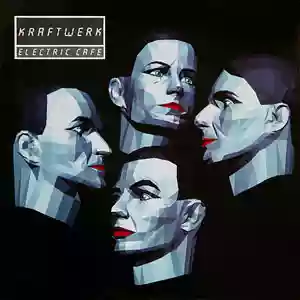
Sooner or later comes the moment when the critics, after years of praise, suddenly turn their backs on you: for Kraftwerk, this happened in 1986, when they released their ninth album "Electric Café"; "Autobahn", "Radioactivity", "Trans-Europe Express", "The Man Machine", and "Computer World" were hailed as milestones of electronic music, while "Electric Café" received only negative reviews, accused of being a sterile and uninspired work.
Its 35 minutes can be divided into two parts, a first, almost exclusively instrumental part, reminiscent of the industrial rhythms of "Trans-Europe Express", and a second where we find sung parts (including the first and only time of Karl Bartos) and a decidedly more pop sound.
The opening track is "Boing Boom Tschak", to be considered however as a continuum with the following "Techno Pop" and "Music Non Stop", characterized by pounding sounds, repetitive bass lines, and the only sung part (albeit by a vocoder) "Music Non Stop, Techno Pop", which repeats continuously alternating some variations: it's a self-definition of their own music, unstoppable, in continuous movement searching for novelty. "Electric Café" is not indeed a misstep in Kraftwerk's production, despite clearly recognizing the style of "Trans-Europe Express" and "Computer World", it still offers very interesting episodes, minimalist approaches (at least in the first tracks) and, after the initial triad, presents two completely different pieces, "Telephone Call" (which continues with "House Phone") and "Sex Object".
After exploring the relationship with the automobile, the radio, the train, computers, and calculators, it's the landline phone's turn, which is sampled in "Telephone Call" along with the automated voices of a telephone company ("The number you have reached has been disconnected"); it all complements catchy and light melodies and Karl's voice.
The same line is followed with "Sex Object", this time the melody is entrusted to strings, while the text, simple but effective, describes a superficial love relationship, in which one of the partners is used and discarded like any object; the concluding track, which gives the album its title, summarizes everything heard before, light yet repetitive and hypnotic melodies, however shaded by a certain melancholy.
Overall, "Electric Café" is an excellent work, it has nothing to envy from the previous ones, and in its brevity, it offers an effective and very "cool" style, among the discography of the German band, it may be the one that will most feel its influence on the birth of genres such as hip hop, techno, and trance.
The production, needless to say, is excellent, the sounds are wisely curated and measured, and a remastered version has recently been released; highly recommended, to listen to in one go, in my view, it can very well stand alongside the masterpieces of the '70s, 5 stars without thinking twice.
Loading comments slowly
Summary by Bot
Electric Café, Kraftwerk's ninth album, faced initial criticism but stands as a strong, influential work. Divided into two parts, it blends industrial rhythms with pop elements and vocal experimentation. The album's minimalist style and production quality highlight its enduring impact on electronic music genres like techno and hip hop. Highly recommended and considered on par with Kraftwerk's 70s masterpieces.
Kraftwerk
Kraftwerk are a German electronic music group formed in Düsseldorf in 1970 by Ralf Hütter and Florian Schneider, known as pioneers of electronic, krautrock and synth‑pop music.42 Reviews
Other reviews
By daftroby
Compared to other masterpieces from the 70s, it is decidedly less brilliant, too much simplicity in the rhythms and melodies.
In short, it may be enjoyable, but on a historical level, in my humble opinion, it doesn’t have much of importance.
By 123asterisco
You have installed external hard drives on your automatons.
Elevate this divertissement of yours to a manifesto.
By Martello
The world is a computer. I am a number. My body? Do I still have a body? Am I still my body?
It’s the end of the world, let’s get comfortable, relax, and enjoy its death.
