
 •
Rating:
•
Rating:
THE REVIEW
Kirsty MacColl was never fully appreciated as she deserved and had a discontinuous and fragmented artistic journey despite being the daughter of Ewan MacColl and the wife of Steve Lillywhite, divided into only five albums over twenty years, with several scattered singles and commercial success not matching her artistic expression. However, she was a magnificent interpreter of high-level pop-rock songwriting, not fitting into any stale clichés except for her art, honest, sincere, avoiding anything artificial and contrived. She was decidedly too little glamorous to be a pop star and too little snobbish to aspire to a place in the pantheon of "alternative" celebrities, a fate common to many of the artists closest to my heart.
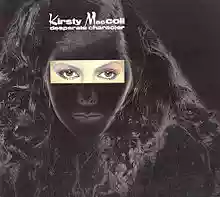
After the debut single "They Don’t Know," released in 1979, the first LP, “Desperate Character,” arrived two years later: Kirsty was only twenty-one at the time, and it shows. This is a youthful and unripe album in the sense of being instinctive, fresh, passionate, spontaneous; simple and sincere pop rock, infused with love and other little stories of youth, sweet with a pleasant tart aftertaste, like an apricot. A very young Kirsty MacColl from Croydon looking more towards America than the working-class England sung by her father, as demonstrated by the lively and funny rockabilly of “Clock Goes Round”, “There’s A Guy Works Down At The Chip Shop Swears He’s Elvis” and the delightful and bittersweet pseudo-country of “Teenager In Love”, with a little playful detour beyond the Rio Grande, the semi-nonsense of “Mexican Sofa”, also known as “Tijuana cup of coffee, Tijuana cup of tea.”
The whole album is a continuous outburst of beautiful melodies and vibrant colors. Songs like “See That Girl” and “Hard To Believe” are archetypes for the semi-acoustic and sentimental pop-rock that Kirsty would develop in the subsequent albums “Kite” and “Electric Landlady,” while at other times vintage sounds from the ‘60s and ‘70s emerge, such as the Doors-like organ solo in “Falling For Faces” or the distinctly sixties vibrant pop of “Just One Look” and “He Thinks I Still Care”, the semi-jazzy ballad “Until The Night” and the captivating and biting ‘30s swing of “The Real Ripper”. “Desperate Character” flows quickly, fun and without lapses in style, Kirsty MacColl's empathetic, versatile, never intrusive, playful, and brilliant vocalism hits the mark, just as much as her simple and sincere songwriting, fresh as a daisy, and therefore shining with its own light. You find yourself with a lively and adorable album, which in its unripe simplicity is perhaps the most successful of Kirsty MacColl's, together with the conclusion “Tropical Brainstorm.” Listening to these two albums, apparently so distant from each other in style and time, one can understand the depth of this true artist, capable of staying true to herself from Croydon to Cuba, always with the same irony, the same natural and genuine charm, the same smile.
Loading comments slowly
Summary by Bot
Kirsty MacColl's debut album 'Desperate Character' showcases a young artist's fresh, passionate pop-rock style. Despite fragmented success, the album shines with genuine melodies and versatile vocals. Its blend of vintage 60s and 80s sounds alongside heartfelt songwriting captures MacColl’s unique charm. This album remains one of her most successful and emblematic works, revealing her true artistic depth.Tracklist Lyrics Videos
Kirsty MacColl
Kirsty MacColl (1959–2000) was a British singer‑songwriter known for sharp, witty lyrics, a warm, expressive voice, and an adventurous blend of pop, folk, and later Latin flavors. Her career spanned from the 1979 single They Don’t Know to acclaimed albums like Kite, Electric Landlady, Titanic Days, and Tropical Brainstorm. She is also widely known for Fairytale of New York with The Pogues. Her life and career ended in 2000 in a boating accident in Mexico.07 Reviews
