
 •
Rating:
•
Rating:
THE REVIEW
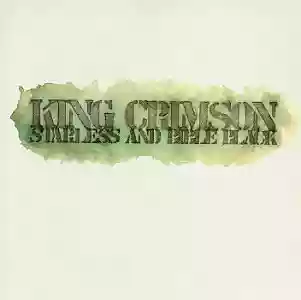
A central piece in the Crimson's prog-metal trilogy, "Starless and Bible Black" (a title borrowed from Dylan Thomas) is, in fact, a live album disguised as a studio album; most of the tracks are actually live recordings (mainly from the 1973 concert at the Amsterdam ConcertGebow, later presented in full in the posthumous "The Night Watch") and thus constitute the first testimony of the group's frenetic concert activity back in '73.
The three studio tracks (with lyrics by Palmer-James) are almost all noteworthy. The opening of "The Great Deceiver" leaves you breathless: a powerful bass and violin attack is followed by Fripp's supersonic guitar ostinato that relentlessly hammers this sarcastic track dedicated to a truly "diabolical" character; it could have been a hit-single if the band had ever wanted one. Released as a single instead, "The Night Watch" is a cultured ballad narrating the life of the painter Rembrandt and his difficult relations with the bourgeoisie of the time, which he then represented in his paintings (such as "The Night Watch" itself). Musically, it is a small masterpiece: from the wonderful introduction (recorded live) with Fripp's rapid arpeggio and Cross’s raw violin to the beautiful guitarist's solo in the central part. A step below is "Lament", a nervous bluesman-like ballad-confession with a frenetic final coda (notable, however, is Wetton's excellent vocal performance). The instrumental tracks, in their turn, offer an overview of the group's musical proposal: "We'll Let You Know" is somewhat the prototype of their improvisations, which move from an initial primordial chaos to gradually recognizable rhythmic or melodic hints (better exemplified in the subsequent "Providence" on "Red"); a similar trend follows the delicate "Trio" (where Wetton's bass, Fripp's organ, and Cross's country violin dialog sublimely); the elusive "The Mincer" (which abruptly ends) and the dark title track. The latter then serves as an introduction to the album's masterpiece, as well as one of Crimson's best instrumentals: "Fracture". It is not an improvised piece but a meticulous and calculated composition where the musicians' undeniable mastery is put at the service of Frippian musical "discipline". It is especially in tracks like this (with their metric complexities, time fields, exotic harmonies) that Bartok and Stravinsky's influence on the group's music becomes evident.
In conclusion, an album that stands as a testament to the English band's best moment but which, in my most humble opinion, also lacks a defined identity: too imperfect to be an excellent studio album (like "Larks"... ), too sketchy to worthily document the live performances at their best by the greatest progressive group that rock history remembers.
Loading comments slowly
Summary by Bot
Starless and Bible Black is King Crimson's fascinating fusion of live and studio recordings, capturing their intense 1973 concert energy. The album features standout tracks like the powerful 'The Great Deceiver,' the cultured ballad 'The Night Watch,' and the instrumental masterpiece 'Fracture.' While musically impressive and innovative, the album somewhat lacks a definitive identity, balancing between imperfect studio work and incomplete live documentation. It remains a vital snapshot of the band's progressive peak.Tracklist Lyrics Videos
King Crimson
King Crimson is an English progressive rock band formed by Robert Fripp in 1968. The group is known for seminal late-1960s/1970s albums, frequent lineup changes, and a long-lasting influence on progressive, art and experimental rock.74 Reviews
Other reviews
By macaco
"Starless And Bible Black" is the album that has most contributed to developing my way of perceiving music over the last twenty years.
King Crimson is rarely taken as a model, and in "Starless..." they are at the peak of antithesis.
