
 •
Rating:
•
Rating:
THE REVIEW
For a few months, I had transitioned from Gloria Gaynor to the Floyd of "Ummagumma." On the advice of Orsetto, my desk mate, I bought the cassette (back then we still used cassettes and tape players) — the original one, in fact, my very first original cassette for three thousand five hundred lire.
Not the bootlegs I was used to, mixes of national Lucio or my favorite number three of Mina. Or worse, those compilations with the hits of the moment, where, however, I had discovered "Reach Out," which back then seemed like an amazing track to me.
Of "Ummagumma," a double album of which I took only the live part, what attracted me the most was the mystery of that title.
And also the cover's mirror play was promising.
The listening was the revelation of another world that I struggled to believe in, not knowing yet that, very soon, that world would be completely swallowed by a placid cow, regurgitating it much more faded and watered down.
One thing, however, was certain: that was the music I wanted to listen to; Battisti, Mina, and Gloria Gaynor could kindly settle in the drawers of memory and be content now and then to send a small glow.
My father was a newsagent at the time, so I could read "Ciao 2001" and "Nuovo Sound." There was also "Gong," but it was a bit difficult for me, considering I was thirteen. Maybe even twelve.
In short, I could perhaps manage to get a cassette a month, and I succeeded in building myself a mini discography almost all progressive.
"Trespass" by Genesis, "Godbluff" by Vdgg, "Live in USA" by PFM, "Burn" by Deep Purple, "Felona e Sorona" by Le Orme, an anthology of Banco del Mutuo Soccorso for the English market.
PFM and Banco didn't displease me, the rest didn’t drive me crazy.
And so my delight remained "Ummagumma."
The real discovery, however, were the extravagant words of a certain Francesco, things like "it's been too long, love, that we are playing chess, they tell me you're winning and laugh like crazy," or that groom who said "but I'm not in anymore, and you're the mad ones."
Then, one day, Orsetto told me about a little party at his house where his sister's boyfriend, a certain Enrico, drunk, yelled, "no, no, the King Crimson, no, no, no, don't take them away from me!!!"
Someone had changed the record, and he was protesting vigorously.
"But how are these King Crimson, Orsetto?"
"Awesome."
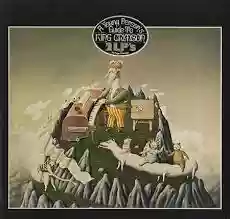
Just in those days, an anthology double album was released. I found, and it was already a miracle, the second part. I lived (and still live) in a small town, and the raids to the legendary "Nannucci" in Bologna began only much later.
Although, reading today the program of disc one and disc two, the first one appears decidedly the best, it was quite a blow.
Like "Ummagumma" and even better.
For months, that cassette stayed in the tape player.
To begin with, there were the three most beautiful Crimson ballads ever: "Night Watch," "Book of Saturday," and "Moonchild."
What to say, in these three songs, there really is a tiny piece of my imagination, the sweetest and most melancholy one...the morning and the night..., the uncertain hour...and a kind of fog that hides and reveals...
Above all, "Moonchild" that has the light of feminine and nocturnal tarot cards, the folky magic of a network of just hinted meanings, the healing power of a whisper or a gesture that in that network float like in a dream, just like the very slight rhythmic beat of Mike Giles's fabulous drumming.
Infinitesimal, soft, and suffused with a melody that is not of this world and a voice that seems to be in a magical mute that instead of extinguishing it wraps it in light.
"Moonchild" is music for that strange metaphysical Shreck, a sort of smiling deity with sad eyes and a moon face, which appears inside the cover of "In the Court," their epochal first album.
According to Robert Fripp, that being would even be the Crimson King himself.
I'm not talking, of course, about the screaming "Schizoid Man" on the front cover,
I'm talking about Shreck.
But let's go back to "Moonchild," which actually would last twelve minutes, and not less than three like here.
Ah, and a shame that is missing what "In the Court" immediately follows, namely an incredible free-form experimentation, impalpable, liquid, and full of nightly magics that become, gradually, more and more dissonant...
What a shame it's missing, also because it's the best way to arrive, full of a sense of anticipation, at "In the Court of the Crimson King," which is present here, in fact very present.
"In the Court of the Crimson King" is a sort of monumental folk song, with somewhat tacky symphonies (just a little?) and flute frills, a fabulous primer (of the best and worst) of the prog to come.
As a kid, it thrilled me. Today the same, although it is especially that timeless melody that I like, and the rest clashes with another kid, the post-punk one. But it doesn't matter; it's good for puppies to vent.
Then there are the other two timeless melodies...not as enchanting as the moon girl and the king, of course, but timeless nevertheless...
"Night Watch" starts with the delicate cacophony of Fripp's electric guitar, to which sweet rattles are then added, a fabulous violin, and God knows what else in an improvisation that reaches intangible whirlwinds of avant-garde delicacy...then here comes the Crimson melody, poignant and magical, and a guitar that almost cries...
"Book of Saturday" is probably just a beautiful song, but one of those that never leaves you. In "Larks' Tongues in Aspic," it is there, like an island of rest after the adventurous journey of a title track that is one of their most beautiful pieces ever, suspended as it is between crazy percussive magics, free form, and killer riffs of a guitar very far from rock conventions.
Here in "A Young Person's Guide," only a small fragment is included, which is a shard of rough diamond of just a few minutes, sufficient, then as now, to drive me crazy. Something that goes from nothing to apotheosis, a one-two-three that is a turbulent river, a waterfall, and whirlpools that end up becoming calm waters.
Then there's an instrumental without percussion, a magic of mellotron, violin, and flute: “Trio.”
"Trio" is a strange and delicate watercolor that starts with a pianissimo of sounds that then become more and more lunar and ringing...
It's a trill of night creatures in a crescendo of infinitesimals...
It's a marvel.
In this anthology disc, which is only, I repeat, the second part of the young listener's guide, there is only a tiny piece of the Crimson planet, the most romantic one.
Sure, there are the exceptions of the tail of "Lark's Tongues in Aspic" and "Cat Food" and "Groon," sharp shards of ultra-modern and nervous sound, but it's the romantic side that prevails.
Listening to disc one, with its incredible loads of elevens, things change. There, examples of Crimson power (a monolith always ready to explode, but as if held back and anchored to itself) don't lack.
But for me, in this double album, disc one doesn't exist. I have never even listened to it.
And I truly care about disc two.
Loading comments slowly
Summary by Bot
The review recounts a personal journey into the world of King Crimson through their anthology 'A Young Person's Guide.' Emphasizing the romantic and mystical aspects of tracks like 'Moonchild' and 'Night Watch,' it highlights the album's impact as a defining prog rock experience. While acknowledging the significance of disc one, the reviewer deeply cherishes disc two and its tender moments. Overall, it's a passionate tribute to the band's artistry and legacy.Tracklist Lyrics Videos
King Crimson
King Crimson is an English progressive rock band formed by Robert Fripp in 1968. The group is known for seminal late-1960s/1970s albums, frequent lineup changes, and a long-lasting influence on progressive, art and experimental rock.74 Reviews
