
 •
Rating:
•
Rating:
THE REVIEW
As the acidic dust of an explosive debut began to clear, it was still possible to get lost among the gray streets of Notting Hill, which in 1981 were certainly not those of Hugh Grant, and with a good dose of courage, decide to instinctively continue the journey, in search of adventure: there is a ramp that leads straight down to a basement, you descend and it's already dark, while the dull beats of a bass drum echo from behind the door; a door that creaks open… and there is Paul Ferguson, with a hard and absent look, continuing to pound on that damned drum. These are sharp blows, maybe just for a soundcheck, but they seem as if they want to go on forever. Suddenly, from the shadows, razor-sharp guitar slashes emerge—yes, Geordie was right there by the side! A determined bass immediately responds, repeating a note insistently, then a wild, tribal, primal dance begins: the city feels distant as directly from another world, the hallucinatory echo of Jaz Coleman enters the scene. This is how I like to think "The Fall Of Because" came to life: the creeping nonsense, the fall of certainties, as the title suggests, perhaps was truly the result of a sinister hint, with someone nervously picking it up "But what kind of… What's This For…!" then follows along with their own instrument, and the new Killing Joke project can thus commence.
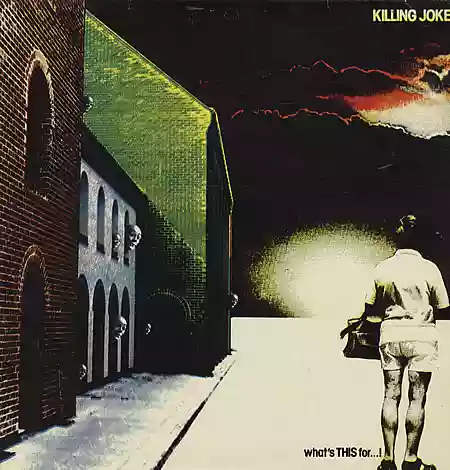
"What's This For…!" - no one will ever truly know what it's for - is the album of pure instinct, of free-roaming rhythms without fear of why or how, of dub experiments, of factory noise, and the ultimate deconstruction of the synth concept, transformed once and for all into an alien device with which to modulate mad insights. The guitars, still as acidic and delirious as in the beginnings, this time do not charge according to punk rules, but they put themselves in service of tribalism that pulses and rages throughout the work, a distinctive mark for the years to come. Rock encyclopedias mostly remember it for delivering to the annals "Follow The Leaders" the first commercially danceable track, accessible at least to certain open-minded dance floors, and the catchy "Tension", structured and engaging, still very popular at concerts today. But "What's This For…!" holds much more within itself: aside from the tribal and experimental components, there is a dark post-atomic aura present throughout, a cloak with dark hues that comes directly to life from the album cover (one of the most disturbing of all time) and dresses nearly every track in the lineup with the colors of a nightmare. Take for example "Unspeakable", where a twilight cloud rushes towards an urban landscape, envelops it, a drum beats once more like a heartbeat, then there's no more escape: "every direction leading to the same place" says Jaz, while hordes of malicious drums accompany the final moments of a desperate escape. The perverse scenario continues with "Butcher", an interplay of sharp and cutting rhythms that evoke an industrial machine in action, a mechanical butcher cutting, grinding, sectioning, and hanging who knows what, amidst lysergic guitars and keyboards stripped of their noble virtues. The second side opens with the aforementioned "Follow The Leaders", a post-funk piece danceable yet far from commercial, with the percussion overlapping with an electronic rhythm forming a novel blend that will become a staple in the dub world. It will be selected as the lead single only for its slight familiarity with the melodic world, a very vague kinship, to be honest. But it's "Madness" that takes the gold for insanity, unraveling its nearly eight minutes in a hallucinated march along the banks of Hell, between a seething bass and the inhuman screams of the renowned Coleman-Ferguson duo. With "Who Told You How", we enter a workshop for a session with high metallurgical content, a moment of free industrial divertissement marked by the desire for experimentation. "Exit" closes, the final triumph of distortions and relentless rhythms, for a track in pure Killing Joke style that also hints at some future creative developments.
With the eight tracks of "What's This For…!", therefore, the path of the Joke continues worthily in the sign of the most unrestrained and instinctive experimentation, which gives the band increasingly unique connotations in the new wave landscape. If, compared to the eponymous debut, something of the punk immediacy is lost, certainly the desire to continue daring and continually pushing beyond the musically permitted boundaries is not. Light years away from commercial intentions, Killing Joke also and above all make music for themselves, to understand what the boundary is within which they can push, provided there is one. They are the true avant-gardists of the movement, who, fearless, continue to push further ahead, among primitive territories and decaying urban outskirts, in search of something to capture, shape, and make their own; and the closer this something approaches the apocalyptic moods of Coleman and company, the more moldable it will be to their image and style. And the more what is produced will carry within it the seeds of the absurd, the more beautiful it will be to shout and make others shout once again "What's this for…!"
Loading comments slowly
Summary by Bot
‘What’s This For...!’ marks Killing Joke’s adventurous second album, characterized by tribal drums, experimental dub elements, and a dark apocalyptic vibe. The band shifts from punk immediacy to a more instinctive and avant-garde sound, forging a unique post-punk identity. Signature tracks like ‘Follow The Leaders’ and ‘Madness’ showcase their boundary-pushing creativity. The album remains a vital influence on the new wave and post-punk scenes.Tracklist Lyrics Videos
Killing Joke
Killing Joke were an English band formed in London, known for blending post-punk with electronic, tribal rhythms and a harsh, industrial-leaning attack, fronted by vocalist Jaz Coleman and guitarist Geordie Walker.24 Reviews
